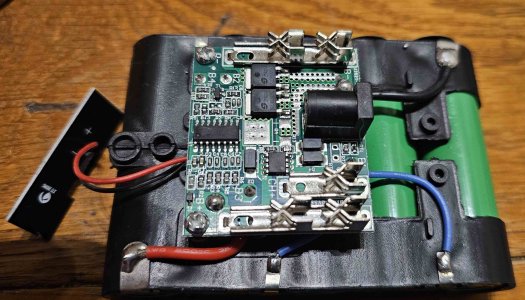
Dead cell in a Li Ion 18V battery pack

Ian_Edwards

Well-Known Member
Joined
9 Feb 2002
Messages
2,222
Location
Aberdeen Scotland
Visit site
I have two dead Li Ion battery packs off an 18V Chines power tool.
I've taken one apart.
They each have 5 18650's in series, in a flat pack. The design looks, superficially OK, the control circuit is sensing each cell individually.
I've measured the voltage across each cell:

1 3.77V
2 0.49V
3 3.78V
4 3.76V
5 3.79V
TOTAL 14.66V

Four questions:
I could use a bench power supply and try try charging number 2 battery, I can control both the voltage and the current with the power supply.
I could try charging the whole bank with the same power supply.
I could replace the faulty battery with a similar one.
I could replace all 4 batteries with new 18650s.

Replacing all 5 batteries the obvious safe choice, but that's a lot of work. I can buy 18650'd with tags already spot welled on, so I wouldn't have to solder directly on the cells.
Just trying to Charge the number 2 is lot easier, the pack hasn't been used for at least 2 years, and has had very few cycles.

Any comments?
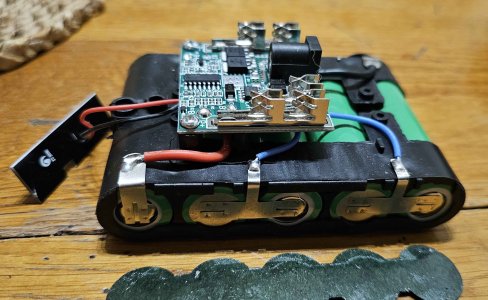
18v Battery pack.jpg

18v Battery pack 2.jpg
 
Last edited:
OK ... you can try direct charging the dead cell at about 4V / max 2A .. to try and revive it to about 3.3V .... then you change and revert to its normal charger which via the batts BMS - the charge should balance out.

BUT the dead cell is likely damaged and will only give short power before it dies again. Replacement of that cell is advised. The other cells appear to have healthy voltages ...

BE CAREFUL .... 18650's come in two basic configs : max 3.6V or max 4.2V ....

If your pack is just off charger and showing 3.7V - then I suspect you have 3.6V cells ... if the pack has not just come off charger - then I suspect they could be 4.2V cells ...

Sales blurb lists 4..2V cells as nominal 3.6V !! 3.6V cells as nominal 3.3V ... etc. If the old cells have labels - check that carefully ...
 
Thanks for the reply.
The batteries say 3.7V 2000 mAh
I try charging the defective cell by setting the current limiter to 100mA, and then winding the voltage limiter up and see where it starts to accept charge. I can then start to wind up the voltage and current slowly, and see where that takes me. My bench power supplies are rated at 30V and 2amps, so I'm unlikely to do too much damage.
 
The replacement 18650 cells are not so expensive and as Nigel says the bad one is probably terminal. Yes you can get cells with tags welded on. It might be a bit of a job to remove and replace the bad one. But hopefully doable. ol'will
 
I take my 18v battery power tool battery packs to a local company to me so they will replace, and test job done.

have also done that with HH VHF Radios and EPIRBs and the fitted the appropriate batterie
 
I take my 18v battery power tool battery packs to a local company to me so they will replace, and test job done.

have also done that with HH VHF Radios and EPIRBs and the fitted the appropriate batterie

Our local street market used to have a guy who made up battery packs ... but he's long gone.

I now have a Spot Welding kit ... about 40 euros ... runs from 12v car battery ... 3S LiPo ... or similar power LiIon / LiFe battery ...
 
As a word of warning, deep discharged (<2V) lithium cells (among other effects) are at risk of growing dendrites, leading to a risk of short circuits in the cell. That may lead to fire or explosion - better to replace the cell if you can. That is why the BMS prevent recharge on a deeply discharged cell.

If you do try to revive it, be careful!
 
As a word of warning, deep discharged (<2V) lithium cells (among other effects) are at risk of growing dendrites, leading to a risk of short circuits in the cell. That may lead to fire or explosion - better to replace the cell if you can. That is why the BMS prevent recharge on a deeply discharged cell.

If you do try to revive it, be careful!

Usually the BMS prevents recharge when a deeply discharged cell / battery - as it cannot match its voltage setting, as well as the cells balance ... The BMS expects a voltage range and number of cells at least at minimum voltage when its connected to charger .. if the voltage lies under or over that range - the BMS refuses to engage.

Dendrites and so on are a factor - but that is in extreme cases and not why BMS refuses to work.
 
Top