Chiara’s slave
Well-Known Member
Tea and cakes? Champagne and strawberries I should think. I have friends who are members, but it’s not really my thing.The start line is set so members can whatch having tea and cakes

Tea and cakes? Champagne and strawberries I should think. I have friends who are members, but it’s not really my thing.The start line is set so members can whatch having tea and cakes

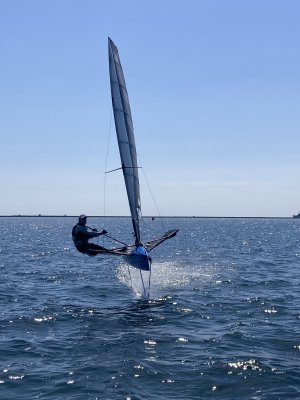
Nothing to see. Nothing dangerous.Started videoing this absolut 'person' after he forced us in a 39' mobo to go into reverse to avoid him, and no, he wasn't holding a steady course. He then pulled the stunt in the video.
If you're going into Portland, keep an eye out for him, he'll make a big mess on someone's hull at some point.
I think I much prefer fresh cucumber sarnies and teaTea and cakes? Champagne and strawberries I should think. I have friends who are members, but it’s not really my thing.


The basis of the "steam gives way to sail" rule isn't speed - when it first became usual practice (before it was codified in the IRPCS), sail might well be faster or as fast. The reason is because a powered vessel has much greater ability to manoeuvre than a sailing vessel, especially the square riggers common back then. A powered vessel also has the ability to slow down rapidly by setting the engines in reverse.The col regs written x years ago before high speed craft still apply and there is no reason why they shouldn’t still do so. After all, the col regs lol form the basis of rules of the air where traffic is travelling much faster. The issue here is that we have to adapt from our current expectation of sailing traffic travelling between (mostly) 0 to 15 knots to where they are now quicker. They are not going much faster than a quick motor craft and we can manage them. Having said that, if a jet ski had pulled the same stunt, I’m sure there would many wrinkled eye brows on here
My actions in sticking the boat in reverse simply brought us to a halt from 4 knots. Right up til then he was on a direct course to impact with the side of me right under the helm seat of the flybridge.The actions of the op contributed to how close the pass was. If he did the same with a jetski, there might be repercussions. Obviously in this case his actions were in good faith and attempting to avoid a closer interaction. The problem really is him not realising just how fast a moth is. Nor having faith that anyone who can foil one can probably steer round him.


Cutty Sark could do 17 knots. Modern container ships are slow steaming at about 15-16 knots. I suspect it was no less manoeuvrable than a large modern boxship too. Progress ain't what it used to be.The basis of the "steam gives way to sail" rule isn't speed - when it first became usual practice (before it was codified in the IRPCS), sail might well be faster or as fast. The reason is because a powered vessel has much greater ability to manoeuvre than a sailing vessel, especially the square riggers common back then. A powered vessel also has the ability to slow down rapidly by setting the engines in reverse.

What an utter and complete waste that would beI accept your point. I suggest you ask the Royal Yacht Squadron to move their start line. The very best of luck, I have some rather nice Armagnac here to revive you afterwards.
20kn is flat out in a moth, so with that kind of exaggeration I’m inclined to think the rest of your comments are much the same.Didn't appear to be racing, there were only 3 of them and weren't following an obvious course.
My actions in sticking the boat in reverse simply brought us to a halt from 4 knots. Right up til then he was on a direct course to impact with the side of me right under the helm seat of the flybridge.
I'm quite aware how hard it is to change direction hard at 40ish knots and this guy had got too close to do so without a sharp course change before I halted us. He was clearly playing 'Steam gives way to sail' to its abolute limit, and yes while technically correct, 11 tonnes of steam that barely has steerage way vs 150kg of sail doing 10 times that speed is pushing it towards Darwinism.
If you think 150kg at 40 knots isn't going to do any damage, go and retake your physics exams or go and see quite how fast you die when you hit a solid object at that speed.
Not at all. Deliberately coming that close to another vessel at that kind of speed is discourteous and dangerous.I wonder if the OP has changed their mind yet? No criticism, as we all have different perspectives on things.
Looked a load faster than that to me. Maybe I was wrong about the speed, but a quick google suggests I might not be as far out as you think, even if it was only for a short distance. It was certainly tanking it along and IMO significantly exceeding 20 knots.20kn is flat out in a moth, so with that kind of exaggeration I’m inclined to think the rest of your comments are much the same.

Check out here what is involved to tack a sailing vessel:-The basis of the "steam gives way to sail" rule isn't speed - when it first became usual practice (before it was codified in the IRPCS), sail might well be faster or as fast. The reason is because a powered vessel has much greater ability to manoeuvre than a sailing vessel, especially the square riggers common back then. A powered vessel also has the ability to slow down rapidly by setting the engines in reverse.

I have some sympathy for you.Not at all. Deliberately coming that close to another vessel at that kind of speed is discourteous and dangerous.
It's akin to having a swarm of cyclists around a lorry in London. You don't know what they're going to do, but they have right of way, very little common sense and the lorry will automatically get the blame when one gets squashed.
Looked a load faster than that to me. Maybe I was wrong about the speed, but a quick google suggests I might not be as far out as you think, even if it was only for a short distance. It was certainly tanking it along and IMO significantly exceeding 20 knots.
He was probably planning on going to go astern of you - until you screwed things up by stopping. Maybe 15m or more behind you.Not at all. Deliberately coming that close to another vessel at that kind of speed is discourteous and dangerous.
It's akin to having a swarm of cyclists around a lorry in London. You don't know what they're going to do, but they have right of way, very little common sense and the lorry will automatically get the blame when one gets squashed.
Looked a load faster than that to me. Maybe I was wrong about the speed, but a quick google suggests I might not be as far out as you think, even if it was only for a short distance. It was certainly tanking it along and IMO significantly exceeding 20 knots.
I don't care how skilled he is.You’re still dismissing the skill of the moth pilot. He will be amongst the most able dinghy sailors in the country.
I have some sympathy for you.
It's all very well being the give way vessel but if the difference between your speed and that of the other vessel is 4x or 5x less then your actions become less relevant, especially to a preoccupied dinghy sailor without a mate to steer while they study traffic movements.
I have heard the Navy use sound signals - 5 short blasts meaning "I do not understand your intentions, keep clear".
Of course a jetski would neither hear nor understand.....
I did make it clear that I started videoing afterwards.He was probably planning on going to go astern of you - until you screwed things up by stopping. Maybe 15m or more behind you.
I used to sail a Hobie FX One. I could easily do 15 knots or more in that in favourable conditions with the spinnaker up and on the trapeze. If on a crossing course with a mobo, I would always aim just behind their stern and would pass a boat length or so behind. Most mobos I have crossed courses with have been moving slowly - so are treated more or less as fix immovable objects.
In the video I fail to see where he came anywhere near you. He was always a long way away.