Crosby C-link too big to join 8mm chain.

fredrussell

Well-Known Member
Joined
24 Mar 2015
Messages
4,153
Visit site
Firstly, apologies for posting a boating query on what now seems to be purely a Covid19 forum, but bear with me please...

Has anyone ever had trouble getting a Crosby 5/16 C-link to fit/join 8mm chain. The chain is bog-standard 8mm galvanised bought from Seamark Nunn not too long ago. The C-link is definitely a 5/16 one - it’s stamped on it clearly, and I’ve used them before to join identical chain. The problem I’m having is that the width of the ‘business end’ of the c-link (clamped good and tight in a vice) is a tad over 11mm, whereas the inner ‘gap’ of 8mm chain is 10mm, or very close to it. I’m obviously very reluctant to widen the gap or to reduce the width of the C-link. Is mine just from a bad batch? It was purchased from Techni so I’m confident it’s not a cheap copy. Any ideas?
 
It's well known that the 5/16 link can be a struggle with some 8mm chain whereas the 3/8 link is fine with 10mm chain. I don't know the best answer from personal experience as I've only used the 3/8 version but you will need to perform a little judicious bending to get a good fit, I'm afraid.

Richard
 
I’ve just fitted the same, yes was too tight on the 8mm chain, when I finished forging the rivets over and then gave it a couple of heavy clouts on its end and also the two links either side and this allowed it to loosen enough
 
I have recently had to fit a 5/16 Crosby C link . Bit of a job while afloat I thought . would be a lot easier to do ashore or return the anchor chain home an do on a heavy duty vice or anvil . I opened the to chain link ends to be joined with a round chisel drift, in a vice . Rivett's were really hard to peen over . But Crosby link looks very robust , compared to std c-links .
 
Agreed. The force required to peen those little critters over is what gives me confidence it’s never coming apart again. Wouldn’t join Two chains any other way now.
 
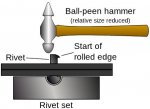
My experience of peening Crosby C-links, or any other heat-treated type, is that a heavy hammer is needed, 2 lb at least, swung vigorously. It is difficult to direct the force needed onto the small end of the rivet, so for this reason it is far better to use a drift. A short length of steel, 1/2 or 3/4 inch, about 6 inches long, works well.
 
On a normal sized rivet I was told to start in the middle and slowly expand the top to mushroom it out, but on the c links the rivet is small and slightly narrow at the top and the hammer needed quite large so I just beat it to death. Also start with a small flat punch helps
 
The biggest problem I had with the first one I did was trying to hold it whilst hitting it, the chain links get in the way and it’s difficult for some to hold it still.

The way I’ve done it since is using a large bench vice, old club one, lay in open jaws and the c link lays flat the the chain links stay still, glad the. Ice is old and not mine though.

not sure how I would do this on boarded though, must be hard
 
Indeed. I started off trying to peen mine onboard but soon decided that I was more likely to damage the boat than the rivet. I moved to the pontoon which then started to damage the wood so I tried using the flat base of one of the large pontoon cleats. That did it. :)

Richard
Yes, Marina cleats make excellent anvils! It's a shame I'm now in a marina that doesn't have cleats - it uses steel loops for mooring lines, which are a bit of a shock to people who come in who don't expect them! No chance of lassoing a cleat...
 
Top