Crimpled wires. Can these be spliced somehow?

The Real Flipper

Well-Known Member
Joined
16 Feb 2022
Messages
185
Visit site
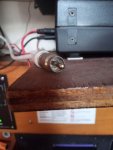
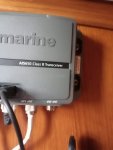
I'm not sure what kind of wires these are. One is for a radio of sorts, another is for a Raymarine AIS.
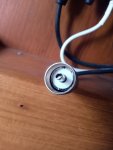
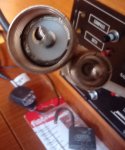
One looks like a stereo RCA plug, the push in type, and the other is larger with a hollowed out plug, and screws on.
Both got crimped almost completely when the boat was shipped by truck. And it was a joy of a day tracking them down to their root locations as they run behind the heads and furniture in the boat.

Anyway I got the locations right, just not sure what they are and how to repair them.
Sure hope these can be spliced because one goes to an antanae which I took apart and saw it is soldered onto a circuit board. Yikes! Don't want to mess with that.
Any tips appreciated :)IMG_20220815_152750_221.jpgIMG_20220815_160907_201.jpgIMG_20220815_163117_373.jpgIMG_20220815_163105_984.jpg2.jpg
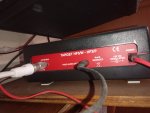
 
Are they different Plugs or just different makes of the same plug?

Well by the plugs alone I thought they were totally different cables. One plug is much larger and screw on, while the other is smaller and plug in. I haven't cut back the wire and seen inside yet so I can't say for sure. Was hoping someone would know.
 
Looking again at the photos, there are shots of two different things - a Target AIS Receiver and a Raymarine Transponder. Which do you need new plugs for and why? If you need to use the same aerials into different sockets then you can get a connector.
 
Last edited:
Looking again at the photos, there are shots of two different things - a Target AIS Receiver and a Raymarine Transponder. Which do you need new plugs for and why? If you need to use the same aerials into different sockets then you can get a connector.
No - the first is a Target HF receiver (aka short wave receiver). From the description, the OP has an active antenna. It's connected using the phono-type push-in plug.

This takes a very different aerial to the one attached to the Raymarine AIS transciever. This is a normal VHF antenna with the pictured PL259 plug (with the screw-in outer bit).

Don't try to connect these two bits of kit together! Or try to use the same antenna for both. But both cables will be coaxial cable, with an inner cable, an insulating sheath, an outer mesh, then the outer insulation.

I confess I don't understand the OP's post - what do you mean when you say both cables "got crimped"?
 
No - the first is a Target HF receiver (aka short wave receiver). From the description, the OP has an active antenna. It's connected using the phono-type push-in plug.

This takes a very different aerial to the one attached to the Raymarine AIS transciever. This is a normal VHF antenna with the pictured PL259 plug (with the screw-in outer bit).

Don't try to connect these two bits of kit together! Or try to use the same antenna for both. But both cables will be coaxial cable, with an inner cable, an insulating sheath, an outer mesh, then the outer insulation.

I confess I don't understand the OP's post - what do you mean when you say both cables "got crimped"?
I assume that his cable somehow got Trapped (Crimped) by something whilst in transit and he wants to cut them, if not already cut, and make a joint.
He doesn't appear to have shown the damaged part only the plugs. That's what I think!
 
No - the first is a Target HF receiver (aka short wave receiver). From the description, the OP has an active antenna. It's connected using the phono-type push-in plug.

This takes a very different aerial to the one attached to the Raymarine AIS transciever. This is a normal VHF antenna with the pictured PL259 plug (with the screw-in outer bit).

Yes, both are correct. The one from the Raymarine is like an antenna from an old car, simple thin long stick of metal. The other is some kind of PCB inside a white tube. On the second one, the cable happens to be soldered to the PCB so it's not easily replaceable without replacing the whole fancy 'antenna' as well. Or at least its risky.

I assume that his cable somehow got Trapped (Crimped) by something whilst in transit and he wants to cut them, if not already cut, and make a joint.
He doesn't appear to have shown the damaged part only the plugs. That's what I think!

Yes, also correct.
I only showed the pictures to identify the types of cables and see if they can be repaired.

The trucking company guy said lower the thing I call a 'Nav Mast' for lack of better description (see pic) so it didn't hit bridges. I unattached a few bolts and lowered it down to him and suddenly it became clear from my vantage I could see the weight of the 'mast' crimped all three wires. He could have seen it clearly from his angle but said nothing anyway...

We lifted it back up but all three wires were busted. He then proceeded to grab and twist on the big white round one and busted it. Doesn't twist off it seems :( Not exactly a details guy! Luckily only the plastic case appears busted and that's a whole another project to somehow superglue or epoxy back together.
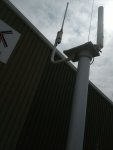
Anyway I have ordered another USB cable for the Wifi extender.
What I need now is to repair the other cables, the ones in the photos above.
And I suspect that Moody Sabre's first post may be the fix. As I'm guessing that both cables are inside at least- the same?

IMG_20220501_122648_461.jpg
 
Thanks - that all makes sense.

I'm afraid I can't offer a lot of practical advice on fixing the cables. In theory you ought to be able to chop out the broken bit and splice in a new length, but how to make the joins good enough for RF work, I couldn't advise. The critical one will be the AIS cable, as you transmit on that - a bad join could, I think, affect the Standing Wave Ratio (SWR) which could be problematic.

For the HF antenna, given that it's already damaged, you could just buy a new one - £47 from NASA, which could end up cheaper than mucking about with dodgy connectors: HF Active Antenna - Nasa Marine Instruments (or you could just use a long wire instead).
 
Thanks - that all makes sense.

I'm afraid I can't offer a lot of practical advice on fixing the cables. In theory you ought to be able to chop out the broken bit and splice in a new length, but how to make the joins good enough for RF work, I couldn't advise. The critical one will be the AIS cable, as you transmit on that - a bad join could, I think, affect the Standing Wave Ratio (SWR) which could be problematic.

For the HF antenna, given that it's already damaged, you could just buy a new one - £47 from NASA, which could end up cheaper than mucking about with dodgy connectors: HF Active Antenna - Nasa Marine Instruments (or you could just use a long wire instead).

Yep, that's the part. Thanks!

Maybe the damaged cables can be repaired like this


OK, so I think I will try a repair on the normal VHF line, and probably buy a new antenna for the AIS as apparently a 'type B' does send and receive. And I really really DO want the freighters and oil tankers on the North Sea and in a foggy night on the English Channel- to see me.

Thanks again for the assistance all!
 
Top