Cradle or stands for a bilge keeler

Joined
21 May 2020
Messages
222
Location
Pyongyang
Visit site
Hi.

As per title, I am wondering about people's experiences with boat cradles or stands for a bilge keeler as I sense my yard is just being a little *rsey and the yardman can't be bothered doing any more work than a minimum, an assumption that comes from more history than just this. *

Quick background, I am restoring a small bilge keeler that has been in the water for years. I'd like to do a really thorough job on the cast iron keels, removing rusted areas and fairing them up nicely (the leading and trailing edges are looking a bit rough). There's hardly any room to get under it on the hard and, of course, it would impossible to get right under the bottom of them.

I've spoken to a number of cradle/stand makers, including the designers of the yard's, and they all appear to think it's perfectly possible to put a bilge keeler on a stand and have recommend a few models. I'd be perfect happy with a Heath Robinson arrangement of blocks, props and t-stands that would allow me to work on one keel at a time. The boat has a central skeg, so there's another point to bear weight. I don't see what the problem could be.

I'm getting nowhere with the yard and am left to feeling that either I'm not getting a straight and honest answer, or I am just being treated as a poor cousin for having a small, old boat (it's 22').

Thanks.

* (Part of that history includes have items stolen by casual labour employed by the yards, something they would not get involved in and I had to resolve myself)

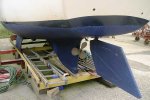
This is the design (but not the boat). And, in case it comes up, no I am not planning on deliberately beaching the boat in the future, so it's not a waste of time doing the keels well.
9074.jpg
 
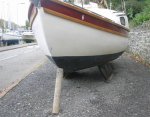
My little bilge keeler is currently sitting very happily on five bits of 2X3 about 6" long, waiting for a postponed lift in. One under each end of the keels and one, plus a little wedge, under the skeg. Several years ago, I repaired the bottoms of my keels and simply lifted the boat with a trolley jack to get it high enough to work under - lift the stern, chock the backs of the keels, let it down, chock the front. Rinse and repeat as necessary. Unless you end up removing a keel (Don't - an old bilge keeler isn't worth the cost and hassle!), there's no need to be as fanatical about not working under a jacked up boat as a jacked up car, but do be aware that a jack isn't as stable as a gurt great lump of wood.

One final tip from someone who's had a bilge keeler for 16 years, a garage crawler is a wonderful thing for working between and around the keels - something like this

657198

It does need a hard surface, though.
 
Oh Dear !

First - get rid of the trailer / frame under her.

How ? Two jacks working in pair each side a bit at a time, carefully staying longitudinally level by blocks under the skeg if necessary. ... jack up between frames and insert blocks under keel / skeg ... let down and do other side ... keep alternating until boat is high enough to place wood beams over top clear of frame for boat to sit on ... remove frame and all the crap under her.

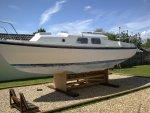
For your boat - I would suggest two railway style sleepers under bilge keels and blocks with wedges under skeg.

This is the way you get a BK boat of yard trailers ...

For security ... a wood post wedged under bow as well ...

If you want to work under the keels themselves ... you just jack her higher and with jacks - you can move the beams as long as you remember to have boat sitting balanced and supported ..

If you want to remove keels ... the same system - but now you put the beams either end of bilge keels still across hull but get sand bags or blocks to help have the curvature of hull supported. You can lead strops from cleats to the beams to help this as well ...
Personally I suggest if you do this bit - have mast OFF the boat as that is a lever that in high wind will try to 'capsize' the hull because the keels are no longer used to stand on.
You could of course use a cradle ... but I've seen some cradles that I wouldn't put a dinghy in !!
Or create a V frame from sturdy wood ...

OK - I cheated with a crane ... but here is my 4 ton BK boat on beams :

WKQ35Ly.jpg


wprfQl7.jpg


This photo is taken after ice had lifted her half up into the garden !! But shows the beams ready for her..

p9ywUtT.jpg


maMqk7f.jpg


Shows just how much you can play with it !!

vIWJZuZ.jpg


Like most boaty things ... its the BEFORE worry that is worse than the actual !!
 
Last edited:
Hi. As per title, I am wondering about people's experiences with boat cradles or stands for a bilge keeler....

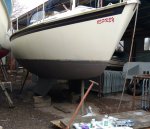
Our 28' bilge keeler comes out of the water each winter. The boatyard put her on four lumps of wood under the keels - one at the front and one at the back on each side; plus a supporting prop fore and aft. The blocks are about a foot thick, so they lift the while boat up enough for access between the keels to be fairly easy, and only about six inches at each end of the keel base is inaccessible for painting (actually, as the keel bases are V-shaped rather than flat, you can get paint down quite a long way even there). With it mounted like that, 4 years ago I did a complete scrape down to gel coat (hull) and bare metal (keels) , re-prime and re-paint.

Steve
 

Attachments

  • IMG_20170226_115527001a.jpg
    IMG_20170226_115527001a.jpg
    102.8 KB · Views: 27
I am restoring a small bilge keeler that has been in the water for years. I'd like to do a really thorough job on the cast iron keels, removing rusted areas and fairing them up nicely (the leading and trailing edges are looking a bit rough). There's hardly any room to get under it on the hard and, of course, it would impossible to get right under the bottom of them.

I think you are attempting to do too much. You can reach all the bits you need to. The very bottom of the skeg and keels will not manage to keep a coat of paint for long and they will have survived its life so far. Just fair up the leading edge (and trailing edge, if you insist). Unless the bilge keels are shot, encased in a grp outer there shouldn't be any issue with wear and the skeg looks to have a shoe fitted.

It's never going to be a new boat again. Just do what you need to.
 
I needed to remove my Jaguar 23's bilge keels. Made a cradle from 4x2 bolted together, with support beams across in front and behind the keels and longitudinal supports between them so it sits on a rectangle. The 'verticles' are inside the keels and angled against the keels so they support them as they slide down on a trolley jack. Lift it a bit at a time as above.
 
Here's another solution. I agree, it's a DIY job with a car jack and axle stands, and odd bits of timber sensibly strapped together.

kingfisher k20 yacht

I think you are right: the job is not 'interesting ' to the yard.
 
As others have said, don't bother too much with the underside of the keels (unless the encapsulating GRP is damaged at the bottom of the keels, which may mean you are in deep do-do).

You should be able to get enough access to the keels by having the boat stood on laterally placed blocks under the front and back of the keels. If you really need to do the whole length of the keel underside the blocks can be moved forwards/backwards once, using the boat lifting technique described above. (Be very careful that at no time could the boat fall on you.)

The other possibility is for an hour or so's access it is not at all unusual to arrange for the boat to be lifted and held up in slings for an hour or so when it's being lifted in or out of the water (particularly if this can be arranged over lunchtime - e.g lifted before lunch, left in slings while the yard has lunch and you quickly scrape the bottom of the keels and then slap on some paint, and then launched after lunch).
 
Some yards have laid down methods for blocking off different types of boats, and the yard staff can`t always deviate far from them, The standard method I've seen is four 12 inch blocks under the keels , two acroprops under the stern and one under the bows. like Little Sister mentioned, have a chat with the yard staff about over lunch time.
 
Much appreciated support. I'm grateful and will do some homework/lateral thinking on this one.

So has no one seen or used a proper cradle then? Beyond "not the way it's done here", are there any genuine reservations to doing so?

It costs the same to keep it on hard standing whether you have one, or it's just standing on the ground.


Just to clarify, that yellow dolly is not underneath it now. Unfortunately, to exacerbate the situation, they left it standing on non-draining concrete where a huge puddle of water collects meaning that it's impossible to work on if there is any rain. Another reason I want it up in the air.

Nor are the keels encapsulated. Just raw cast iron bolted on. They are also slightly bulbous at the bottom, not flat plates, hence hard to get under. The leading and trailing edges were corroded in places and I just want to take it back to bear metal before sealing.


I can't see the problem with using a cradle and secondary props for safety and to take the load. May be it wold be possible to put props/jacks underneath the 'armpit' of the keel and raise it up one side at a time? The boat's only about 3,000lbs.

* Thanks also for confirming my worst fears about towing it in this camera happy CCTV world, Mr Kingfisher K20. What a story. I think you're onto something there with the idea of making a cradle to lift it if I can't get something proper. Like you write, it only needs a few inches. We're certainly in similar territory.
 
What's more frustrating is the boat has been moved several times as the yard was re-arranged, when it could have dealt with,without any further hassle. Either they don't like to listen, or there's communication problems between the office and the staff.
 
I just don't see the point in having a cradle or exta supports for a bilge keel yacht when on the hard, I had a cradle fr my old long keeler, but have never even thought about one for my bilge keeler, a couple of timbers under the keels is all that is needed, railway sleepers are good but I usually use CLS studding as do most of the bilge keel boats (by far the most common in our harbour) that are on our hard over winter.
 
Good work, thank you.

Do you think it will hold once the keels are re-attached? Did you build other jigs to lower and raise them?

Unfortunately, it does not allow one to work underneath the belly of the boat. May be one at either end with a jack built in. Like someone wrote, with a trolley jack or something built in.

Like the way it spreads the load.
I just don't see the point in having a cradle or exta supports for a bilge keel yacht when on the hard
Read the first post then.

I'm wanting to remove all the rusted metal, treat, fair and then repaint the keels (in approximate order). Can't do that when it's sitting on them, or sitting in a puddle of water. Keels need to be dry to make paint stick. After 50 years of sitting in the brine, they need some love.

Then to give myself a little more room to work underneath it.
 
I did read OP.
IMHO only time a cradle for a bilge keeler with cast iron keelsould be if you intend to drop the keels, in which case something like gardians would be sufficient, if they were encapsulated the effort and expense may be justifiable as the encapsulation can grind away, but the choice obviously is yours.
As peteK says whatever you put on the bottom of the keels will wear off in no time, but as your boat has a central skeg you Do have the option of jacking it up from either keel.
 
Only as quick as anti-fouling would wear off anywhere else, if it is not being kept on a drying mooring, which it will not.


So you just leave the bottom 4" or 6" of your keels unpainted and rotting?

Like I wrote, as with the issue of damp, I'd like to get under comfortably. If I could do both at the same time without farting around lifting one side then they other, all the better.

Less time, more systematic efficient work.

Strip one, wipe down, strip other, wipe down, rust coat one, rust coat other, time first is dry, paint it, by the time that's finished, paint the other etc. Clean brushes, fill, fill, sand, sand, wipe, wipe, paint, paint. It's a rhythm. Less having to clean at each step. Less getting stuck waiting on each stage.

Make sense now?

Anyway, I've still not read any reason why a bilge keeler can't go on a cradle, is there one?

Thanks.
 
Last edited:
Good work, thank you.

Do you think it will hold once the keels are re-attached? Did you build other jigs to lower and raise them?

Unfortunately, it does not allow one to work underneath the belly of the boat. May be one at either end with a jack built in. Like someone wrote, with a trolley jack or something built in.

Like the way it spreads the load.

Read the first post then.

I'm wanting to remove all the rusted metal, treat, fair and then repaint the keels (in approximate order). Can't do that when it's sitting on them, or sitting in a puddle of water. Keels need to be dry to make paint stick. After 50 years of sitting in the brine, they need some love.

Then to give myself a little more room to work underneath it.

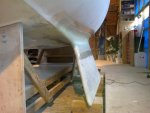
I sorted that after the guy who was peeling the hull asked for more access so i dropped the height ofthe box part of the cradle by 300mm so you could climb in and lay on it, very comfy when rolling out cloth onto the hull.

03052012714.jpg
 
Top