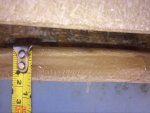
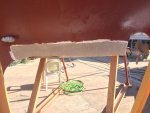
Crack in hull below shaft

Thank you for the replies.
There is no and will not be any insurance but third party liability
So far I got half a dozen people, some professionals, some experienced boaters, to suggest how the fix should be done. This and the tips I got on other forums made it clear that:
Polyester and not epoxy
Alternating 450 & 500 grams of mat and roving (respectively), 2 of each in each layer. 4 layers all together, each with the above distribution. These are the layers that will go on top of the whole grinder area, extending from aft of the keel to the propeller which is an area of about 160cm by 70 cm. Yet first I will fill in the cavity itself with the above mentioned materials, until the hole is flush with the surrounding hull. It's about three cm at the bottom and one on the side. From the inside I'll place a removable piece of hard foam with weights on it to create support against the pressure of laying up layers into the hole from below.
The area is dry as bone. No flaking or delamination of material left there. The yard here is 30c and 40% humidity. The boat was in the water for 24 hours and had very little water in that bilge as I have constantly dried it.
Yes it is a big and complicated job but I believe it can be done properly and will result in an extremely sound area of the hull, an area that is not under stress while sailing, only when holding some 7 tons on a narrow point for 3 days. The boat will never be lifted again with straps on that area, only on the keel which is cast iron, yet in that aft area of the keel there is only one last bolt while fw of it its all double bolts.

As I have not done a repair of this size before, actionable comments are very welcome.

Could you send a picture of the area you grinded? I glassed 8 hull holes on my Longbow with polyester and combimat, and it was lifted from that areas. Glassing is easy, you just want to prepare the area well, and push with your roller the air out. So you will need some good resistance behind. I did a better and more detailed repair because it is my boat. Apart from this, if a repairman does repair like this, he must be reccomended by someone you trust and ofcourse you should see sample of his work around the boatyard.

I am lucky to know a great and very experienced guy who told me how to do it, but its hard to find such guys if i am not mistaken!
 
Last edited:
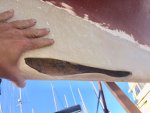
I can't see a way to add images here. Also my posts get deleted for some reason...
The resistance would be hard foam placed inside with weight on it. What would be best to separate it from the polyester later? I need to remove it and keep the bilge clear.
Also thinking of rounding the 90 degrees angle between the foam and the hull using filler, in order to prevent air from getting trapped there.
 
I dont know if the foam will give enough resistance, and if it moves things will be a mess. A tip for this is that you set the foam, apply 2 layers of chopp mat and let them cure. Be gently on pushing these layers as you dont want to move the foam. Use a cheap brush and cut the edge with sissors so the brush will get harder and push the polyester in the fibers much better. You will then have a hard fiberglass surfuce where you can do your main glassing and push with the roller without being afraid of the foam move!( these 2 layers not need anything-ready to accept new layers)
I assume that you will set the foam from inside of the hull? You should cut it to mach the shape of the hull as much as possible.
I have used masking tape and duct tape, and none of them adheres with polyester. Even a pvc shopping bag can be used bettween foam and new lamination for seperation.
Also have in mind that roving doesnt not go on roving. Only alternate mat and roving or buy combimat which have both swen.
What grit did you sand? 36-40 is good but not thinner- for good adhesion.
Ofcourse blow the grinded surface and be generous cleaning with Acetone just before lamination.
At the end mask the area with tape to help it keep in place and protect it from humid until it cures. I used succesfully simple brown duct tape as it is strong and then goes off easily.
One thing to have in mind is that the new lamination should have plenty of surface to adhere. (area grinded to a lake shape or crater...)
When you remove the foam you can go from the inside of the hull and add some more layers. I dont think you need a lake from the inside , just sand it anyway you can and lay some chopp strand pieces connecting old with new.

Hope i helped! Good luck!
 
Thank you for the great tips!
I was thinking that all layers, both the hole fill up stage and the subsequent large layers of the whole 160x50 grinder area, should be wet when laid upon each other.
I'm not sure I understand your description of the lake/ crater.
My foam options are: white dense and flexible packaging material, a swimming noodle, a camping mattress. One of them will fit snug in the narrow bilge, pressed tight against the sides so I might not need to add weight.
40 grit is what I used for the outside old exposed laminate.
I'll now wire brush the sediments from the inside of the bilge laminate.
However it seems I'll have to maneuver the first layers in the hoke by hand, so their edges are inside, otherwise the whole hole fill up piece might move out if it is not supported on the edges of the inside of the bilge.IMG_1302.jpg
IMG_1311.JPG
IMG_1321.jpg
IMG_1319.jpg
 
I can't see a way to add images here. Also my posts get deleted for some reason...

If you are posting on a mobile phone the default view is the mobile one. You can't use the forum picture uploader from this view & also if you edit a post it gets deleted. To get around this choose full site at the bottom of each page & edit or upload photos from there. To get back to mobile view choose it from the drop down list at the bottom of each page.

I've not done many underwater repairs but I use epoxy, because adhesion is better. It takes longer though & you have to measure accurately when mixing. Costs more too but that is of little consequence for a small repair. I finish off with epoxy paint because gelcoating epoxy is not straightforward. Under antifoul it doesn't show.
 
Doesn't a picture or two make a lot of difference. Not quite sure how that bit managed to get cracks there. I had thought they were higher up and much more serious so recant my previous views. Looks like that may have been a localised issue. Probably not that difficult a repair if that is it. Make sure the edges of the hole are bevelled back to ~10 times the thickness of the fibreglass round the hole so you get a large transition area from new to old. You could probably use something like one of those IKEA thin (~2mm) chopping boards to back the hole (they are very bendy). Trim it and wedged in place. I doubt the resin would stick to it. Loads of videos on YouTube on repairing various holes in fibreglass hulls for techniques on doing it.
 
I'm not sure I understand your description of the lake/ crater.

Good job so far!
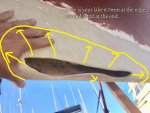
You should have the old laminate grinded in a way that at the edge of the hole you should have the thinest laminate and gradually getting thicker . So that is forming a "lake or crater" or a beveled area. With this technique you give the repair a much larger surface for adhesion than just filling the 17mm laminate on pic. So at the edge of the hole it needs to be grinded more and gradually lighten your hand with the grinder so at a radius of 10-15 cms you have the full old laminate thickenss , ( i would lower it to around 6-7 mm but others would eat it completly at the edge). So your first step then is to copy the shape of the hole and cut the fabrics so they can fill the 6-7mm hole. When you are flat, you can then gradually start adding bigger and bigger pieces of fabric.
And yes you should wet the fabrics at the ground and then help with the paint brush as you set them on place. And dont forget to push the air out both at the ground and at place, you can easily see if air gets traped.
When the repair is done, grind and apply some thickened epoxy grind again a bit and you are done!

PS!
You will not have the time to do this at once, the polyester will cure before even you wet half of the layers. Thats not a problem at all though , go with doses of 200 ml of resin max , and make more to continue. If previous layer cures that not makes any difference to adheshion as polyester is made to accept new layers even the next day.
Also, be precise with making the resin. Use a food scale to weight the resin and a syringe to add the MEK.
Make the repair at an hour with the minimum humidity.


IMG_1302.jpg
 
Thank you for the great tips!
Because the hole is irregular shape, at both far ends it is missing the bottom and the side while at other point the bottom is there, I'll have to at first stage get the hole filled. Second stage will add larger pieces in and around the hole and third will have full size pieces covering the whole grinder area.
Looks like in first stage the layers will have to be laid by finger tips, inside, from the outside, and be cut a bit larger then the hole so the edges are lying inside. Therefor the bevel on the edges of the hole may need to be on the inside of the edges. That is, thicker old laminate inside and gradually reduced to near no thickness on the outer edges of the old laminate. Doe that make sense? I belive the drawing you posted is describing a reverse bevel.
Also I think the hole pieces may be cut rectangular. The hole is so irregular and narrow at some points, that it may be too complicated to cut per the paper copy I made. That way there will be enough edge to hold on the inside of the old laminate. Once a couple of these layers are laid I'll have to use cut outs fabric more or less the hole's shape, as there will be no more edge inside to lay fabric on.
The swimming noodle fits very well in the bilge, tight against the sides. I'll have to leave a small gap between it and the bottom of the bilge so there's room to place the fabric on the bottom edge. Once laid, I'll pull down the noodle using several rods I'll insert into it, secured at its top with a metal bar and washers. That will allow to wiggle it a bit and push trapped air out. Then it will be pressed down on the hole and on the wet fabric edges. Before it dries completely I'll need to remove the rods so further layers can be laid. The noodle will be wrapped in a pvc shower curtain and brown plastic package tape which I hope will prevent sticking to the laid layers. This is the tricky stage.
 
You are welcome, glad i can help!

Your plan sounds very nice, i would like to comment on 2 things.

On the pic i have drawn the bevel area from the outside of the hull and the reason is that this will give much more strength to the repair than being from the inside. The force from the sea, waves, anything you hit, even the belts when lift the boat, will have direction from outside of the hull pushing it inwards. If you need to do a bevel from the inside, then you definately need to grind a main bevel surface from the outside.

Polyester is very very sticky, maybe you distort your first wet layers while trying to uninstall the rods. Alternatevily you could just go from the inside of the hull and push down the metal bar (without rods) on the noodle with a broomstick.
 
I'll have to bevel both inside and out. Otherwise the thickness of the hull bottom from the inside out will create a step that will likely trap air once I lay the single inside layer I can lay. Beveling both inside- out and outside_in will create a bottom that bevels to nothing. Does that make sense?
The rods section indeed was dropped. I'll push from above and lay weight on top of the bar.
Also, the inside layer must be wetted outside. It will probably be, from bottom of the bilge upwards: mat, roving, mat, roving. Which will make it heavy, hard to manipulate, and may even sag when still wet.
Is there a better way of picking up a wet layer from the work table to the hole than what I read - using a brush to pick it up? From my short experience with polyester this is very hard to do without breaking well arranged wet fabrics.
What fabric should be laid first ( the one in contact with the old laminate), mat or roving?
In the conditions here I have some 20 minutes before the polyester is to hard to work with. I'll mix the smallest batches ( 1% catalizator) possible.
The rest of the layers will be wetted in place.
The largest layers, running from top of the grinded area on port, down to the bottom, and back up to the top of the grinded area on starboard. Is it better to wet a vertical layer in place from top to bottom or the opposite?
Thank you
 
Is there a better way of picking up a wet layer from the work table to the hole than what I read - using a brush to pick it up?

You can also wet all the fabrics on table and place them altogether at the hole as a single patch (your internal patch right?). By this you can wet them properly and push them with the roller on working table. One disadvantage of applying the internal patch from outside is that you will not be able to see how it attaches at the internal bevel area.
If you had access to glass from inside first that would be the best as you would see what you do.. But if not, this is the way to go. Mat is the fabric you should start with. Mat fibers start dissolving after a while with polyester so you should set them in place fast otherwise they will break on table. No problem with roving though.

The rest of the layers will be wetted in place.

Its better to wet everything on table, because you are working overhead and polyester will drip from your hands to your elbows! Fabric needs working it with the brush to absorb the resin so doing that at place is very hard! set it wet on place and nail it with brush again. A fabric that has absorb enough polyester should be at the color of resin, at the spots where is still white there is not enough resin.

Is it better to wet a vertical layer in place from top to bottom or the opposite?
Again any fabric larfer than a credit card i would wet it on the working table!
 
After several test, simulations and dry runs we finally got the repair going last week. We used polyester, mat 450 g, roving 500 g. We successfully inserted from the outside a wet U shaped layers, covered on the inside with wax paper - mat-roving-mat-roving - and managed to press it against the narrow bilge sides in a limited access area around the Stern tube. Used the aluminium roller to press the air out, also from the inside. Managed to slide a swim noodle covered in brown packaging tape and smeared with baseline into the wet U layer and added weights on top. We then filled from the outside the small gaps left in one point between the hull existing laminate thickness and the U layer, using chopped mat and thick polyester. Then we started laying pre cut layers - mat-roving - on a wet hull and wet them in place, roller to get air out. Totally 10 layers. The resin dried well and the repair seems very solid both inside and out. Now after grinding the margins clean, we will refill some of the margins with polyester filler, then put top coat ( with the same catalyst used for the polyester) on top of everything to seal the whole thing. Then antifouling. No sanding or primer, as per the shipyard elders advice. Even the original shape of the hull was restored to near perfect. No surveyors involved;)

Thank you everyone for the advice!

IMG_1333.jpg
 
Then we started laying pre cut layers - mat-roving - on a wet hull and wet them in place, roller to get air out. Totally 10 layers. The resin dried well and the repair seems very solid both inside and out. Now after grinding the margins clean, we will refill some of the margins with polyester filler, then put top coat ( with the same catalyst used for the polyester) on top of everything to seal the whole thing. Then antifouling. No sanding or primer, as per the shipyard elders advice. Even the original shape of the hull was restored to near perfect. No surveyors involved;)

Thank you everyone for the advice!

Had a quick look at the repair when in Bruce's this morning, nicely finished but, sorry if I'm being a killjoy, it's an area where lifting slings generally locate and, personally, I would want to see far more layers than 10 as they're unsupported, can see the hole through the patch.
 
To Spirit
Yes, I agree that this is the sensible way to go and I should add that repairs of this kind require proper know-how from experienced repairers and an input from the boat builders. It is not a question of having someone to blame, It has more to do with acting diligently as a prudent uninsured owner in the eyes of the underwriters for future claims.
Furthermore, one should look that the internal stiffening of this area is not compromised . There is no point in repairing the shell when the stiffener which perhaps in this case is the form of the bilge transverse frame ahead of the shaft gland is also damaged or wasted and contributes nothing to the local strength.
 

Other threads that may be of interest

Top