Corvette 32 - A tale of one owner’s upgrade

Halon is no longer an option in UK as it has been illegal for many years now, I had a Sea-Fire FM 200 system fitted in my engine room auto and Manual pull release, its quite bulky compared to Halon and as yet I have not tried it in anger.

Skin fittings, check for anything marked with CW 617N as this is ordinary brass and should be replaced its expensive and time consuming but if all skin fittings are in a poor condition and of an unknown age replacing the lot with new DZR would be a good place to start. Being able to prove to your insurance that Skin fittings are removed inspected and excellent condition or replaced with new every seven years is a good place to start.

You have traditional stuffed stern seals which by their very nature need to drip to make a seal, I have had Tides Marine stern seals, these are dripless so engine room is dry and clean. You will need clean shafts for Tides to work.

Probably a bit obvious but Anode wiring as well as a visual inspection and replacing any corroded connections and green copper wiring (replace with tinned wire in bilges as much more resistant to corrosion) when the boat is out of the water do a continuity test to all underwater metals to see if all is connected.
 
Trevor,

Unlike common rail engine you can pre-fill your last chance on engine and AC/Delco style lift pumps have priming lever.

The Thornycroft alloy header tanks were always nicer than mild steel Cummins versions.

Do you have Jabsco raw water pumps or have they been replaced with Sherwood pumps?

Cummins manual is a bit of a tome, years ago Benjav sent me a pdf copy Thornycroft manual which is far more brief, happy to pass this on.

I you do want a genuine Cummins manual for ships papers certain I can find one in the loft of the correct era.

One final and simple upgrade for your age of B Series is exhaust manifold coolant flow.

When the B300 came out around 1988 it was noticed that in the event of an overheat caused by interruption of raw water flow would result in cracking of exhaust manifold. The manifold was redesigned with thicker wall casting but during validation work it was realised that as usual engineers were chasing the problem not the cause.

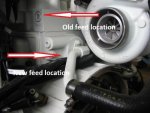
The actual issue was that coolant flow to manifold from rear of head is only just adequate, the solution was to take coolant feed from the back of the block. Simply entails knocking out large core plug on rear block face and fitting water outlet adapter casting to feed manifold and finally blank off head tapping. This small mod makes engine far more abuse resistant in the event of an overheat. I can sent pic if you require.
 
Cummins manual is a bit of a tome, years ago Benjav sent me a pdf copy Thornycroft manual which is far more brief, happy to pass this on.

I did indeed and, if you can't find it easily, let me know and I can send a copy. I recall you were kind enough to send me the full Cummins manual and an amazing level of detail about the exact engines I had which was greatly reassuring. I used those engines extensively over the seven or so years I had the boat to which they were fitted and they never missed a beat.
 
What great support - I have written my answers into your thread response ...

Trevor,

Unlike common rail engine you can pre-fill your last chance on engine and AC/Delco style lift pumps have priming lever. Spotted that thanks.

The Thornycroft alloy header tanks were always nicer than mild steel Cummins versions. Yes see photo

Do you have Jabsco raw water pumps or have they been replaced with Sherwood pumps? They look like Jabsco or Johnson style.

Cummins manual is a bit of a tome, years ago Benjav sent me a pdf copy Thornycroft manual which is far more brief, happy to pass this on. The boat came with both Cummins and Thornycroft original manuals, which are amongst the best I have ever read for a clear description and easy to follow instructions. A PDF version would be great as I like to keep all my boat files on my iPad backed up on Dropbox.

I you do want a genuine Cummins manual for ships papers certain I can find one in the loft of the correct era. Kind offer thanks, but see above.

One final and simple upgrade for your age of B Series is exhaust manifold coolant flow.

When the B300 came out around 1988 it was noticed that in the event of an overheat caused by interruption of raw water flow would result in cracking of exhaust manifold. The manifold was redesigned with thicker wall casting but during validation work it was realised that as usual engineers were chasing the problem not the cause.

The actual issue was that coolant flow to manifold from rear of head is only just adequate, the solution was to take coolant feed from the back of the block. Simply entails knocking out large core plug on rear block face and fitting water outlet adapter casting to feed manifold and finally blank off head tapping. This small mod makes engine far more abuse resistant in the event of an overheat. I can sent pic if you require. Yes please I can then see if this has been done

I did read an article from a US Cummins site about an improvement to the idler bearing - is this recommended or overkill ?
 
What great support - I have written my answers into your thread response ...


I did read an article from a US Cummins site about an improvement to the idler bearing - is this recommended or overkill ?

Tony Athens of Seaboard Marine looks in here from time to time so I will choose my words carefully.

Seaboard Marine in California probably sells more Cummins B & C marine engines (including QSB/QSC) in a year than Cummins Distribution Europe, their parts business of both genuine as well as their own brand is significant and they ship Worldwide as they are very proactive. The customer base Seaboard is both commercial as well as leisure and they support many very high hour engines, leisure sector in North America generally accrue far more annual hours than Europe.

Dependent on the belt wrap of your configuration you may or may not have a separate idler, either way both the idler on the tensioner and idler if you have one have standard bearings. In my experience give them a spin. if they stick or rumble press bearing out and obtain replacement from local bearing factors for about a tenner and life is good.

I have Gates belt gauge and obtain genuine belts from local motor factors, about quarter of Cummins price.

Good luck
 
I noticed this on the wiki page.

Fuel consumption
Fuel consumption ranges from about 2 mpg at 6kt down to around 1mpg at maximum speeds. 1.5 mpg would seem a realistic typical figure in everyday mixed use. Running on one engine extends the range; for example at 7 kt, fuel consumption is about 2.5-3 mpg (on a Yanmar 300 engine). QUOTE]

Have you tried running on one engine, and does the boat track straight as the props seem to be very close to the center line?
 
Just to say that the fuel consumption figures are based on experience - I typically get 1.5 mpg (from twin Yanmar 6LPAs) and the single engine running figure was from another Corvette owner, from experience.
Pleased to see you used an extract from the wiki Corvette Motoryacht entry - I wrote it!
 
Just to say that the fuel consumption figures are based on experience - I typically get 1.5 mpg (from twin Yanmar 6LPAs) and the single engine running figure was from another Corvette owner, from experience.
Pleased to see you used an extract from the wiki Corvette Motoryacht entry - I wrote it!

Nice article, some very interesting facts. I'm worried by the low bow at displ. Speeds, does it dig into waves at slow speed ?


I see that they made a sedan aft cockpit version. Have you ever seen one?
 
late Turbo-coolant feed.jpg
What great support - I have written my answers into your thread response ...


I did read an article from a US Cummins site about an improvement to the idler bearing - is this recommended or overkill ?

Pic of current production B Series. My own modification uses the same casting part # however I simplify the water connection.
 
Thank you for your interest. Don't know why people keep on about how the bow "looks low...." maybe the VERY early ones were as there was increased buoyancy in the stern to compensate for the aft-positioned engines. Maybe it's an illusion. It certainly doesn't "dig in" - just the opposite - it very soon begins to try to plane and get the nose up. At about 9 knots it's starting to think about planing and the bows are rising significantly. After 10 knots, I'm thinking of a little trim tab to bring the nose down a bit, which normally increases speed a fraction. In a sea, however, I leave the nose up to help lessen the spray over the foredeck (and flybridge in more extreme conditions). So many reports say what a dry boat the Corvette is, but I have to disagree, especially if head-on to a wind in a short chop. Water regularly soaks the flybridge in these conditions.

Never seen a sedan aft cockpit version. As I stated in the wiki entry, to the best of my knowledge they only made 2. They also only made 2 without flybridge. I do have photos of both, from various websites.
 
If you have a photo of the sedan Please post it, or a link. Thanks.

The hull appears to be very capable at slow and planing speed without experiencing the dreaded hump. Contrary to popular belief I think a slow planing speed is essential for rough water handling; who wants to get beaten up at high speed when you can throttle back to 10 kts and get a better ride.

It looks like a boat that's well worth the effort of restoration.
 
There was a strange version with an aft cockpit and flared sides for sale in Ireland when I was looking, and it was going for a low low price, but wasn't for me.

I can have a trawl for it if you wish.

There is also a standard version with smaller 150HP engines for sale in Northern Ireland, also quite cheap AP, but a bit of a project.
 
There was a strange version with an aft cockpit and flared sides for sale in Ireland when I was looking, and it was going for a low low price, but wasn't for me.

I can have a trawl for it if you wish.

There is also a standard version with smaller 150HP engines for sale in Northern Ireland, also quite cheap AP, but a bit of a project.

There's this one for sale with twin 300 HP: http://www.apolloduck.co.uk/feature.phtml?id=432635
 
corvette-320-68958070141652485054534856544570x_zpsdoizeeea.jpg
 
Last edited:
There's this one for sale with twin 300 HP: http://www.apolloduck.co.uk/feature.phtml?id=432635
Interesting. This one came on just before I bought mine. The photos do show the boat in good condition, but there are not many of them. It is a 1989 boat. I would have suggested her value somewhere around £50 - 55k, but whether the vendor would consider this is another matter.

It is not a '320' it is a 32. The 320 was the later boat built in Brundall, not Nottingham.

The 600 refers to the total engine capacity HP - mine is labeled as a 'Corvette Classique 420' (2 x 210 HP) actually a mark 2 Corvette. The mark 1 were the earlier 1970 versions.

I have no details of the Cummins 300 HP engines, but around that time (1990) most were being fitted with Cummins 6BT5.9M 6 cylinder B series turbo charged 5.9 litre Marinised. Perhaps Latestarter can elaborate on what the engines might be at 300 HP each, but from what I have learnt the 5.9 litre is the commonest Cummins applied around that time..

I do get very suspicious very quickly when I see misleading statements in boat ads. Like another Corvette which was advertising new stainless tanks, which turned out to be one tank replaced in 1998 with another mild steel tank - both were very rusty on that boat. Or meticulous maintenance with five year old fuel filters !
 
>Interesting. This one came on just before I bought mine. The photos do show the boat in good condition, but there are not many of them. It is a 1989 boat. I would have suggested her value somewhere around £50 - 55k, but whether the vendor would consider this is another matter.<

This is the basic problem with all old boats ; what happens if an engine goes bang. How much money do you pour into a 30 years old hull?

I've been watching the prices of swift trawler 34': 2010 versions now at £125-130k in Europe because of the low euro.....

You could easily put £50k into an old corvette .

 
>Interesting. This one came on just before I bought mine. The photos do show the boat in good condition, but there are not many of them. It is a 1989 boat. I would have suggested her value somewhere around £50 - 55k, but whether the vendor would consider this is another matter.<

This is the basic problem with all old boats ; what happens if an engine goes bang. How much money do you pour into a 30 years old hull?

I've been watching the prices of swift trawler 34': 2010 versions now at £125-130k in Europe because of the low euro.....

You could easily put £50k into an old corvette .

I won't be !
 
Top
