
Correct spec VHF cable and how to join ?

  • Thread starter Thread starter CPD
  • Start date Start date

CPD

Well-Known Member
Joined
20 Sep 2006
Messages
3,014
Location
Hampshire
Visit site
What should be the spec of the VHF cable from mast top to VHF radio, and what is the best / correct way to join the split in the cable within the boat, allowing the mast to be removed ?. I am guessing choc box and gaffer tape should be absent :). Links would be most useful - aerials and connections are one of my weakest areas of knowledge. Many thanks as ever ……
 
You should use RG-8X (if 20m+ mast on an ocean racing boat maybe RG-8U).

Since I remove my mast only every decade or so, I just have an extra 30 - 45cm of cable below deck, and simply cut the coax cable each time, taping up the cut end very carefully to stop water ingress. When it comes to re-step the mast I make another join using Shakespeare joiners.
 
RG213 sorry
RG213-U would be fine, but it's fat (10.3mm dia) and inflexible so less convenient than 6.1mm dia commonly used by moderate sized yachts. So I lump it with RG-8U in terms of application. How long is the cable run between masthead and VHF set? 20m?
 
RG213-U would be fine, but it's fat (10.3mm dia) and inflexible so less convenient than 6.1mm dia commonly used by moderate sized yachts. So I lump it with RG-8U in terms of application. How long is the cable run between masthead and VHF set? 20m?

yep almost exactly 20m …..
 
Cheaper, but very common antennas such as the V-tronix Hawk are supplied with RG58 cable. This is the lowest spec you could expect to use.

20m of the different cables have the following diameter and loss:
Cable typeOD in mmloss in 20m of cable
RG585.04.2dB
RG8X6.13.4dB
RG8U10.31.8dB
RG213U10.31.8dB
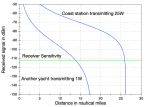
What difference does 3.4 - 1.8 = 1.6dB make? The graph below shows the likely range (conditions dependent to a degree, but nominal values not too far off real) for VFH sets against received signal strength. One can see that the limit for a normal CG is around 26 miles, limited by curvature of the earth. Add an extra 1.6dB - the equivalent of de-sensitising the receiver by 1.6dB - has a completely negligible effect on range. Maybe yacht to yacht it might reduce range from 14 to 13 miles? Do you care much?


vhf_range_1.png

PS: Where there is a difference between 3.4 and 1.8dB is when you have to obey the Offshore Special regulations. For classes
MoMu0,1,2, according to para 3.29.2b, the cable must have less than 40% power loss. The way to calculate this is (0.6 is 40% loss):
dB = 10*log10(signal/reference) = 10 * log10(0.6) = -2.2dB . So you'd need the fatter cable if you're racing in categories MoMu0,1 or 2.
 
Last edited:
Thanks JDC that’s really useful. If the v-Tronix hawk aerial is at one end of the price/performance spectrum, what would you put towards the other end for combined VHF/AIS receive / transmit ?
 
Commercially have used over 25M of good quality RG58 with decent amount of braid to get a signal to a 3db aerial from 25W radio without any noticeable problems.
Would normally use BNC connectors for breaking any cable run in a dry location.
PLs as last resort.
"N" a pig to attach for the unskilled.

Over time ie. years moisture will eventually get into the cable.
The first sign of this, black liquid oozing out of the cable from the plug at the rear of the radio as the internal braid slowly dissolves.
 
Last edited:
You need to carefully check the specification of any coax as there are many variations within a type number.
Ideally you want tinned 7 strand or 19 strand core for flexibility and a small minimum bend radius.
A tinned copper shield with at least 95% coverage.
The outer PVC jacket should be UV resistant for outdoor use.

It is possible to get RG58 with a solid single strand bare copper core with a PVC jacket for indoor use only. Also some RG58 is for legacy network or audio use and not recommended for RF use. This would be totally unsuitable for use at sea.

For a reliable system it is probably more important to get a quality cable that will last than worry about the odd dB loss.
 
  • Like
Reactions: jdc
PL259 are not a very good connector.

Bayonet Neill Conchellman
Threaded Neill Conchellman
Neill

are all better. Just make sure that you get the 50 Ohm version, personally I would wrap the connectors and barrel in Self-amalgamating tape.

You may be better off visiting some Ham radio shops for the supplies, much cheaper than chandlers.
 
Cheaper, but very common antennas such as the V-tronix Hawk are supplied with RG58 cable. This is the lowest spec you could expect to use.

It also has a piercing connector, that many people use many times leading to high return loss at the interface.

Thanks JDC that’s really useful. If the v-Tronix hawk aerial is at one end of the price/performance spectrum, what would you put towards the other end for combined VHF/AIS receive / transmit ?

Combined in a single unit, or putting some sort of 3dB coupler or active switch in the Tx circuit?

Wouldn't risk the second - adding a failure point is not a good idea.
 
With regard to splitters, many people use them without reporting problems, but I have chosen not to. Instead, I use a second antenna on a post at the stern. My rationale is that it provides a completely independent antenna which I can use as an emergency spare for the main VHF, as well as improved reliability for both the AIS and VHF (no need for a splitter).

AIS does not benefit from a masthead antenna as you really aren't concerned by ships which are still below the horizon! Even the infamous Special Regs for racing (link in my above post) allow the AIS antenna to be only 3m above sea level.
 
You could use ultrafkex 7 which was recommended on here and if the claims are correct out performs many thicker cables.

https://www.google.com/url?sa=t&sou...QtwJ6BAgDEAE&usg=AOvVaw0mfZf-TGLiu3yKIBcp9-ge


there are UK suppliers...
I see that there is also Hyperflex 5 which is a little smaller at 5.4mm OD.
Hyperflex 5
The ultimate cable must be Extraflex Bury with 10.3mm OD and a PE sheath that would probably outlast a GRP boat. Only 1dB loss for 20m cable.
Extraflex Bury
 
With regard to splitters, many people use them without reporting problems, but I have chosen not to. Instead, I use a second antenna on a post at the stern. My rationale is that it provides a completely independent antenna which I can use as an emergency spare for the main VHF, as well as improved reliability for both the AIS and VHF (no need for a splitter).

AIS does not benefit from a masthead antenna as you really aren't concerned by ships which are still below the horizon! Even the infamous Special Regs for racing (link in my above post) allow the AIS antenna to be only 3m above sea level.
I also avoided a splitter but put my stubby Ais ntenna at the mast head and it gets very far off targets... My rational is that solo off shore I want as much notice as possible....

I have a second vhf on a pole at the Stern and another vhf at the mast head which is currently not working.

One of my winter jobs is to fit a new Metz antenna and some superflex 7 at the masthead.

I then intend to use a second vhf in the cockpit connected to the Stern antenna for use in the unlikely event that I need to speak to anyone.

Whilst the masthead will allow me hear forecasts and further off stations below decks...

I might have an issue with feedback if I try to transmit whilst the other is switched on and I'd be slow to transmit at full power through an antenna that is only a foot or so from my Ais antenna...but this will just require switching off the Ais momentarily..
 
I have Just replaced our system, I used a Metz and ultraflex 7. I also used these connectors from Messi and Paloin as they are sealed and will help with waterproofing. The results with both range and clarity have been impressive so far.
MESSI & PAOLONI PL259 for Ultraflex7 (EVOLUTION) PL259 Connectors at £6.26 | Ham Radio

As we are hoping to not drop the mast for a few years we ran the cable from the antenna to the VHF without a join but left a loop by the mast heal plate to allow for a connector later. If you can avoid a joint.
 
Top