Copying old yacht plans

Saltram31

Well-Known Member
Joined
22 Feb 2009
Messages
314
Location
Solent
Visit site
I have a set of yacht plans of my boat which are old and are sadly deterioting by the way of yellowing and breaking at the folds. They are a large set,so a normal copier won't do. It seems that the companies I have contacted don't do old technology. Anybody know a business that carries out such work?
TIA.
 
search 'copy centre' plenty around, specialize in copying plans, maps and the like

Indeed, I had a full-size chart scanned in a highstreet print-shop because I wanted it reprinted at half-size to fit on a bulkhead. I think the scanner for this size sheet was a roller type though, rather than a flatbed, which might be a problem if the OP's drawings are really fragile.

Another option might be to lay them out flat and take a high-resolution photo from a camera securely mounted centrally above? Either at home, or professionally if that's available.

Pete
 
prv's photo idea would work, Skatt, but will distort the scale away from the centre since you'll struggle to get the camera far enough away when shooting straight down. Mounting the plan on a wall would be better if it will lie fairly flat. Use a tripod and the smallest aperture, not auto.

If uniform scale matters, you might try an architect's office: they're used to copying old plans, and often big ones. But my first stop would be a copying centre: if the old plans are too damaged, they should be able to tell you.
 
Last edited:
Almost all large format scanners will be drum scanners; this is the most likely type for a copy centre to have. They are fine, and the diameter of the drum is quite large, so the plans would have to be in a really bad state (as in papyrus left in the desert for 2000 years bad) before they wouldn't go round it.

However, an alternative which you might well find at a local printer's would be to use a process camera. That is basically a camera that occupies a room! The optics are designed to avoid the issues that prv mentions, and they are extremely precise. I presume that these days the camera operates with a digital back rather than film - last time I used one, it was film or nothing! The Wikipedia article mentions that they are no longer in widespread use, but printers often hang onto old technology, and even if they don't use it, you may find that they still have the kit. Try printers who deal with things like maps.

There are ways of correcting for the camera distortions of normal camera, but they require a lot of information about the lens, which probably isn't available for consumer equipment. Alternately, if the document was overlain with a transparent graticule (reseau grid) it would allow the geometry to be reconstructed.
 
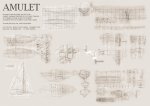
I had exactly this problem. I had my dad's drawings for Amulet (from about 1960) on discolouring fragile old paper. I asked an architect friend about scanning them and he gave me some contacts of companies who could do it. They all quoted outrageous prices - several hundred pounds. There may be less upmarket commercial solutions.

The organisation I worked for has a photo/reprographics lab that produces images for publications and presentations. The head of that outfit photographed the plans for me and produced them at high quality. They were grubby, torn an discoloured in the original.

This was not simply a matter of sticking them of the wall and snapping them. They had a special setup for flattening and lighting in ways to avoid reflections. (To tell the truth I haven't actually seen it, so I can't give much detail.)

A collage of them is attached. (I could do it much better now - I was less skilled in image manipulation back then.)
 

Attachments

  • AmuletPlan.jpg
    AmuletPlan.jpg
    141.8 KB · Views: 1
When I was seeking to do something similar with old maps (that I would never have got permission to put through any sort of machine), I was told that it could be done with a portable hand scanner, and then the sections stitched back together using software that would match up the scans and resolve (to an acceptable degree) any distortions, and then could be printed off by any copy shop or w.h.y.. I have no practical experience of doing this, though.
 
When I was seeking to do something similar with old maps (that I would never have got permission to put through any sort of machine), I was told that it could be done with a portable hand scanner, and then the sections stitched back together using software that would match up the scans and resolve (to an acceptable degree) any distortions, and then could be printed off by any copy shop or w.h.y.. I have no practical experience of doing this, though.

It depends on what you mean by "acceptable"! It would NOT be acceptable for any kind of professional purpose, or even for navigation. Each scan would have some distortion (a portable hand-scanner is dependent on steadiness of hand!) and the stitching process is also error prone; all these errors are cumulative. WHile you might achieve a visually acceptable result, it would NOT be accurate enough for navigation unless you were very lucky. As the OP is dealing with engineering drawings whose dimensional integrity is important, a procedure like this probably won't produce an acceptable result.

I speak from experience of stitching all sorts of geographic information together! ANY process that involves merging images together is errorprone, and it is surprising how rapidly errors accumulate.
 
You could try scanning with a smartphone before going to the expensive options.

I use scanbot quite a lot. It has automatic edge detection which puts the rectangle back in proportions, if the contrast between the edge of the paper and the background is big enough.
 
It depends on what you mean by "acceptable"! It would NOT be acceptable for any kind of professional purpose, or even for navigation. Each scan would have some distortion (a portable hand-scanner is dependent on steadiness of hand!) and the stitching process is also error prone; all these errors are cumulative. WHile you might achieve a visually acceptable result, it would NOT be accurate enough for navigation unless you were very lucky. As the OP is dealing with engineering drawings whose dimensional integrity is important, a procedure like this probably won't produce an acceptable result.

I speak from experience of stitching all sorts of geographic information together! ANY process that involves merging images together is errorprone, and it is surprising how rapidly errors accumulate.

Interesting to know. I was sceptical, but was also not up to date with the digital wizardry that was then (and still is) unfolding.
 
It depends how badly they are falling apart. As has been said most copier shops/printers have drum scanners, if it were just going on the seams i would probably get a roll of Scotch Magic tape and very carefully tape it back together, the tape is such that when it is photocopied it will not show up in the copy. (keep the edges of the roll clean ) you should then be able to go for an ordinary photocopy. I used to work in the plans section of HM Land Registry, we used quite a lot of tape !
 
Interesting to know. I was sceptical, but was also not up to date with the digital wizardry that was then (and still is) unfolding.
It isn't so much the digital wizardry as the limits of the process itself, which has (in one form or another) been around since the 1950s. The commercial "stitching" software that is available to naive users is a pale shadow of what professional photogrammetrists use - and even that is regarded as error-prone under some circumstances (one of my former colleagues published extensively on this!). Obviously, scanning a flat document does eliminate one set of major problems (that of using 2D photos of a 3D surface), but using hand-held, uncalibrated equipment introduces a different set.
 
It depends on what you mean by "acceptable"! It would NOT be acceptable for any kind of professional purpose, or even for navigation. Each scan would have some distortion (a portable hand-scanner is dependent on steadiness of hand!) and the stitching process is also error prone; all these errors are cumulative. WHile you might achieve a visually acceptable result, it would NOT be accurate enough for navigation unless you were very lucky. As the OP is dealing with engineering drawings whose dimensional integrity is important, a procedure like this probably won't produce an acceptable result.

I speak from experience of stitching all sorts of geographic information together! ANY process that involves merging images together is errorprone, and it is surprising how rapidly errors accumulate.

So far on this thread I haven't seen any mention of what I expect is on the plans near the title. "do not scale". A clear instruction that the dimensional accuracy of the drawing is not to be relied upon. So long as the drawing is legible an imprecise copy will do.
 
The OP is not going to navigate across his yacht plans nor presumably to loft a new boat by simply scaling from them ( the paper originals will already be inaccurate) so it is quite practical to reproduce them,tidy them up as necesssary and get them plotted as a fair copy.I have done this a number of times by using a flat bed scanner and later stitching them manually in a CAD or graphics programme.It is something of a labour of love but can provide base plans at the start of a project sufficient to underlay in CAD and annotate or tweak as necessary.The key is to make use of an existing grid ,as on seacharts or to add diagonal pencil register marks on the original after it has been taped together on the back and to overlap the scans,to either bitmap or tiff file.These can be brought into sufficiently accurate register either in a graphics programme,quite sufficient for a display drawing or in CAD the grids can be used to ensure accuracy across folds or gaps.
An additional sheet of glass is handy to lay over the chart in the flatbed so that it is easier to achieve and maintain an accurate position .A graphics programme is the easiest way to rotate a scan to the vertical rather than attempting to square a plan that overhangs the scanner and a removable lid is desirable.
 
...I have done this a number of times by using a flat bed scanner and later stitching them manually in a CAD or graphics programme.It is something of a labour of love but can provide base plans at the start of a project sufficient to underlay in CAD and annotate or tweak as necessary...

This all sounds very complicated. The OP's location is "Solent", there must be an A0 flat bed scanner/copier available somewhere in the area.
 
Top