
Cooking on the batteries - induction alternative.

Tim Good

Well-Known Member
Joined
26 Feb 2010
Messages
2,888
Location
Bristol
Visit site
So in an effort to be increasingly self reliant and environmentally better... we bought an portable induction hob after learning that others have been successfully using them from their inverters. Anyway after buying a nice Tefal 2000w induction hob I was disappointed to find out it didn't work because my inverted didn't produce a pure sine wave. More details on this thread

Anyway I bought a cheap electric hob with ceramic top recently just to see if it would work. As expected it did work since it is effectively just a heating element with no posh circuits that want a pure sine wave. I was however expecting it to be slow and ludicrously inefficient. Not so!

The one I got was 1300w and heats nice and quickly and is surprisingly efficient. I haven't tested the induction hob side by side yet but I can cook a meal and the batteries do not seem to take much of a hit.

Anyway I do intended to do a side by side test but for those that can't run an induction hob on their inverter like me, these standard electric hobs are certainly a worthwhile alternative.
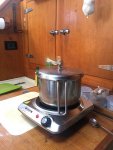
1A91A3B2-54CD-4121-9CD5-FDD26C135550.jpeg
 
I am glad the hob seems to suit your needs. There is no way around the simple heating efficiencies. ie you lose efficiency say 10% in the inverter then the heat of the actual hob should be 100%. However to get the heat into the water (or food) you will lose heat to the atmosphere and in heating the pot and hob. Hence the claim that induction heating is more efficient even though you lose a bit in the electronics. (10% maybe) So for just heating water an electric jug should be the most efficient.
You have an enormous convenience in being able to use these things on shore power but I can't help but be doubtful of your ultimate satisfaction running on batteries. Just too much current at low voltage. I might suggest that you consider an alternator (240v AC) driven from the boat engine. for cooking. Or I would go for a small spirit cooker as a standby. ol'will
 
So in an effort to be increasingly self reliant and environmentally better... we bought an portable induction hob after learning that others have been successfully using them from their inverters. Anyway after buying a nice Tefal 2000w induction hob I was disappointed to find out it didn't work because my inverted didn't produce a pure sine wave. More details on this thread

Anyway I bought a cheap electric hob with ceramic top recently just to see if it would work. As expected it did work since it is effectively just a heating element with no posh circuits that want a pure sine wave. I was however expecting it to be slow and ludicrously inefficient. Not so!

The one I got was 1300w and heats nice and quickly and is surprisingly efficient. I haven't tested the induction hob side by side yet but I can cook a meal and the batteries do not seem to take much of a hit.

Anyway I do intended to do a side by side test but for those that can't run an induction hob on their inverter like me, these standard electric hobs are certainly a worthwhile alternative.

View attachment 72389

Do you have battery monitoring ? If so, what's the current draw when it's on full heat ?

I'm also interested in you battery and charging setup. How many Ah are the batteries ? How many Watts of solar power ? What's you average solar yield ?
 
Do you have battery monitoring ? If so, what's the current draw when it's on full heat ?

I'm also interested in you battery and charging setup. How many Ah are the batteries ? How many Watts of solar power ? What's you average solar yield ?

Currently draw is approx 100amps. It's 1300w.

4 x Trojan T105 so that's 450ah. 400w of solar and importantly they are clear of partial shade from radar, wind generators, antennas etc.

However a chap on this forum who I met recently by chance in Spain, has half our AHs and less solar and cooks on his induction every night providing the forest ahead is sunny. I don't believe you particularly need a big bank to operate an electric hob but you do need some way of of being them back to 100% charge the next day ideally. And of course wiring that will cope with 100amps of power between battery and inverter.
 
Currently draw is approx 100amps. It's 1300w.

Is that measured with a battery monitor or ammeter, or calculated ?

4 x Trojan T105 so that's 450ah. 400w of solar and importantly they are clear of partial shade from radar, wind generators, antennas etc.

Yes, it's important to avoid shading as much as possible. I have a pair of 100w panels on an arch at the transom and they give enough power to run the whole boat through the Summer.

However a chap on this forum who I met recently by chance in Spain, has half our AHs and less solar and cooks on his induction every night providing the forest ahead is sunny. I don't believe you particularly need a big bank to operate an electric hob but you do need some way of of being them back to 100% charge the next day ideally. And of course wiring that will cope with 100amps of power between battery and inverter.

You just need to balance the size of the battery bank, the size of the solar array and what you use. Enough capacity for your needs over 24hrs (better yet 48hrs if possible) and enough solar to charge them back up, as you say.

BTW, not criticising what you're doing, i'm interested in your figures.
 
Is that measured with a battery monitor or ammeter, or calculated ?


Yes, it's important to avoid shading as much as possible. I have a pair of 100w panels on an arch at the transom and they give enough power to run the whole boat through the Summer.


You just need to balance the size of the battery bank, the size of the solar array and what you use. Enough capacity for your needs over 24hrs (better yet 48hrs if possible) and enough solar to charge them back up, as you say.

BTW, not criticising what you're doing, i'm interested in your figures.

With the new torjans this year, a hydrovane and led lighting I would say I could go 4-5 days without taking the batteries below 50% easily. Cooking on the hob and using an electric kettle. I dunno maybe 2-3 days perhaps. The solar seems to be topping up the batteries every day by 2pm no problem with an input of about 1.2kw before it goes to float charge.
 
The solar seems to be topping up the batteries every day by 2pm no problem with an input of about 1.2kw before it goes to float charge.

1.2kW is a transient measure. Do you mean 1.2kWh (= 100Ah at 12V)?
There's obviously huge variation between boat regimes, but I'd say having to replace 100Ah when the sun rises is a reasonable ball-park figure for an energy-efficient liveaboard (at least when it's sunny). We have no electric cooking/heating, so our biggest drain is the fridge. Cooling trumps heating, anyway, when it's hot ;)
 
The solar seems to be topping up the batteries every day by 2pm no problem with an input of about 1.2kw before it goes to float charge.

300W solar into 2 x t105's in the Algarve down to maybe 80% SOC in the morning I'll only just get to full by the end of the day - takes a *very* long time. No float, or rather float set to same as absorption @ 14.8V. Pretty much every regulator goes to float far too early with default settings.
 
300W solar into 2 x t105's in the Algarve down to maybe 80% SOC in the morning I'll only just get to full by the end of the day - takes a *very* long time. No float, or rather float set to same as absorption @ 14.8V. Pretty much every regulator goes to float far too early with default settings.

Do you have a way of monitoring what your getting from those panels? Just a small amount of shading across a corner will destroy any output from them.
 
The effects of shading are overblown IMO. Yes it can completely knock out a panel, but it has to be the right type of shade. For example, I notice not difference in output at all, on the occasions when I have the shadows of sheets of lines over panels., but something with a more solid shade, like say the mast will have more of an effect.
 
Do you have a way of monitoring what your getting from those panels? Just a small amount of shading across a corner will destroy any output from them.

Just what the victron says if i hook up the laptop to it. Shading isn't such a big deal when the batteries are getting up towards full charge as they don't accept much current.

But the battery meter is pretty accurate which shows what's actually going into the batts. I emailed Trojan who said about 1% in Amps of capacity in amp hours going in at 14.8V is a good indication of a full battery. Best we've got anyway short of sitting with a hydrometer taking readings every hour til the SG stabilizes.
So if voltage is 14.8V and batteries are accepting 2.25A for my 225Ah (2 x t105) then should be close to 100% charge. I think the risk of damage by not getting to full charge as often as possible is much greater than some corrosion from a hour or 2 extra at absorption, certainly for the beefy trojans. . So for me anyway float = absorption. 14.8V.
 
We have five 105 ah seal leaded batteries and two panels of 150w each .
I find by mid day my batteries are around 14.6v , I assume that's because of the panels ,
if I cover the panels and leave the for a few hours the voltages will show around 12.9 /13v that under load with the fridge working .
I would say that by mid day our batteries are back fully charge ,
I say this is because if I check my MPPT when their are low I will seen up to 10 amps going into the batteries , by mid day the input can be as low as 1 or 2 amps
as for SOC it's been drummed into me by some here that it means nothing so now I only take note of the voltages .
Just looked now and although it's still day light but no sun there just 0.5
The voltages is 12.8 I expect when I look in the morning it be 12.4/12.5 v
 
Top