Converting to Lithium

CPD

Well-Known Member
Joined
20 Sep 2006
Messages
3,022
Location
Hampshire
Visit site
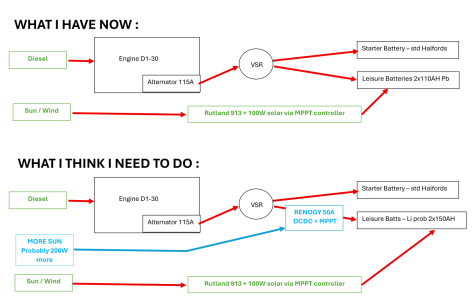
Hopefully you can see a (hugely) simplified sketch of what I currently have - a lead-acid charging system directly off the alternator using a VSR.

Also shown is what I think I need to do to upgrade to a Lithium system and at the same time add more solar.

I have become a little overwhelmed by the variety / complexity of DCDC chargers on the market, so decided to draw out my system to help clarify my thoughts.


A few points :

a. All leisure battery inputs/outputs go through a battery monitor.

b. I want to change as little of the current system as possible as it has proven itself over 10+ years.

c. This is the DCDC charger I am looking at


Questions :

1. Does it look right / safe / okay ?

2. Am I missing something / anything ?


Last comment :

I know there are many other ways of doing the same thing. I am looking for the most simple. Many thanks in anticiption of numerous comments :)l !!!!

1770738489137.png
 
I'm no expert, but...

The VSR is usually between the starter battery and leisure battery.

Pos + charging cable from the alternator goes to the starter batt,
Cable from start batt goes to VSR in, and from VSR out to the leisure battery + pos.


The idea is that the starter battery is then always near fully charged.

When engine is on alternater kicks out over 14v, this closes the VSR so both batts are charging while engine running.

When you stop the engine the residual voltage drops below the VSR rating (of say 13.2v) and the VSR opens disconnecting the leisure batt.

I've never seen a VSR used in the way you have drawn it. But, hey, what do I know?
 
Last edited:
Your Dc to Dc charger eliminates the need for the VSR . Alternator to engine start battery, dc to dc between start and house bank. Your Dc/ Dc will give you options to change configuration for different batterry chemistry . Some of them have built in mppt solar also
I found the most complicated part was planning the position of all the gubbins with the available real estate..don't forget the fuses
 
I'm no expert either, but have looked at the possibilities for Jazzcat.

With the VSR between the alternator and the battery, I've a nasty feeling that, should the VSR fail, you could fry the alternator. I'd do away with the VSR altogether, and wire the alternator directly to the starter battery, and use the DCDC charger from the starter battery to charge the domestics. If your domestic battery bank has enough umph to start the engine, a 1-2(-both) switch would provide backup if the starter batter let you down, but I'm not sure using the both position would be a good idea, so maybe a set of jump leads would be a safer bet
 
A VSR should only ever be between batteries. With the DCDC is is not needed at all .

Lithium can be really simple - alternator to the start battery and then DCDC to the Lithium . Add a class T fuse to replace whatever you had on the old house bank and make sure there is a battery cut off switch to isolate the lithium and not a 1-2-Both switch

Yes to the solar via the MPPT DCDC to the lithium
Check that the Rutland has the correct settings for the lithium - I suspect it does not, in which case wire it to the start battery and let the DCDC charger transfer across the charge it brings in

Also don't forget a fuse on the inlet and outlet of the DCDC (rated to the wire size which should be rated a bit above the maximum output)

The Renogy kit is good and I have fitted lots of it ... but, my own choice would be to use a separate DCDC and MPPT so that if one fails you don't lose all charge. If doing that then get Victron DCDC and MPPT with the "smart" function (Orion Smart and Smart Solar MPPT) so they can talk to each other on a bluetooth network (its all in built so you just tell it to network itself) and ensure they sync how the Lithium is charged. The MPPT is only around £60 and the Victron Orion TR DCDC is about £150 so the cost is almost the same as the Renogy.
 
A VSR should only ever be between batteries.
Although I agree it's not needed I can't see what your logic is here. A VSR is just a voltage based switch and can be used as such for any purpose that requires that.
The VSR will switch on the circuit to the DC/DC when the battery reaches a suitable voltage. As long as it's not a two way VSR that would work whether the DC/DC has the functionality or not to protect the engine battery from over discharging. It might switch on/off too often perhaps, but it's no different to what is effectively smarter VSR circuitry built in to DC/DC chargers which serve the same function. In this instance it would result in two systems doing the same thing, but that's another issue.
 
Although I agree it's not needed I can't see what your logic is here. A VSR is just a voltage based switch and can be used as such for any purpose that requires that.
The VSR will switch on the circuit to the DC/DC when the battery reaches a suitable voltage. As long as it's not a two way VSR that would work whether the DC/DC has the functionality or not to protect the engine battery from over discharging. It might switch on/off too often perhaps, but it's no different to what is effectively smarter VSR circuitry built in to DC/DC chargers which serve the same function. In this instance it would result in two systems doing the same thing, but that's another issue.
When the DCDC is in place we both agree the VSR is not needed

The VSR is as it says voltage sensitive - so when the alternator/engine is off the VSR is off but doing nothing as the alternator is off. When the alternator comes on then the VSR will read the charge voltage and close so the battery charges - just as it would if the VSR was not there at all . But the VSR as drawn is giving charge to both batteries and not prioritising the start battery as it should - if it is between the start and house then the start is sure to be well charged before the house gets charge.

If it's between the alternator and start its a point of failure that can mean you can't start the engine. So pointless and possibly dangerous .
 
But the VSR as drawn is giving charge to both batteries and not prioritising the start battery as it should
As drawn it does prioritise the engine. Then closes and connects power to the DC/DC. We agree it’s unnecessary if the charger has it’s own voltage sensing but it’s not bad to connect there. Some DC chargers may not have voltage sensing in which case this is the solution and wired as shown.
 
As drawn it does prioritise the engine. Then closes and connects power to the DC/DC. We agree it’s unnecessary if the charger has it’s own voltage sensing but it’s not bad to connect there. Some DC chargers may not have voltage sensing in which case this is the solution and wired as shown.
It does not, that's marketing hype from VSR makers. As soon as the engine starts the alternator voltage will close the VSR.
 
It does not, that's marketing hype from VSR makers. As soon as the engine starts the alternator voltage will close the VSR.
My point was that it’s not different in terms of VSR having a DC charger between it and the battery, the VSR will still do what it did before. I wasn’t saying it was a good idea, I was questioning the statement made that they must be connected directly to batteries.
 
It does not, that's marketing hype from VSR makers. As soon as the engine starts the alternator voltage will close the VSR.
Actually I would say the "prioritising"of engine battery with a VSR is real enough in that VSR can only connect service battery when engine battery voltage under charge reaches the switching voltage. If engine battery were really low in charge and voltage it might soak up all alternator charge keeping voltage down and take time being "prioritised" before VSR operates. (as sales pitch claims)
However in practice a well charged engine battery will usually take charge for but a few seconds before voltage on charge rises to operate VSR as Paul says. So appearing to close VSR near as soon as engine starts. ol'will being pedantic
 
Top