Conundrum with installing my new ISOTEMP hot water system

krissteyn

Well-Known Member
Joined
27 Jul 2006
Messages
92
Visit site
This is a brand new 24l tank - and I am following the instructions precisely.
However , their appears to be no way to bleed all the air out the tank.
I dont know the exact configuration of whats in there , but the outlets of both the fresh and engine water
are approx 1/2 way up the side of the tank. So I will have to put pressurised water through it and hope it carries air with it.

I am not too fussed with bleeding the engine water - the heat exchanger is higher and it will naturally bleed the air out.
But the tank is rated at 24l and if I have 2 or 3 (or more) liters air , then I have got less water - and I have a family requiring to use the hot shower...

So , can anybody out there tell me if their is a trick ?

All I can think of so far is to up-end the tank prior to switching on the electric element to bleed as much as I can...

SV Footprints OVER...
 
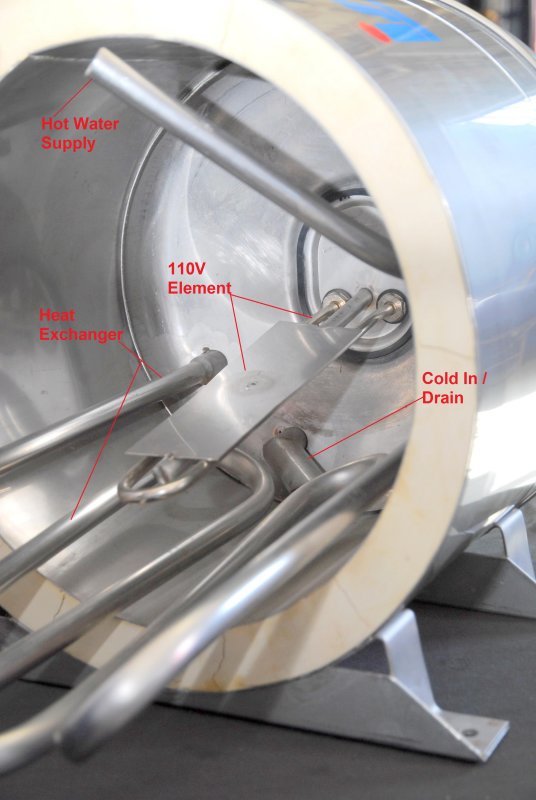
The hot water outlet is a pipe which curves up inside the calorifier and draws the water from the very top of the tank, where it's hottest. It will also remove the air in the tank.
 
There is no bleed on mine, it just self purges when filled. Guess yours will do the same.

What is worth considering is plumbing in some form of drain so that you can empty the tank over the winter. This should be just before the cold water entry point. The other option is that you have to disconnect the cold water supply and drain that way. I have to slacken off the hot water pipe also or draining takes forever.
 
Last edited:
There is no bleed on mine, it just self purges when filled. Guess yours will do the same.

What is worth considering is plumbing in some form of drain so that you can empty the tank over the winter. This should be just before the cold water entry point. The other option is that you have to disconnect the cold water supply and drain that way. I have to slacken off the hot water pipe also or draining takes forever.

Can't you just open the PRV to drain it?
 
I have exactly the same tank. When I had to replace the heater element recently I took the opportunity to have a good look around inside the tank. Although the tank fitting for the hot water outlet is halfway up the tank, inside the pipe does go right to the top of the tank. No need to bleed and no need to worry! :)
 
Just for the OP's benefit, here's a cutaway of an Isotemp calorifier, showing how the hot water outlet draws water from the very top of the calorifier. It's from an American site, so it says the immersion is 110v.

122792089.jpg
 
Can't you just open the PRV to drain it?

Doesn't work that way. I tried draining through the PRV & only got trickle of water out. Thought it had drained when I had run the system dry through the taps until speaking to a friend who suggested that was not the case. Turned out to be quite correct and had to undo the cold water inlet to drain tank.
 
Magic - some things , the admiral does NOT know ! Ha !

The answers here have clarified and dispelled my worries.... I now know why I never qualified as a plumber...

Have installed it - just waiting for the pipes to arrive and we can have a hot shower :)

Kris
 
As a Webasto Isotemp dealer I can confirn there is no requirement to bleed the hot water and also to reinforce the advice to provide a drain off valve at the cold water inlet for winterisation.
 
The literature with my Isotemp calorifier, instructs you to click over the temp release valve to open and remove the hot feed pipe from the calorifier to assist in winter draining. Is this a correct procedure to achieve full drain down for winter storage.
 
The literature with my Isotemp calorifier, instructs you to click over the temp release valve to open and remove the hot feed pipe from the calorifier to assist in winter draining. Is this a correct procedure to achieve full drain down for winter storage.

Opening a hot tap will do the same but best drained down from a proper drain cock, PRVs can be difficult to use as a drain as it is often difficult to keep them at the top of the spring and if you get a bit of calcuim wedged in them during drain down they will weep for ever.
 
Opening a hot tap will do the same but best drained down from a proper drain cock, PRVs can be difficult to use as a drain as it is often difficult to keep them at the top of the spring and if you get a bit of calcuim wedged in them during drain down they will weep for ever.

Spring on mine broke 5 years ago so i removed the pressure relief valve & chucked it away.
To drain the system I undo the couplings having drained all I can with the normal taps
 
You're saying you don't have a pressure relief valve now?

That is correct.
Note we are talking about compressed water here not compressed gas.
Compressed liquid does not cause explosions in a system like this. The worse that will happen is a blown pipe joint
The pressure is initially governed by the water pump. Any excess dribbles out the tap.
If one is testing a boiler or pressure vessel it is done by filling with water ( or other fluid) then using a hydraulic pump to get the pressure.
If the vessel fails. Bit of water squirts out. You do not get a massive bang as you would on,say, a compressor
 
Last edited:
What you get, and I have seen it out of a tap is scalding jets of steam and boiling water if the immersion runs away, PRVs are cheap as chips and no reason not to have one, none at all. Under pressure water reaches a far higher temperature than 100c point and most water systems will not burst until at least 5 bar so your tap becomes a steam cleaner good enough to strip skin, might never happen but a fiver will reduce the possibility even further.
 
What you get, and I have seen it out of a tap is scalding jets of steam and boiling water if the immersion runs away, PRVs are cheap as chips and no reason not to have one, none at all. Under pressure water reaches a far higher temperature than 100c point and most water systems will not burst until at least 5 bar so your tap becomes a steam cleaner good enough to strip skin, might never happen but a fiver will reduce the possibility even further.

Happened to me when the PRV failed & hot water pipe blew off the front of the calorifier with very hot water everywhere. Fortunately, all was enclosed within the engine bay but SWMBO got one hell of a fright - I was up on deck at the time.

Replaced the PRV, beefed up all the pipework and added an extra expansion vessel to the hot water system just downstream of the calorifier as well as the one next to the water pump as a precaution. No problems since.
 
Last edited:
there are a few MYTHBUSTER episodes where boilers go "bang" - it aint funny !

That happened because of the build up of high pressure steam, which is many times more compressible than water
If you read thread No. 16 above-- the pressure valve can fail as well, so it did not do a lot of good in that situation, did it?
 
Last edited:
If tested regularly a couple of times a year by turnig against the spring (something often neglected) they are a provable and a definate improvement on not having one.

That happened because of the build up of high pressure steam, which is many times more compressible than water
If you read thread No. 16 above-- the pressure valve can fail as well, so it did not do a lot of good in that situation, did it?
 

Other threads that may be of interest

Top