Containers lost overboard

It’s an illustration of a general principle that I first read in “The Economics of Tramp Shipping”, by Basil Metaxas, published in 1971 though the idea may have been around before my youthful self read of it.

Shipping demand is not price elastic.

Not downwards (and I once fixed a VLCC at Worldscale 22 which in that particular case was US$ 2,000 a day) and happily not upwards (and I fixed the same ship at Worldscale 114).

Because freight is such a tiny part of the delivered value of most goods, the demand hardly alters at all.

To time charter a Capesize bulk carrier type of ship that only ever carries coal and iron ore, at $180,000 a day, or a little more than a dollar per day per ton of cargo moved, with port dues port costs and fuel on top of that, is insane - unless you are a steelworks and you don’t want to lose your blast furnaces.
 
Last edited:
It’s an illustration of a general principle that I first read in “The Economics of Tramp Shipping”, by Basil Metaxas, published in 1971 though the idea may have been around before my youthful self read of it.

Shipping demand is not price elastic.

Not downwards (and I once fixed a VLCC at Worldscale 22 which in that particular case was US$ 2,000 a day) and happily not upwards (and I fixed the same ship at Worldscale 114).

Because freight is such a tiny part of the delivered value of most goods, the demand hardly alters at all.
The tanker guys seem to really understand that principle... hiring a VLCC for $100k a day to hold cargo on contango just waiting for the oil price to move.
 
The Loadstar despite the ghastly pun in the name is a very well thought of freight forwarders’ journal. I’ve found its reporting to be careful and accurate :

Container freight rates from Asia surge to new highs – 'it's gone mad' - The Loadstar
Reading the two articles on shipping rates was very interesting. The spot rates certainly do not represent the cost of all the containers being carried, it is like a late booking on a busy train or aircraft.

Also on Loadstar were 2 other interesting articles.

Container shortages the biggest disrupter: where are all the empty boxes? - The Loadstar
This explains the problem of empty containers being in the wrong part of the world and how they are trying to solve this.

Maersk and MSC drop Felixstowe from transatlantic service and head for Liverpool - The Loadstar
Some carriers are changing from using Felixstowe for Liverpool or Zeebruge. Other carriers have stopped taking new freight bookings until after the Chinese New Year. It also says that Southampton is starting to get the same problems as Felixstowe.

No doubt the situation will rectify itself over the next 3 to 4 months, but all shippers will experience some increase in shipping rates. This will have an effect on retail prices in the future, especially bulky items like furniture.

I am finding this thread very informative and interesting. In the distant past I did have some experience of having goods shipped by container from the Far East to Europe, but have more recent knowledge of the air freight market on a similar route, though now well out of date.
 
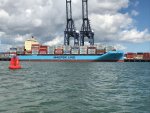
Re the vertical bow on Venta Maersk, at least a couple of cruise ships have been built recently with bows like this - I suppose that one advantage is that you can then get a longer waterline length, along with a shallower half angle of entry at the waterline, compared to a more conventional raked bow.
And this probably has more of an advantage now re resistance than a raked stem with a bulb.
 
I haven't paid closest attention to this thread, but I've enjoyed dipping when I've had time.

Returning to the consequences rather than the causes, of lost containers, it occurs to me that motor yachts - especially the rapid ones - are likely to have even more to lose by ramming into a submerged container, and less chance (at higher speed) of spotting it.

Do questions of running into containers (or other flotsam) come up on the motor boat forum, or is it largely a sailing preoccupation?
 
I haven't paid closest attention to this thread, but I've enjoyed dipping when I've had time.

Returning to the consequences rather than the causes, of lost containers, it occurs to me that motor yachts - especially the rapid ones - are likely to have even more to lose by ramming into a submerged container, and less chance (at higher speed) of spotting it.

Do questions of running into containers (or other flotsam) come up on the motor boat forum, or is it largely a sailing preoccupation?
I suspect that the risk is highest in blue water, rather than shallow, coastal waters. And very few motor yachts are capable of travelling the kind of distances. Sailing yachts are the primary ocean crossers, so they are more at risk.
 
A most informative thread and one i have enjoyed reading thanks to all the contributors.

I recently lent our yacht to the brother in law and his partner and they pootled round Lake Solent for a week, upon their return I was informed they had gone into Yarmouth Harbour called up and requested a berth for the night, they then also informed the Harbour Master that they were towing a tree that they had found, they were greeted by 2 boats one the berthing master and the other to take over towing the tree, which was then craned out to await cutting up. It wasnt an Amazon log but was still some 30-40 foot so big enough to damage a yacht/mobo hence not leaving it out there.
 
It seems the race for ever bigger container ships isn't over yet.

Hapag-Lloyd Orders Six Ultra-Large Containerships at DSME – gCaptain
They're not actually racing to ever-larger. There are already larger teu-capacity boxships in operation, but to be fair, in terms of size, the 18k-24k ones are all about the same. The capacity difference comes from stowage arrangements, vessel layout etc. These one will be around 400 metres long and 60 metres beam, like most of the others. The only recent change in size has been the beam and adding another row of containers across.
The Hapag ones will carry fewer boxes because they'll need to sacrifice more space for the LNG tanks.
 
The LNG business is a really bad idea for several reasons but the most important one is “methane slip” - the amount of fuel that passes through the engine un-burned. The problem is that methane is roughly one hundred times worse as a greenhouse gas than carbon dioxide - and the slip figure can be as much as eight per cent...
 
Top