
Considering getting my bilge keels sandblasted

chris-s

Well-Known Member
Joined
24 Apr 2019
Messages
816
Visit site
As above, I'm considering getting our keels sand or grit blasted as they are pretty knarly.

We acquired the boat (24 foot Pegasus 700) last spring and when it came out of the water in October we got the yard to powerwash the hull. This took of loads of old antifoul and it's quite clear that maintenance by the previous owner had dropped off over the last few years at least. The boat is only in the water for 6 months of the year, we do intend to keep it for four or five years at least.

Whilst I could just run a wire brush over it and then slap on some antifoul and I'm sure it would be fine, I'd rather do a 'better' job.

I'm either faced with doing the job myself with an angle grinder and flappy paddle wheel or paying somebody to do the job for me. For me to do the job I would need to rent a generator (no electric on site), rent a large grinder (my little one isn't really up to the job), purchase disks/pads, materials to curtain the boat off from others in the yard and expect it to take me a good weekend to curtain it off, clean the keels and then clean up behind me afterwards. On the otherhand I've received a quote of £660 all-in which sounds pretty attractive to me and is in the range of what I had in mind. The company have done boat keels and bits before so are familiar with working around GRP, will curtain off the boat and clear up etc.

If I proceed with this, what about the post-clean steps?

I am not interested in epoxy'ing up/sheathing the keels as I can see that it would easily get compromised and lead to water getting in between especially when it gets put onto the sled and dragged in/out of the water.

I had in mind, starting on the same day something like...

. apply cost of rust inhibitor - any particular brands?
. apply coat of primer - any particular brands?
. fair out any low-spots
. two-pack epoxy primer
. antifoul

Does that sound about right? Any particular products you would suggest?

Would I need to apply any particular primer before the antifoul?

Thanks

Chris
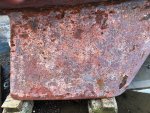
IMG_2256 (1).jpg
 
I'd use a phosphoric acid rust treatment followed by an epoxy primer.
Personally, I'd probably DIY, because then you can do part of it, then get it primed rather than leaving it to start rusting while you wait to prime it.
I bought a small generator which would run a normal small angle grinder.
I'd imagine in a yard with no power, others might chip in to the genny?
Or you could sell it when you're done.
But I see your logic in paying to get it done.

I believe unless you can get the keel indoors and bake it dry, rust will be back sooner rather than later, so there is a limit to how much cash or effort to put in.
I see it as a game of keeping things in check so this time next year it's still in a reasonable state.
 
Your better off to rent or borrow a needle gun descaler than using a grinder, as it allows you get into all that deep pitting, which a grinder does not. Priming must be done immediately after descaling to prevent any oxidization. That way it is also easier to work at your own speed and convenience and without the panic working around the pot life of two part primers.
 
Your better off to rent or borrow a needle gun descaler than using a grinder, as it allows you get into all that deep pitting, which a grinder does not. Priming must be done immediately after descaling to prevent any oxidization. That way it is also easier to work at your own speed and convenience and without the panic working around the pot life of two part primers.
Needle guns are great for steel but poor for grey cast iron. Grit blasting is always going to be best but otherwise angle grinding is next best choice. Needle gunning and wire brushing tend to drive rust into somewhat soft and porous cast iron.
 
Needle guns are great for steel but poor for grey cast iron. Grit blasting is always going to be best but otherwise angle grinding is next best choice. Needle gunning and wire brushing tend to drive rust into somewhat soft and porous cast iron.
I have seen needle gunning used in Holland at the yard where we kept our boat for a number of years; generally speaking they seem to know what they are doing when it comes to metal boats as they specialized in them. A great many of the old Dutch vessels are built of iron, not steel. To get a similar effect with grinding would require removing a considerable amount of material in and around the pitting to effectively get rid of all the corrosion. If you think that the porosity in the casting is such a serious issue, then it would stand to reason that the keels may have to be brought into a heated dry space for the process to achieve a satisfactory end result
 
If it were me I would buy a battery powered angle grinder. Use this with sanding disc or flap wheel . A wire brush disc on a drill might also help get into crevises. Do it your self at your own pace. Yes you need PPE and perhaps screens.
I find it hard to believe that professionals can do a cheaper easier job. But I may be wrong. What I do know is that there is no easy long term fix for corrosion on cast iron keels . Just do your best as described slap on the primer as described and be prepared to have to do some more next winter. (hopefully less than now). If you lay out good money now you may find corrosion next winter anyway. ol'will
 
Yes, I checked them out only to find that I had already seen these. I think they would do the job. It escapes me why a grinder would be fine, but a wire brush isn't, porous or not.
I think they would do the job too.

The action of a grinder is quite different from that of a wire brush. Less pressing involved, the direction of cut is parallel to the surface. A wire brush needs to be pressed hard to work well, the resulting force being into the metal.
 
I have seen needle gunning used in Holland at the yard where we kept our boat for a number of years; generally speaking they seem to know what they are doing when it comes to metal boats as they specialized in them. A great many of the old Dutch vessels are built of iron, not steel. To get a similar effect with grinding would require removing a considerable amount of material in and around the pitting to effectively get rid of all the corrosion. If you think that the porosity in the casting is such a serious issue, then it would stand to reason that the keels may have to be brought into a heated dry space for the process to achieve a satisfactory end result
I think you will find that these Dutch vessels are made from wrought iron. I very specifically wrote 'grey cast iron', a very different material.
 
I think they would do the job too.

The action of a grinder is quite different from that of a wire brush. Less pressing involved, the direction of cut is parallel to the surface. A wire brush needs to be pressed hard to work well, the resulting force being into the metal.

Wire brushes aren't really abrasive, they can leave a polished oxide layer which looks like clean steel.
 
I generally try to restrict myself to things I know something about or at least have experience with ... including a cast iron keel and metal working in general. The real problem for the poster will likely be in the area at or under the recess into the hull, at the keel flange, and where corrosion quite likely has set in and crept under. This will require propping up the boat and taking off the keels. On the upside, the gentleman can do this one at a time, take them home and refinish them in the comfort of his garage and by what ever means he sees fit. Each keel weighs less than a decent motorbike (about 300kg or so) and could easily be moved with a palette jack.
PS. I have no particular attachment to wire brushes, other than that I have used them more than I care to think about and have some idea as to their limitations.
 
Last edited:
I generally try to restrict myself to things I know something about or at least have experience with ... including a cast iron keel and metal working in general. The real problem for the poster will likely be in the area at or under the recess into the hull, at the keel flange, and where corrosion quite likely has set in and crept under. This will require propping up the boat and taking off the keels. On the upside, the gentleman can do this one at a time, take them home and refinish them in the comfort of his garage and by what ever means he sees fit. Each keel weighs less than a decent motorbike (about 300kg or so) and could easily be moved with a palette jack.

Indeed, in an ideal world I would remove them, redress them, change keel bolts etc but that’s not going to happen anytime. Maybe next winter but I’d need a really good reason to undertake that project.
 
Indeed, in an ideal world I would remove them, redress them, change keel bolts etc but that’s not going to happen anytime. Maybe next winter but I’d need a really good reason to undertake that project.
Fair enough, there are more fun things to do in life. Do some abrasive violence to them, slap on a coat of interprotect and enjoy the sailing. We'll be all dead by the time they've rusted away.
 
Top