Connecting VHF to GPS recevier, NMEA etc

frlrubett

Well-Known Member
Joined
2 Mar 2020
Messages
78
Location
Rochford
Visit site
I have a Navman 7100 on the boat.

I am looking to connect a GPS received to it, so I can use the distress function.

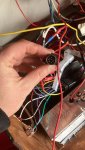
In the manual it says the comm port is a 4800 baud, NMEA. Attached is a photo of the radio end's connector.

A quick search for compatable GPS receivers has turned up this...

LINK

Will this work in theory?

Does anyone know which pin goes to what on the GPS module and if there is a connector I can buy and wire?

Thanks!
 

Attachments

  • WhatsApp Image 2023-02-11 at 11.07.45.jpeg
    WhatsApp Image 2023-02-11 at 11.07.45.jpeg
    250.8 KB · Views: 23
You need to see the instructions for the "antenna" but it almost certainly requires 3/4 wires. One +12V, a NMEA signal and a -ve/earth that can be shared between power and NMEA.

Usually you will provide 12V to the GPS and two wires from the GPS NMEA out to the NMEA in (Comm port) on the VHF. Connectors will depend on what the VHF expects
 
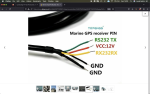
The red and thicker black go to the +/= 12V.

The green RS232 TX is the NMEA out that goes to the NMEA in on the VHF. The thinner black goes to the -ve/earth NMEA in on the VHF. Then just need to make sure they are set to the same speed (e.g. 4800)
 
Chop the end off the plug you have and use the wires, on the gps unit linked the yellow and green are likely the nmea and red and black the power, you'll do no harm getting the nmea wires the wrong way around so if it doesn't work swap them round and try again, 4800 is pretty much standard speed for gps nmea signals.
If you have the instructions for the navman it'll have the wire colours in it.
nmea tx on gps to nmea rx on radio.
You could do a much cheaper job using a gps module <£10 and a 5v regulator to power it as long as it's mounted away from the elements, gps doesn't have to be up top on a grp boat and the little patch antennas are plenty good enough, most of the cheap usb gps units have plain nmea available if you open them up and bypass the usb adaptor bit.
 
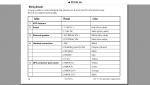
The installation supplement for the Navman 7110 (likely very similar) is here; Manual Navman VHF_7110 (page 14 of 18) (English)

The pins and cable colours for the NMEA cable are:

21AA92FB-DCF4-446F-BDFB-9B8E31485D3A.png
Chop the connector off the VHF cable (unless you fancy trying to find a female DIN plug to match, then connect the antenna Green wire to the VHF yellow wire and the antenna thin black wire to the VHF green wire. Antenna red and thicker black wires to power.
 
Last edited:
Chop the end off the plug you have and use the wires, on the gps unit linked the yellow and green are likely the nmea and red and black the power, you'll do no harm getting the nmea wires the wrong way around so if it doesn't work swap them round and try again, 4800 is pretty much standard speed for gps nmea signals.
If you have the instructions for the navman it'll have the wire colours in it.
nmea tx on gps to nmea rx on radio.
You could do a much cheaper job using a gps module <£10 and a 5v regulator to power it as long as it's mounted away from the elements, gps doesn't have to be up top on a grp boat and the little patch antennas are plenty good enough, most of the cheap usb gps units have plain nmea available if you open them up and bypass the usb adaptor bit.

Ah ok, I was thinking about chopping the plug off the VHF radio end and having a look!
 
The installation supplement for the Navman 7110 (likely very similar) is here; Manual Navman VHF_7110 (page 14 of 18) (English)

The pins and cable colours for the NMEA cable are:

View attachment 151026
Chop the connector off the VHF cable (unless you fancy trying to find a female DIN plug to match, then connect the antenna Green wire to the VHF yellow wire and the antenna thin black wire to the VHF green wire. Antenna red and thicker black wires to power.

So.... When i cut the NMEA plug off the back of the VHF, there should be (or could be) 8 cables

Antenna Green to VHF Yellow
Antenna Black (thin) to VHF Green
Antenna Red to Power ---- use a voltmeter to find which is the 12v from the VHF? or is there a red cable?
Antenna Black (thick) to Power --- how do i find this cable? ( is it black?)


Thanks a lot!
 
So.... When i cut the NMEA plug off the back of the VHF, there should be (or could be) 8 cables

Antenna Green to VHF Yellow
Antenna Black (thin) to VHF Green
Antenna Red to Power ---- use a voltmeter to find which is the 12v from the VHF? or is there a red cable?
Antenna Black (thick) to Power --- how do i find this cable? ( is it black?)


Thanks a lot!
There isn’t 12v power in the vhf NMEA data cable. You need to connect the antenna red to an appropriate switch on your switch panel (protected by a suitable fuse) and the antenna black to ground, probably a 12v bus bar in an electronics locker near your switch panel.
 
There isn’t 12v power in the vhf NMEA data cable. You need to connect the antenna red to an appropriate switch on your switch panel (protected by a suitable fuse) and the antenna black to ground, probably a 12v bud bar in an electronics locker near your switch panel.

I used the power connections of the radio itself - which kept all wires neat and in one place....

But as to GPS rcvr .... 73 quid ???? Plenty of GPS chip rcvrs for about 10 - 20 quid that can be double side taped to back of VHF ... a 12v to 5v regulated BEC for about a fiver ...

I did this for my previous VHF ....

GPS :

Beitian Dual BN-220 GPS GLONASS Antenna Module TTL Level RC Drone Airplane

12v to 5v BEC :

DC-DC Converter Step Down Module UBEC 3A 5V / 12V BEC For RC Airplane FPV for RC Drone FPV Racing
 
Last edited:
There isn’t 12v power in the vhf NMEA data cable. You need to connect the antenna red to an appropriate switch on your switch panel (protected by a suitable fuse) and the antenna black to ground, probably a 12v bus bar in an electronics locker near your switch panel.

This is what has had me confused, I assumed NMEA sent power. Thanks for clarifying this.
 
yes have been looking at this, would save me quite a bit of £££.

My VHF was sitting set into under the side deck ... GPS worked fine. In fact my Lowrance for years had its GPS antenna lodged in the window .... my replacement Onwa has its GPS puck on top of plotter inside cabin ... no problem. The average GRP or wood boat is not such a problem ...
 
Top