Confused battery set up. Two batteries in parallel.

I'm no electrical expert here beyond knowing how to use a 1-2-Both switch.

But there's more circuitry involved here than just a couple of switches. And I don't need to understand it or troubleshoot it if I stick to a 1-2-Both.

Horses for courses...
 
You haven't understood. With two separate on/off switches you just arrive at the boat, turn them both on, use the boat, then turn them both off when you go home. There's absolutely no need to fiddle with the switches. It's so much easier than a 1-2-Both switch, and there's no risk of accidentally flattening the engine battery.
OK, I accept that.
Therefore maybe a single switch in the batteries common negative line would equally do the same job! (see my drawing in #19)
 
OK, I accept that.
Therefore maybe a single switch in the batteries common negative line would equally do the same job! (see my drawing in #19)

Just switching the common negative doesn't actually do the same job. With separate engine and domestic switches, it's possible to turn off the 12v to the engine whilst retaining power to the domestics. So, for example, if you need to work on the alternator, you can do it safely whilst still keeping the lights on so you can see what you're doing.
 
Interesting point.

What happens if the engine electrics are turned off whilst it's running?

Assuming a diesel of course...
If you disconnect a running alternator from the battery you will probably fry its diodes.

That is the main objection, as far as I am concerned, to a 1,2 both, off switch. If you change from one battery to the other while the engine is running you must go via the "both" position on the switch . It is easy forget this and switch via the "off" position or for a well meaning crewmember who does not appreciate this to do so.

The rule on the boat that I crewed was that only the skipper was allowed to operate the battery switches
 
Interesting point.

What happens if the engine electrics are turned off whilst it's running?

Assuming a diesel of course...

Depends how it's wired. If, for example, the alternator output goes to a diode splitter feeding the charge to both batteries, there'll still be a load on the alternator so it will be OK.
 
Thanks both.

On the 1-2-Both switch, mine doesn't rotate a full 360 degrees. Fully anticlockwise for Off. Fully clockwise for...

Hmm...

I claim expertise on this.

Yep.

First click clockwise is 1
2nd ditto is Both
Third and last click is 2

I do have to check it's done right each time.
 
Thanks both.
On the 1-2-Both switch, mine doesn't rotate a full 360 degrees. Fully anticlockwise for Off. Fully clockwise for...
Hmm...
I claim expertise on this.
Yep.
First click clockwise is 1
2nd ditto is Both
Third and last click is 2
I do have to check it's done right each time.
With that design you are less likely to accidentally go to "off" when changing battery selection................. still not completely fool proof though
 
Just switching the common negative doesn't actually do the same job. With separate engine and domestic switches, it's possible to turn off the 12v to the engine whilst retaining power to the domestics. So, for example, if you need to work on the alternator, you can do it safely whilst still keeping the lights on so you can see what you're doing.
I agree, but I was questioning your scenario [With two separate on/off switches you just arrive at the boat, turn them both on, use the boat, then turn them both off when you go]
 
I agree, but I was questioning your scenario [With two separate on/off switches you just arrive at the boat, turn them both on, use the boat, then turn them both off when you go]

Yes, that's how I normally use my boat, and I don't think it's questionable. It illustrates just how easy it is to use, compared with a 1-2-Both switch.
 
First, I would suggest that Battery 2 might well have reached it's End Of Life, so needs replacing.

Yes, this is also indicating that Battery 2 is knackered!

This is a simple Circuit Diagram of what you appear to have and how it should be wired up:
Note that the Solar connects direct to the battery and not through the 1-2-B switch so it will do its job when you are away from the boat.
Also I have shown the Solar connected to the House Battery so when you are out sailing it helps to keep your instruments voltage up.

View attachment 89025
Thanks both.

On the 1-2-Both switch, mine doesn't rotate a full 360 degrees. Fully anticlockwise for Off. Fully clockwise for...

Hmm...

I claim expertise on this.

Yep.

First click clockwise is 1
2nd ditto is Both
Third and last click is 2

I do have to check it's done right each time.

My switch operates anyway 360. So just as easy to go via off and fry the alternator?
 
Yes, that's how I normally use my boat, and I don't think it's questionable. It illustrates just how easy it is to use, compared with a 1-2-Both switch.
Interesting. Doesn’t the low oil pressure alarm go off it you have the engine battery on without the engine running?
 
Yes, that's how I normally use my boat, and I don't think it's questionable. It illustrates just how easy it is to use, compared with a 1-2-Both switch.
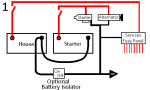
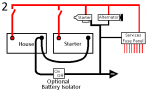
Sorry, but I think I will question it. Are you using two switches as in drawing 1 or as in drawing 2 or another way I haven't thought of?
If 1 how do you charge the other (House) battery?
If 2 and you say "you just arrive at the boat, turn them both on, use the boat, then turn them both off when you go" then you are always running your batteries in parallel so running the risk of doing just what you are trying to avoid of flattening your starter battery!

2 sw a.png2 sw b.png
 
Sorry, but I think I will question it. Are you using two switches as in drawing 1 or as in drawing 2 or another way I haven't thought of?
If 1 how do you charge the other (House) battery?
If 2 and you say "you just arrive at the boat, turn them both on, use the boat, then turn them both off when you go" then you are always running your batteries in parallel so running the risk of doing just what you are trying to avoid of flattening your starter battery!

View attachment 89097View attachment 89098

I'll try to explain further. Neither of your circuit diagrams applies. Indeed, in your diagram 1 the house battery doesn't seem to be charged by anything.

My boat has an on/off switch for the engine battery, and an on/off switch for the house bank (3 batteries). The output from the alternator goes to a low-loss splitter, which feeds the charging current to the engine battery, the house bank, and the bowthruster battery (which has its own on/off switch). The outputs from the low-loss splitter are isolated, so the engine battery is never in parallel with any other batteries.
 
I'll try to explain further. Neither of your circuit diagrams applies.
Got it (y)
You didn't mention a splitter, my point of reference was the OP's setup.
in your diagram 1 the house battery doesn't seem to be charged by anything.
Yes, that's why I asked "If 1 how do you charge the other (House) battery?"
Now tout est clair.
 
Interesting. Doesn’t the low oil pressure alarm go off it you have the engine battery on without the engine running?

No. The engine isolator isolates the engine battery from everything. When it's turned on, power is available, but you still need to turn the "ignition" key on, or press the "ignition" button.
 
If you have a 1-2-B switch and you're happy with it, no need to read on and tell me about and how great it is, i'm perfectly happy that you like it. and you are not in any way obliged to change it.

For anyone interested in an alternative method, here's a basic schematic of what PVB is talking about. It's a simple drawing, showing no fuses and just a single domestic battery, that can obviously be as many batteries as needed. This show a low loss splitter, such as the Victron Argofet, which is connected exactly the same as the old diode splitters. With this layout it doesn't matter to the alternator if both switches are turned off.

From an end user perspective, single switches are very simple, whatever method of split charging is chosen. All you need to do is turn up at the boat, switch the engine and domestic switches on, sail the boat, turn them both off when you go home.

There is a list of good points about this type of system, it's too late in the day to post them now, maybe tomorrow.

Charging-2-Batteries-One-Engine-with-ArgoFET.jpg
 
No. The engine isolator isolates the engine battery from everything. When it's turned on, power is available, but you still need to turn the "ignition" key on, or press the "ignition" button.
That’s interesting- I’ve never really questioned that bit of my setup. I need to turn the engine battery isolator in the cabin (on comes loud alarm) then go up to the cockpit and press a button. Irritating if you are on watch and need to quickly turn the engine on. Must have another think when I’m next able to get to the boat as I had assumed that was normal on more modern boats.
 
You can get almost any colour on eBay although I'm not sure about grey. You could choose the nearest colour (dull white) or even paint them grey. :)

Obviously it has to be the same headlining that Land Rover use where the material is glued onto a hardboard-like backing panel and the glue gives up the ghost after 15 years. :(

Richard

I would go for a contrast colour and make a feature of it. :)
 
Top