Confused battery set up. Two batteries in parallel.

joyfull

Well-Known Member
Joined
10 Feb 2014
Messages
177
Location
Plymouth, UK
Visit site
Please excuse my total bewilderment about how batteries work and how my boat is set up.

I bought a boat late last year which has two batteries connected in parallel (positive to positive). They are connected to a big isolator switch which has options OFF, BOTH, 1 or 2.

One battery is new last year 96ah, one at least four years old 100ah.

I presumed that one would be the service battery and one dedicated to the engine (so that I could always start the engine).

I have found that both batteries feed into the services (lights, nav etc) when switched to BOTH, 1 or 2.

Also the engine ignition works whether the isolator is on BOTH, 1 or 2. However if 2 is low voltage the engine wont turn over so I have to switch to BOTH.

All power is off when switched to OFF.

When switched to 2 the power in the battery to run the cabin lights decreases until the lights dim. Then when I switch to BOTH or 1 the lights come bright again.

Is this the correct configuration with the isolator switch? Both 1 and 2 can run the services, but 1 can be isolated by switching to just 2 for the services.

I am unsure whether it is wired up correctly.

Another strange point. I charged up the newest battery (1) ashore to 12.9v as the engine is not working at the moment and my solar panel does not seem to top up enough.

The second battery is low on voltage and last night dropped to 8.5v whilst I was reading. So I switched to BOTH to get more light.

I forgot to switch to OFF when I went to sleeping leaving the isolator at BOTH and this morning battery 1 had dropped from 12.9v to 12.6v and battery 2 had increased to 12.2v. Does that mean that battery 1 charged up battery 2 overnight?

I must say I am confused and not sure if my boat is configured correctly.

Any thoughts or advice greatly appreciated.
 
If the two batteries are wired in parallel they are effectively acting as just one large battery. From your description is appears that you have another battery, presumably a starter battery, somewhere else, which you have not discovered yet. It could be that the two batteries are wired in parallel but through the switch but you can easily determine that by looking.

Richard
 
Last edited:
Normal set up. The engine start and the cabin light instruments all come from the same battery. You just have a choice which you use. I , 2 or both.

My procedure on boat with that is to always start battery from 1 (whicch is the newer) run it like that for half hour to get past headland then turn over to 2 and use that for rest of 6 hour voyage. If one goes very flat connecting it to the other using BOTH will simply flatten the good one so swapping to other battery the best solution if starting an issue. If both batteries a bit ssedy however then both might give enough oomph to start engine.

Our other boat has two switches and separate batteries for engine and services, but thats not what most boats use and not what youve got
 
In essence you have just one electrical system and your isolator switch is used to select which battery you want connected to it.

There's no separate engine starting battery.
 
In essence you have just one electrical system and your isolator switch is used to select which battery you want connected to it.

There's no separate engine starting battery.

And people keep saying how simple a 1,2, both switch is.

As you say the 1,2,both switch just selects which battery you draw power from,

if for 1 is engine battery you start on position 1, this supplies engine and domestic power from battery 1

With engine running and battery 1 charged, then select battery 2, to supply engine and domestic power from battery 2 and recharge.

Both is for low battery 1 and 2, or charge both with engine running.

Brian
 
Ah, a 1-2-Both switch, my favourite thread.

OP, you are mistaken in your description. If the batteries are indeed wired in parallel, as you describe, there must be another battery somewhere.
 
Ah, a 1-2-Both switch, my favourite thread.

OP, you are mistaken in your description. If the batteries are indeed wired in parallel, as you describe, there must be another battery somewhere.
Here I would agree with any advice you gave about throwing away the 1-2-B switch. My guideline is that anybody who has to ask a question about a 1-2-B switch shouldn’t have one. Instead simple isolator switches and a VSR circuit should be fitted instead.

1-2-B switches are for electrical nerds only, and even then only if they are not absent minded ever.
 
Here I would agree with any advice you gave about throwing away the 1-2-B switch. My guideline is that anybody who has to ask a question about a 1-2-B switch shouldn’t have one. Instead simple isolator switches and a VSR circuit should be fitted instead.

1-2-B switches are for electrical nerds only, and even then only if they are not absent minded ever.

I actually prefer 1 2 both switches for boats even though i am electrical engineer, They are fool proof if done correctly whereas other voltage select relays etc can give trouble. Aux batteries for mobile homes and vans can benefit from different arrangements.

The OP more ever has a 1 2 switch and merely needs to know how it works not what arcane peice of kit could replace it.

Any two battery system should be parallel on the negative but separate on positive so if the OP has paralleling on positive either there is a third battery or something very wrong, The OPs description of using match a correctly set up 1 2 switch with merely poor or flattish batteries, thus I suspect paralleling only in the both position
 
I actually prefer 1 2 both switches for boats even though i am electrical engineer, They are fool proof if done correctly whereas other voltage select relays etc can give trouble. Aux batteries for mobile homes and vans can benefit from different arrangements.

The OP more ever has a 1 2 switch and merely needs to know how it works not what arcane peice of kit could replace it.

Any two battery system should be parallel on the negative but separate on positive so if the OP has paralleling on positive either there is a third battery or something very wrong, The OPs description of using match a correctly set up 1 2 switch with merely poor or flattish batteries, thus I suspect paralleling only in the both position

I am glad I am adding some entertainment in these strange and tedious times (if you like sailing or golf!).

After reading the thread above I can confirm that I have just two batteries. They are paralleled on the negative and to the engine (ground I presume).
Both positives go to that lovely big isolator switch which has positive direct to the starter motor.

Phew, that's a relief.

Now to asking the not so obvious (to me). When the engine is running does the alternator only charge the battery that the isolator is switch to, i.e 1, 2, BOTH or none (no charging if OFF).

And back to my original note, if left on BOTH overnight will the higher charge battery charge the lower one (as happened last night)?
 
Yes and yes but don't switch to OFF with engine running, or the alternator could be damaged. Also not a good idea to leave on BOTH as both batteries could be flattened.
Use BOTH only when engine running.
 
Here I would agree with any advice you gave about throwing away the 1-2-B switch. My guideline is that anybody who has to ask a question about a 1-2-B switch shouldn’t have one. Instead simple isolator switches and a VSR circuit should be fitted instead.

1-2-B switches are for electrical nerds only, and even then only if they are not absent minded ever.

Think i'll give this one a miss Rupert, it's clear to see where it's headed already :)
 
I am glad I am adding some entertainment in these strange and tedious times (if you like sailing or golf!).

After reading the thread above I can confirm that I have just two batteries. They are paralleled on the negative and to the engine (ground I presume).
Both positives go to that lovely big isolator switch which has positive direct to the starter motor.

Phew, that's a relief.

Now to asking the not so obvious (to me). When the engine is running does the alternator only charge the battery that the isolator is switch to, i.e 1, 2, BOTH or none (no charging if OFF).

And back to my original note, if left on BOTH overnight will the higher charge battery charge the lower one (as happened last night)?

In that case, I would not describe your batteries as being wired in parallel. They can be connected in parallel but can equally easily be used as separate batteries. It would appear that to charge both batteries you therefore have to use "Both" but only when the engine is running or you will flatten both. It also appears that you have a problem with the battery that will not power the lights unless you have never charged that battery. If you have charged it and it still won't power the lights, then replace it.

I would also label your switch "House" and "Engine" rather than 1 and 2, or whichever way round is best, just be make it clearer.

Richard
 
However if 2 is low voltage the engine wont turn over so I have to switch to BOTH.
When switched to 2 the power in the battery to run the cabin lights decreases until the lights dim. Then when I switch to BOTH or 1 the lights come bright again.
The second battery is low on voltage and last night dropped to 8.5v whilst I was reading. So I switched to BOTH to get more light.
First, I would suggest that Battery 2 might well have reached it's End Of Life, so needs replacing.
I forgot to switch to OFF when I went to sleeping leaving the isolator at BOTH and this morning battery 1 had dropped from 12.9v to 12.6v and battery 2 had increased to 12.2v. Does that mean that battery 1 charged up battery 2 overnight?
Yes, this is also indicating that Battery 2 is knackered!

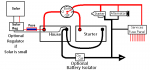
This is a simple Circuit Diagram of what you appear to have and how it should be wired up:
Note that the Solar connects direct to the battery and not through the 1-2-B switch so it will do its job when you are away from the boat.
Also I have shown the Solar connected to the House Battery so when you are out sailing it helps to keep your instruments voltage up.

1-2-B Circuit S.png
 
Last edited:
I aso use a 1,2 both switch less to go wrong if you understand it,in the op case not realising he had a faulty battery a automatic system may be better.
,
 
Top