
Compass Headings and soundings

Resolution

Well-Known Member
Joined
16 Feb 2006
Messages
3,472
Visit site
Reading an 1877 Wreck Commissioners Report about a sinking off Ushant, I found difficulty in sorting out what true courses they were sailing on. References to “north-east by north” and “north-east three quarters north” need clarification. Can any of you traditionally -trained guys help out?

The other bit of old speak that confused related to taking soundings. Fascinating to learn that in fog they had to stop every now and then, take soundings , go back to the charts and try to guess where they were. Incorrectly in this case. What does “no bottom at 90 fathoms” mean? “40 fathoms with a bottom of sand and shells “ is pretty clear.

And of course “ the helm was put hard-a-starboard” in order to turn the boat to port, even though steering was by a wheel.
 
Reading an 1877 Wreck Commissioners Report about a sinking off Ushant, I found difficulty in sorting out what true courses they were sailing on. References to “north-east by north” and “north-east three quarters north” need clarification. Can any of you traditionally -trained guys help out?

The other bit of old speak that confused related to taking soundings. Fascinating to learn that in fog they had to stop every now and then, take soundings , go back to the charts and try to guess where they were. Incorrectly in this case. What does “no bottom at 90 fathoms” mean? “40 fathoms with a bottom of sand and shells “ is pretty clear.

And of course “ the helm was put hard-a-starboard” in order to turn the boat to port, even though steering was by a wheel.
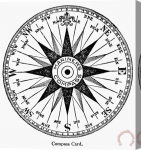
That means that the lead on a 90 fathom line did not touch the bottom. therefore the depth was greater than 90 fathoms.
 
north-east by north == midway between northeast and north-northeast.
northeast 3/4 north == northeast, 3/4 of the way to northeast-by-north.

For reference, NNE is midway between N and NE. The first quartering of the compass gets you the single letters (NSEW), halving each of those gets you the NE, SE, SW, NW, halving those in turn gets you the NNE, ENE, etc, and thence to NEbN before finally spliting into half or quarter points.
 
north-east by north == midway between northeast and north-northeast.
northeast 3/4 north == northeast, 3/4 of the way to northeast-by-north.

For reference, NNE is midway between N and NE. The first quartering of the compass gets you the single letters (NSEW), halving each of those gets you the NE, SE, SW, NW, halving those in turn gets you the NNE, ENE, etc, and thence to NEbN before finally spliting into half or quarter points.

NNE etc. is used in the old system of angular measure formerly used to specify compass directions. With 32 “points” on a compass being equal to 360 degrees, one point (i.e. from NNE to NE by N) equals 11.25 degrees. Half a point is just over 5-1/2 degrees, and a quarter point is just under 3 degrees, or just as close to steering accuracy on any sailing vessel as one can get.
 
NNE etc. is used in the old system of angular measure formerly used to specify compass directions. With 32 “points” on a compass being equal to 360 degrees, one point (i.e. from NNE to NE by N) equals 11.25 degrees. Half a point is just over 5-1/2 degrees, and a quarter point is just under 3 degrees, or just as close to steering accuracy on any sailing vessel as one can get.
Penberth 3 beat me to it, with an excellent diagram of an old compass card too. :)
 
Who can box the compass verbally? I can, but quite slowly.
The bearings I don't know use colours, eg 'Red ten-oh', shouted by John Mills on a destroyer's bridge! A dumbing-down for wartime ratings perhaps?
 
NNE etc. is used in the old system of angular measure formerly used to specify compass directions. With 32 “points” on a compass being equal to 360 degrees, one point (i.e. from NNE to NE by N) equals 11.25 degrees. Half a point is just over 5-1/2 degrees, and a quarter point is just under 3 degrees, or just as close to steering accuracy on any sailing vessel as one can get.
Exactly, 1/4 points are precise by sailing ship standards and perfectly adequate
 
Reading an 1877 Wreck Commissioners Report about a sinking off Ushant, I found difficulty in sorting out what true courses they were sailing on. References to “north-east by north” and “north-east three quarters north” need clarification. Can any of you traditionally -trained guys help out?
A very logical way to steer a boat. You try holding a course with 10° of 93°
 
Here you go. 11.25 degree increments, which is 360 degrees divided by 32. Superseded by whole circle bearings, but I thought everybody still knew about it - I must be getting old! I think it's called "boxing the Compass".

View attachment 119800
At school our form master was ex-Navy. His "party trick" was reciting the points of the compass. I cannot remember how many!
Funnily enough, I think he was Mr East...
 
Last edited:
Who can box the compass verbally? I can, but quite slowly.
The bearings I don't know use colours, eg 'Red ten-oh', shouted by John Mills on a destroyer's bridge! A dumbing-down for wartime ratings perhaps?
The Red Ten oh is a relative bearing from the ship’s head. I.e. 10 degrees off the bow on the Port side. Much clearer in a combat situation than giving a compass bearing. I think this would a sighting report such as aircraft or periscope rather than a helm order?
 
Who can box the compass verbally? I can, but quite slowly.
The bearings I don't know use colours, eg 'Red ten-oh', shouted by John Mills on a destroyer's bridge! A dumbing-down for wartime ratings perhaps?
I never learned the last 16 points, the "by" ones, but I interpret north by west as north and a bit west, which seems to work. By the time I was learning them, for anything more than the 16 N, NNE, etc, I was taught to use bearings.

As for Red 10-oh, I read that at 100 degrees to port. Green 45, would be 45 degrees to starboard. relative bearings
 
I never learned the last 16 points, the "by" ones, but I interpret north by west as north and a bit west, which seems to work. By the time I was learning them, for anything more than the 16 N, NNE, etc, I was taught to use bearings.

As for Red 10-oh, I read that at 100 degrees to port. Green 45, would be 45 degrees to starboard. relative bearings
Relative bearings, now I see.Perhaps better than using hours of the clock which I was taught.
(Re clocks, I was interested to learn that many of my daughter's generation, 'millenials', have no instinctive way of describing direction of rotation: they were brought up with digital clocks! )
 
At school our form master was ex-Navy. His "party trick" was reciting the points of the compass. I cannot remember how many!
Funnily enough, I think he was Mr East...
My father taught me to box the compass - in quarters! - while I was at primary school. It hasn't been of practical help, but it's useful when reading "We Didn't Mean To Go To Sea".
 
Top