Colregs -- a question of interpretation?

  • Thread starter Thread starter timbartlett
  • Start date Start date
Yep, if the ship was going to change direction, it would have done it far before I got just a few hundred yards from it. I'm always on auto, so mostly going in a straight line. Maybe some ships, from miles away, changed course a bit, but I would not have known about them. Always we'd be on the fly, with the radar be low.

Haydn , I think your action is only the final option.


If you can just think about it, its just so obvious..........
Tim says the ships are giving way to us from 6-4 nm away, and altering course @ 4 miles away then I reckon they are out of our sight.

Yep suppose I could have picked them up on my radar, if downstairs. But was nearly always upstairs. Boat always on Track, auto pilot.

So tracking a straight line from say Plymouth to CI's.

How come the buggers come to attack me from my left. if Tim says they have 6/4 miles to change course, how come they are still all facing me.
Richard 10002 has given a pretty good explanation of why altering course to port is prohibited under Rule17.

I always think of a collision situation in four phases:
1: no risk of collision -- both vessels free to manoeuvre at will
2: risk of collision established -- stand on vessel must stand on, give way vessel must give way
3: risk of collision, but inadequate action by give way vessel, stand on vessel may alter course to starboard or change speed
4: collision inevitable unless stand on vessel takes action: action by stand on vessel is mandatory, including the option of altering course to port.

The crux of the matter is when do we enter each phase.

As Benjenbav says, Legal precedent suggests that there is no risk of collision beyond six miles.
When a ship is within six miles, it may be very difficult to observe a change of bearing until the ship is quite close. Rule 7 says that Risk shall be deemed to exist if the compass bearing of a vessel does not appreciably change.
So I'm inclined to say that -- in open water, we move into Phase 2 at about 6 miles

IMHO, we cannot then take legitimate avoiding action until it is obvious that the other vessel is not taking adequate action. In open water, I might start feeling concerned about an approaching ship at about 2 miles, but remember that a <12m sailing boat's nav lights are only required to be visible for 1 mile -- and as a ship cannot be expected to give way to a vessel it cannot see, I suggest that the boundary between phase 2-3 is at about 1-2 miles.

The last phase is when the give way vessel has left it too late to manoevre. Cockroft and Lameijer suggests that Phase 4 begins at 12x your own vessel lengths. This is illogical, because the distance at which the other vessel has left it too late to manoeuvre is connected with the other vessel's characteristics, not yours --- but it's a good indicator of what is being taught/examined in nautical college. And translated down to "about 120 metres" it seems to me to be perfectly reasonable.

For comparison, Cockroft and Lameijer give these figures (for ship-ship encounters):-
Outer Limit of stage 2...... 5-8 mile
Outer Limit of stage 3...... 2-3 mile
Outer Limit of stage 4...... 12 own-ship lengths

how come they are still all facing me.
I bet when you alter course to avoid a ship approaching from your starboard side, you "aim for his stern", and then follow his stern round until you are back on course. If so, then of course you are "facing him". Why be surprised when he does the same?

PS. MAIB reports (almost by definition) only yell us about incidents where something has gone wrong. But the report into the Wahkuna collision, for instance, refers to evidence from the ships voyage data recorder which showed that the ship had previously altered course to avoid another small radar contact at a range of 4-5 miles. Wahkuna was also seen on radar at 5-6 miles, but appeared (at that stage) to be passing clear.
 
Last edited:
Altering course to port, an explanation as to why it is so tempting for the 12m 25knt boat.


Imagine a ship @20 knots.

In front of the ship, shade in red a danger zone , a thin cone @ 30 degrees being the most likely course.

Now draw two lines in magenta starting at the ships bow to signify his extreme emergency manoeuvre, now shade it in.

There will be some clear safety water left , most of which is the either side of the ship, an arc port & starboard at the bow and loads at the stern.

If the ship is aiming to pass our stern , the ship @ 200-250m away has us within the magenta area and we are about to enter his red area.

If we foul a prop , the ship can not miss us.

if we turn to starboard we go through the red zone.
if we stop , we have already established he will hit us.
if we slow and turn to starboard , we will be in the magenta zone and will have caused confusion.

if we turn to port sharply we will be outside the magenta zone and safe down the side of the ships starboard side, even if our actions have caused confusion the ship can not possible hit us. even if we foul a prop we will be outside the magenta zone.
 
5 degrees to port, please

B2_hellerupbugt.jpg


:cool:
:D

Btw perfectly safe, everybody happy...
 
How and why COLREGS attract so much discussion on leisure boat forums is a bizarr mystery. :confused: It's not rocket science. You'd think there were fatalities every month from collisions involving leisure craft. There isn't. Small craft sail and power are very maneouverable. It's easy and common sense to avoid crashing such slow craft, and especially easy to keep out of the way of shipping.

Much ado about nothing methinks.

You don't see endless discussion on rules of the road on auto forums, so why here? :confused: RTAs kill every single week!
 
Altering course to port, an explanation as to why it is so tempting for the 12m 25knt boat.


Imagine a ship @20 knots.

In front of the ship, shade in red a danger zone , a thin cone @ 30 degrees being the most likely course.

Now draw two lines in magenta starting at the ships bow to signify his extreme emergency manoeuvre, now shade it in.

There will be some clear safety water left , most of which is the either side of the ship, an arc port & starboard at the bow and loads at the stern.

If the ship is aiming to pass our stern , the ship @ 200-250m away has us within the magenta area and we are about to enter his red area.

If we foul a prop , the ship can not miss us.

if we turn to starboard we go through the red zone.
if we stop , we have already established he will hit us.
if we slow and turn to starboard , we will be in the magenta zone and will have caused confusion.

if we turn to port sharply we will be outside the magenta zone and safe down the side of the ships starboard side, even if our actions have caused confusion the ship can not possible hit us. even if we foul a prop we will be outside the magenta zone.

Agreed! If you are the stand on vessel but decide to take action, the most sensible action is to alter to port to pass astern of the give way vessel.

However, if you are the give way vessel, and decide to give way, the most sensible action is to alter course to starboard to pass astern of the stand on vessel.

Given the rules, the chances are that in most instances, the give way vessel will do the most sensible thing. If they don't seem to be doing the right thing, the rules deal with it. If they reach the point where they can't do anything on their own to avoid collision, the rules deal with it.

At some point, perhaps after many vessels had done the most sensible thing, and hit each other, a decision was made to make one the give way vessel, and the other the stand on.

So that's how it is, and there is no exception for leisure sailors, tempting as it may seem.

As an ex merchant seaman, the thought of turning to port to avoid a collision makes me cringe. In a car, It's a bit like turning right across the oncoming traffic, or not giving way to the right on a roundabout. You just wouldn't do these things, unless circumstances forced you - e,g. If a big artic. is heading for you, and you can't turn left to get out of the way, your best bet might be to turn right across the oncoming traffic, and hope you make it through a gap.

As I've already said...... Turning to port before risk of collision exists, thus avoiding a risk of collision developing, is fine.

Your final paragraph, where your turn to port means you pass down the ships starboard side, and he can't possibly hit you by turning to starboard, suggests that you are very close to the ship, that a collision is certain, and that altering course to starboard, or slowing down or stopping, won't avoid the collision. In these circumstances, circumstances may not admit anything other than a turn to port - the rule isn't broken.

Having said that, the picture you paint is one where the stand on vessel is almost looking up at the anchor of the give way vessel - stopping, or turning up to 180 to starboard, prior to this, would probably have been the sensible action?

The rules are not definitive, so it's always a question of judgement. If there is a collision, that judgement will be questioned.
 
Altering course to port, an explanation as to why it is so tempting for the 12m 25knt boat....
I can see why it is tempting. What I don't see is why it so difficult to resist that temptation. Maybe one needs to have stood on the bridge of a ship to appreciate why the temptation is dangerous, but that wasn't the original question -- the question was "Can someone please offer an interpretation of Rule 17 that makes altering course to port to avoid a give way vessel legitimate?".

I can think of plenty of things that are tempting but illegitimate!

You don't see endless discussion on rules of the road on auto forums, so why here? :confused: RTAs kill every single week!
I suspect that if anyone on the auto forums suggested that it was "common sense" for small vehicles to drive on the right or go anticlockwise round roundabouts, they would be regarded either as a complete nutter or a troll.

On boating fora, it seems to be the other way round: those who argue in favour of conforming to the rules are accused of being reckless, unrealistic, or trolling, while those who argue in favour of either disobeying the rules or of simply ignoring them ("throw away the rule book") claim that it is "common sense" to do so.

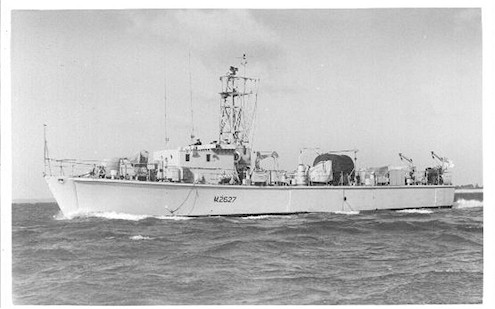
PS. Presumably your "give way to ships" principle is based on size. Can you give us a clu which (if any) of these are big enough to qualify as vessels that you would automatically give way to?

640px-HMS_Sabre_-_P285.jpg

300px-HMS_Blazer_on_Loch_Goil.jpg

Mfv-Lloyd-Tyler-709820.jpg

hms_felmersham.jpg

2397.jpg

746_1_40my_ple_0910_jmc_1128.jpg_1031_(original).jpg

showphoto.aspx

yacht-kokomo-profile-image-by-alloy-yachts.jpg
 
Last edited:
I suspect that if anyone on the auto forums suggested that it was "common sense" for small vehicles to drive on the right or go anticlockwise round roundabouts, they would be regarded either as a complete nutter or a troll.

On boating fora, it seems to be the other way round: those who argue in favour of conforming to the rules are accused of being reckless, unrealistic, or trolling, while those who argue in favour of either disobeying the rules or of simply ignoring them ("throw away the rule book") claim that it is "common sense" to do so.


Well said timbo, rules are made to be conformed to, not for common sense interpretation.


Reminds me of when I done my advance motor cycle training with a Class1 Police instructor. he ask a question of one pupil about speed in the National Limit and the pupil replied "Thats where I must do 70mph".

Instructors reply "No, the 70mph is a LIMIT not a target".
The problem of applying common sense to RULES is that everyones idea of common sense is different.

You ask my wife.:)
 
The problem of applying common sense to RULES is that everyones idea of common sense is different.

You ask my wife.:)

And everyone has a different idea of when a collision risk exists.

My idea is that at 25 knots and 4 miles (almost 10 minutes) away, the chances of me hitting another vessel is absolutely zero. Therefore rule 17 is irrelevant and i can steer any course i choose (providing i don't create a risk of collision, etc).
 
And everyone has a different idea of when a collision risk exists.

My idea is that at 25 knots and 4 miles (almost 10 minutes) away, the chances of me hitting another vessel is absolutely zero. Therefore rule 17 is irrelevant and i can steer any course i choose (providing i don't create a risk of collision, etc).

Why would you be thinking about altering course to avoid a collision that you know isn't going to happen?
 
Think this whole arguement is a bit silly. 4 miles may be difficult for two ships in good weather. But a ship and a mobo can never be a problem, providing one or the other is not drunk.


As I said before, but Tim did not agree with. Nearly all encounters with ships, by mobo's are at around 90%. Lets face it, you hardly ever pass one and if you do, it's not an issue. Meeting one head on. Cant remember when, but again not an issue, we pass him to starboard, though dependent on my course, I might decide to make a big turn to port, long before there is any danger.

But mainly we meet ships cruising down the chanel, whilst we are crossing from one side to the other. So we think in one or two ways, we can pass safely in front, or maybe better to go behind. We have no idea if the ship can stop, turn, or if it's going to. But we do know that we can stop or turn in an instance.

Lets concider the other options, if I chose to hold my course, I must first concider all the other ships around, can the ship alter course to starboard, without running into other problems.? I then have to get out my chart, to make sure the ship can get over the sand bank. But what draft is he??

When I have worked out the tide and all the other conciderations, I now have to find out, if there is actually anyone on the bridge, many times there is not.

So my choice is to stick to the rules, or go some other way that the ship in not going.
 
In a similar vein...

Whilst returning to Sovereign Harbour from St Kats on Monday evening the following (roughly) was heard on chnl 16 whilst we were just of Folkstone......

(female voice) "Seastar 1 this is Warship Edinburgh, what are your intentions?

Ship calling Seastar 1, we're going to Dover

(new male voice) Seastar 1 Warship Edinburgh; we are on stand on vessel and you are required to alter course immediately

Warship Seastar 1: can't you just go round my stern?

Seastar 1 Warship Edinburgh: Under international collision regulations you are required to alter course immediately. Confirm you are doing this now

Warship Seastar 1: It would be easier if you could go round my stern

(I think this interaction was repeated a couple more times)

then a slight delay

Seastar 1 Warship Edinburgh: I confirm that we are altering course to go round your stern but we will be reporting your failure to comply with International Collision Regulations

HMS Edinburgh is a type 42 frigate
 
Last edited:
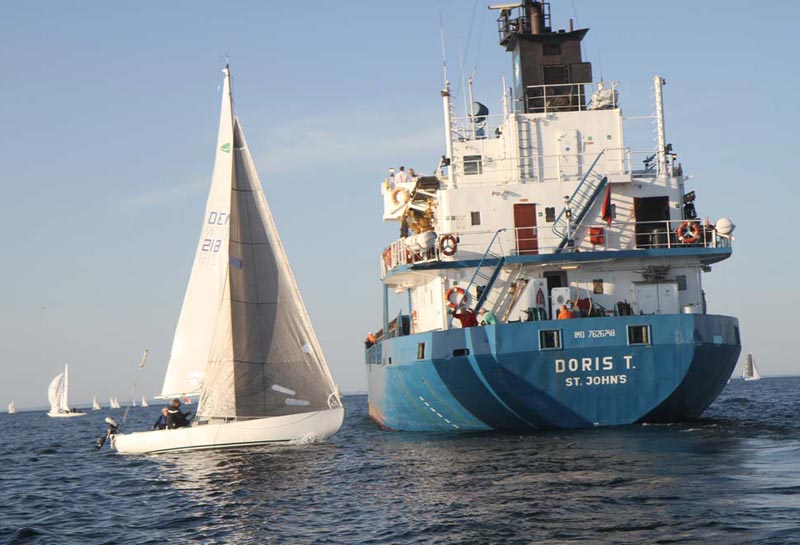
You are driving a 12m motor cruiser in open water, at about 25 knots, and you see a ship approaching from your port side. By the time the range has reduced to about 4 miles, you are concerned that there is a risk of collision.

Based on other recent threads, it seems that many people would alter course a few degrees to port (I guess somewhere between 5 and 50 degrees).

Can someone please offer an interpretation of Rule 17 that makes altering course to port to avoid a give way vessel legitimate? Here is the rule. I've highlighted the bits that I see as being an issue in this case.

Just one question Tim:
Why do you insist on using Rule 17 and not Rule 8 in this case :

"(a)Any action taken to avoid collision shall, if the circumstances of the case admit, be positive, made in ample time and with due regard to the observance of good seamanship"

Do you really insist on us forcing a situation where we HAVE to take action, or is good seamanship not to avoid HAVING to take action ???
 
Hi Tim. I wasn't making any comment on the merits of the COLREGS, just the bizar amount of traffic they generate on leisure boat forums considering their interpretation be that good, bad or ugly doesn't generate frequent collisions involving leisure craft. There seems to be a lot to say about a non issue. I put my own hand up too, as I've also got sucked into colreg discussions in the past but wonder why.
 
Hi Tim. I wasn't making any comment on the merits of the COLREGS, just the bizar amount of traffic they generate on leisure boat forums considering their interpretation be that good, bad or ugly doesn't generate frequent collisions involving leisure craft. There seems to be a lot to say about a non issue. I put my own hand up too, as I've also got sucked into colreg discussions in the past but wonder why.

Simple answer but I've not managed to get my idea across to Tim . Any ships with Tim in charge or any other expert of excellence will have spotted us and taken action well before we even realise there was a risk of collision. As they will pass us without risk of collision we will not need to alter course for them. Any ships like seastar1 who expect us to move will stand on and will be happy for us to take avaisive action, we will not be causing confusion as these ships didn't alter and they expected us to move. In summary if there exists a risk of collision at close quarters then it is so obvious the ship hasn't seen us or requires /expects us to move.
 
You are driving a 12m motor cruiser in open water, at about 25 knots, and you see a ship approaching from your port side. By the time the range has reduced to about 4 miles, you are concerned that there is a risk of collision.

<snip>

There's your mistake Tim, you think a risk of collision exists, the rest of us don't.

We think if we continue on our current course a risk of collision may develop, so we change course early, well before rule 17 comes into force.

Personally (and i'm pretty sure many others here will do the same), i turn obviously to port. The course vector line on my plotter will now be just astern of the ship. The crew on the ship will see my obvious course change, if they've even noticed me yet. I'll keep that vector line just astern of the ship by making small course changes to starboard. As i get closer to the ship a risk of collision never exists and my small changes to starboard never create one. The ship crew, again assuming they are paying attention, will see what i'm doing, unless they have hired the village idiot, they won't be at all confused.

Not only will i have complied with COLREGS, rule 17 will not have been in play and i will have exhibited good seamanship by not causing a risk of collision, not waiting until one exists through my inaction and i will not have forced a large ship to make course changes. All without putting anyone at risk, breaking any rules, adding any significant time, distance or inconvenience to myself.

Why you insist that a risk of collision exists at 6nm for a 25 knot motorboat is beyond comprehension. My own boat won't actually make 25 knots, but at my usual cruise speed of about 17 knots, there is no way in a million years a ship, or even a sailing yacht, could collide with me if he tried. I'd drive circles around him all day.
 
Not only will i have complied with COLREGS, rule 17 will not have been in play and i will have exhibited good seamanship by not causing a risk of collision, not waiting until one exists through my inaction and i will not have forced a large ship to make course changes. All without putting anyone at risk, breaking any rules, adding any significant time, distance or inconvenience to myself.

Why you insist that a risk of collision exists at 6nm for a 25 knot motorboat is beyond comprehension. My own boat won't actually make 25 knots, but at my usual cruise speed of about 17 knots, there is no way in a million years a ship, or even a sailing yacht, could collide with me if he tried. I'd drive circles around him all day.

Technically, I think Tim is right as Rule 17 is in the part that applies 'Within Visual Range', but that was the point I made earlier - whilst two large ships might be able to see each other with binoculars at 6nm, I doubt the average leisure boat would see another and be able to determine his course, speed etc at that range. Combine this with a busy waterway where there may be 20-30 such 'targets' (and much closer) and that's where I think that particular wording/definition becomes weak. How many solo helms in small leisure craft have the skills to plot that number of targets at that range without radar/ais and electronics?

My view isn't that we should ignore Rule 17 - far from it, but there has to be common sense used for the point at which it is applied and that will be different for two freighters doing 17kts than it will for a 40' sailing boat doing 6kts and 25' mobo doing 30kts! Rule 8 applies at all times however unless overridden by more specifically determined rules and that is by design as I read it.

My comments about removing specs was very much tongue-in-cheek, but one thing is certain - visual range is not a definable distance as it depends on so many factors from height of viewpoints/vessels to air quality, light levels and eyesight of the individual. Two 14' speedboats are not going to see each other in a chop at 6 miles...

I certainly wouldn't expect to go 6+ miles out of my way to pass ahead of a tanker and go around her just because I happen to have come within the 6 mile range if I were already planning a course change to port! :D
 
Just one question Tim:
Why do you insist on using Rule 17 and not Rule 8 in this case :

"(a)Any action taken to avoid collision shall, if the circumstances of the case admit, be positive, made in ample time and with due regard to the observance of good seamanship"

Do you really insist on us forcing a situation where we HAVE to take action, or is good seamanship not to avoid HAVING to take action ???
Why did you delete the bit of Rule 8 that says "shall be taken in accordance with the rules of this Part"?

Rule 8 is in Part B. Rule 17 is in Part B.

Rule 8 is telling the Give-Way vessel to act early and boldly. It is not saying "ignore any other rules yo feel like: it specifically highlights the fact that you still have to act in accordance with the other rules.

No, I do not "insist on us forcing a situation where we HAVE to take action": I simply fail to understand why so many people seem absolutely determined to take action that will confuse the situation when the rules tell them they have an obligation to to stand on, and why -- having decided that they are going to ignore one bit of the rule, they then seem determined to take the most dangerous and confusing action they could possibly achieve -- not merely ignoring Rule 17, but doing what they are expressly told NOT to do.
 
Technically, I think Tim is right as Rule 17 is in the part that applies 'Within Visual Range', but that was the point I made earlier - whilst two large ships might be able to see each other with binoculars at 6nm...
Technically, it's far easier than that, because the rule doesn't say anything about "...within visual range...".

Part B applies "in any condition of visibility". Within Part B, Section 2 applies "to vessels in sight of one another". As though that were not enough, the Definitions (Rule 3) clarifies "within sight" as meaning "when one can be observed visually from the other".

No need to measure range -- simply "Can you see him? Yes/No." (it does, of course, assume that you have "been to Specsavers" and have reasonable (corrected) vision!)

Nor do you need to plot course and speed or anything: you simply check to see whether the bearing of a vessel is steady. If it is, you have a risk of collision. (Rule 7di) If you have RoC with a vessel on your starboard side, you give way to it. If you have RoC with a vessel on your port side, you stand on.
 
Last edited:
Top