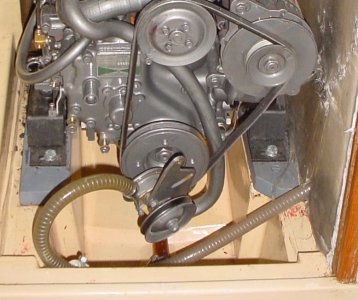
Coach screws securing engine mounts. Stainless or mild steel?

Water pump off.jpg
Photo shows my engine on its mounts. The grey painted bearers are mild steel, held onto the GRP bases with carbon steel screws. The mild steel mounts are bolted to the bearers with galvanised steel bolts into tapped holes. This arrangement is more than 20 years old and has completed nearly 3000 hours. Water in the engine bilge is far from uncommon but there is no significant corrosion. I have sprayed the mounts with Waxoyl but not the bolting.
 
Cheers Vyv. Mine had not faired nearly as well as yours. Rear mounts were very rusty and rubber had completely separated from metal on both rear ones. I used stainless coach screws in the end.
 
The engine mounts are well painted whereas mild steel bolt heads are not so you may get unsightly rusting if you do get a leak.
I was very unimpressed by the paint finish on my Yanmar mounts especially considering the cost of new ones. My deep bilge is always slightly wet as I can't get the last few drops of water out and the rear mounts rusted through in about 10 years. I now keep them well painted and touch them up but I think other makes of mounts are possibly better protected.
 
it’s baffling to me that these things are not made from stainless.
Probably because there is a much wider market for flexible mounts than the leisure marine industry and few applications where they are likely to be dowsed in water.

In a properly maintained installation they wouldn't get wet anyway.
 
Probably because there is a much wider market for flexible mounts than the leisure marine industry and few applications where they are likely to be dowsed in water.

In a properly maintained installation they wouldn't get wet anyway.
In a perfect world there would be no rust
and your boat would never leak
The wind would always be with you
No clattering suspect squeeks
Nothing would grow on your bottom
Which would forever be lissome and sleek
But sadly this is tne real world
Tis of reality we must speak
 
Last edited:
Is it not just the salty marine air that gets to them?
The steel parts of the flexible mounts are protected by paint and/or plating so there's no reason they should corroded any more than any other part of the engine.

If one starts to corrode I'd be looking for a water leak above it.
 
Are you sure it's mild steel? It's called mild because of its ductility - which is excellent for construction - but is not desirable in bolts. I thought machine screws and bolts were almost always Carbon steel, so not 'mild' (especially the stronger ones like 8.8 or above).

This is pedantry probably - it's not answering the OP I'm afraid!
 
Are you sure it's mild steel? It's called mild because of its ductility - which is excellent for construction - but is not desirable in bolts. I thought machine screws and bolts were almost always Carbon steel, so not 'mild' (especially the stronger ones like 8.8 or above).

This is pedantry probably - it's not answering the OP I'm afraid!
A great deal of bolting on engines is mild steel, i.e. carbon content less than about 0.2%. Most ancillary bolting is the lowest grade, 3.6 or 4.6, as anyone who has ever stripped a thread can testify! It is only when we get to critical bolting such as cylinder heads that the 8.8 and 10.9 carbon steel bolts appear.

The OP's coach bolts will almost certainly be mild steel, as there is little point in making bolts for wood from expensive high strength steel.

Unfortunately there is little difference between any of them so far as corrosion resistance is concerned. Galvanised bolts have very limited resistance to seawater.
 
Top