
Climbing rope and UV

Roberto

Well-Known Member
Joined
20 Jul 2001
Messages
5,849
Location
Lorient/Paris
sybrancaleone.blogspot.com
Help from climbers required :)
I have made an adjustable tether which is attached to the mast (the blue metal piece is a Slyde from Kong), after a few month exposition to the sun the climbing rope has really discolored, does this significantly degrade its strength?
It's 9mm, so there are no nautical substitutes (and the Slyde does not work with either 8 or 10mm). Top quality rope bought in a very reputable climbing stuff shop.
Should one plan to replace it every few months?
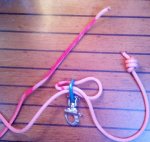
IMG_20220528_110845_3CS_copy_404x380.jpg
 
An ex-climber here. Why are you leaving the rope out in the sun? Back in the day to take your rope from the cupboard, go climbing and return the rope to the cupboard.
 
An ex-climber here. Why are you leaving the rope out in the sun? Back in the day to take your rope from the cupboard, go climbing and return the rope to the cupboard.

That's the obvious answer.

Re: only taking 9mm rope, easy to find "grippers" that will cope with all the common sizes, e.g. 8-11mm.
 
Thank you :)
Not now for me unfortunately but sometimes one may cruise for months; or even with shorter sailing periods it's a bit like jacklines, it's the sort of things one fits at the beginning of the season and removes before wintering.
I think I'll replace the rope with some UV resistant webbing and a stainless steel buckle, end of my experiments with climbing rope ?
 
Help from climbers required :)
I have made an adjustable tether which is attached to the mast (the blue metal piece is a Slyde from Kong), after a few month exposition to the sun the climbing rope has really discolored, does this significantly degrade its strength?
It's 9mm, so there are no nautical substitutes (and the Slyde does not work with either 8 or 10mm). Top quality rope bought in a very reputable climbing stuff shop.
Should one plan to replace it every few months?

Check the manufacturers web site or speak to them. I would haul it with a halliard as and when required and stow it away after use.

It will degrade in sunlight. The question is ,. How quickly. The blue on some marine ropes is protection against sunlight. I would be
suspicious if the blue faded away. . ;)
 
In general, you are better using the rope, rather than tape, for uv resistance. Most of the strength of the rope comes from the core, which is protected from uv by the sheath. In a tape, all the fibres come to the surface at some point, so the whole sling can be rotten. In situ tape abseil slings are notorious for uv failure. If you were using a toothed clamp like a Jumar on a rope, it could strip a uv degraded sheath, but should not be an issue with the device in the photo. I would advise against using tape, even uv resistant tape, in a similar application.
 
I leave our snubbers, bridle, (climbing rope 10mm) permenantly attached or deployed (in The Australian sun). The outer cover is primarily there to support or protect the core, it is specifically designed to be abrasion resistant.

Snubbers, or a bridle, to me are a consumable - they will fail and or they do need replacement (in the same way you replace your sheets or sails). We carry spares. In a bit over 20 years we have had 2 snubbers fail - they snapped with a sound like gunshot. If I had to deploy our snubbers every time we anchored - I would not use them - too much faff. better to use them and accept they will need to be replaced. Our snubbers, bridle, is deployed from the transom along the side decks, threaded through the stanchion bases. All my wife needs to do is deploy rode, attach snubbers - job done.

The major cause of failure is that the core degrades (which you cannot see) due to repeated stretch cycles - which means they are doing what was intended.

Don't give up on climbing rope - once you have your fears suppressed - it is very useful for its elasticity characteristics, cannot be beaten. It is not entirely clear what you or how you are using the rope - maybe you could simply store it as you do your sheets ( in a sheet bag).

Jonathan
 
Help from climbers required :)
I have made an adjustable tether which is attached to the mast (the blue metal piece is a Slyde from Kong), after a few month exposition to the sun the climbing rope has really discolored, does this significantly degrade its strength?
It's 9mm, so there are no nautical substitutes (and the Slyde does not work with either 8 or 10mm). Top quality rope bought in a very reputable climbing stuff shop.
Should one plan to replace it every few months?

View attachment 135986
Suprised it's faded so quick. You probably don't know rope brand because it will have been bought off the roll.
Kong slyde is a trully excellent piece of kit but not sold as a safety item, no CE mark.
My wife had hers on 8mm, but she wants it to adjust quick and i guess one rope manufacturers 8mm isn't anothers.
I think the fading is poor rope, if that is uk sun. I have used plenty of abseil stations with in situ rope that looks a lot better than that. If i came across that on an ab, i would back it up with new. It is probably ok but why take the risk for a few £. Up to 40% of strength of a climbing rope is in the sheath.
There are no circumstances where i would leave a piece of climbing rope outside 24/7 and expect it to be a good piece of safety kit for very long.

That said i have cut plenty of old bits of climbing rope from ab stations that looked like they wouldn't hold anything and have been shocked by how difficult they were to cut with a very sharp knife.

Incidentally, which i am sure you know, the reason for tying in using a slyde in a clumbing belay situation using climbing rope is its ability to absorb shock loads. If you tie in with dyneema and fall off the ledge because of slack in the system you risk snapping the dyneema or breakung the karabiner.

 
In general, you are better using the rope, rather than tape, for uv resistance. Most of the strength of the rope comes from the core, which is protected from uv by the sheath. In a tape, all the fibres come to the surface at some point, so the whole sling can be rotten. In situ tape abseil slings are notorious for uv failure. If you were using a toothed clamp like a Jumar on a rope, it could strip a uv degraded sheath, but should not be an issue with the device in the photo. I would advise against using tape, even uv resistant tape, in a similar application.
Thank you :)
I guess that could be more a concern with jacklines, which are kept exposed, washed by sea water, stumped upon etc. OTOH, I have pulled my 4-5yo tape jacklines between two #52 winches and nothing happened, surely not a numerical test but I reckon I could walk on the tape causing minimal deflection. I cut them into sail ties and made new ones anyway, but they seemed to have a significant UV resistance.
The tether on the picture is kept attached at the mast: I have my own tether at the harness, when I arrive at the mast I attach the second, fixed one to my harness ring and trim its length to keep myself at the right distance (very short when winching and reefing, longer when I need to work at the mainsail head which is very high). This second tether being so short, it would hardly have to bear a huge load, that would be my weight being tossed a few decimeters.
The discoloration seems to indicate that it has no UV protection at all, probably not the right material for the job.
 
Thank you :)
I guess that could be more a concern with jacklines, which are kept exposed, washed by sea water, stumped upon etc. OTOH, I have pulled my 4-5yo tape jacklines between two #52 winches and nothing happened, surely not a numerical test but I reckon I could walk on the tape causing minimal deflection. I cut them into sail ties and made new ones anyway, but they seemed to have a significant UV resistance.
The tether on the picture is kept attached at the mast: I have my own tether at the harness, when I arrive at the mast I attach the second, fixed one to my harness ring and trim its length to keep myself at the right distance (very short when winching and reefing, longer when I need to work at the mainsail head which is very high). This second tether being so short, it would hardly have to bear a huge load, that would be my weight being tossed a few decimeters.
The discoloration seems to indicate that it has no UV protection at all, probably not the right material for the job.

OK, I will now admit I have tape deck jackstays which came with boat! I started removing them every time I left the boat, but have got sloppy about that. Reassuring that yours stood your test, but it is still a niggle at the back of my mind. I should replace them with wire. I would be very surprised to hear that a sheathed rope of 9mm or more had ever failed under body weight, unless cut, or dyneema and shock loaded.
 
Last edited:
OK, I will now admit I have tape deck jackstays which came with boat! I started removing them every time I left the boat, but have got sloppy about that.
Yep the difference between theory and real life, there are so many things one "should do" that if indeed they are all done there is no time left to go sailing ? I leave them on during the season and replace every few years, removing them after every sail might make them last decades but in my opinion really too much hassle :D
 
Top