Cleaning sanitary pipes with vinegar?

If its all plastic that's good. I am always a little apprehensive about putting bleach down my toilet. I will every so often and give it a couple of pumps so it sits in the pipe but never leave it for more than half an hour. Does anyone else use bleach. Mine is the standard toilet they sell in most marina's. Sorry i forget the name.
 
Not really true it depends on many things from aeration of the solution to the type of bronze but to a greater or lesser extent they will be attacked.
Possibly after long exposure but for the purposes of descaling 30 minutes is ample.

More than 10 years ago I researched an article for YM, trying to differentiate between 60/40 brass, DZR and LG2 bronze. I purchased new fittings in these materials and exposed them to a range of household chemicals, these were:
Brick acid cleaner (hydrochloric acid < 10% concentration
Ammonia solution < 5% concentration
Ceramic hob cleaner nitrilotracetic acid
Regular hob cleaner citric acid
Super-powerful toilet cleaner glycolic acid
Kettle descaler phosphoric acid

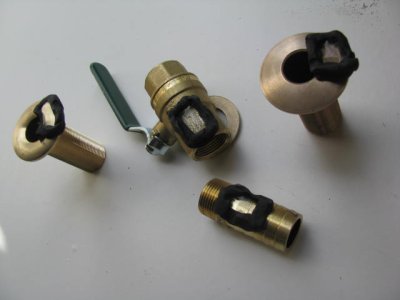
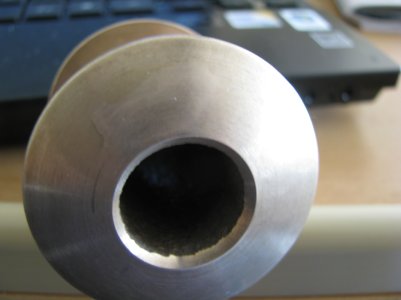
I tested the fittings by forming a small dam with Plasticine on a suitable surface, then pouring in the chemical and leaving for 10 minutes. The hope was that the rectangular shape would be obvious when the dam was removed, but nothing had any effect. Later, I dipped the fittings in the products for up to 30 minutes, with no more success. Photos show the dams on each fitting and the bronze skin fitting after HCl testing once the dam had been removed. No staining whatsoever, same after 30 minutes immersion.

IMG_2145.JPG Bronze no attack.jpg
 
If any one is concerned to long term exposure to any acid you can neutralize the acid by rinsing with a solation of bicarbonate of soda.

I used to use 30 % concentration HCA (pool Acid) and once the gas blue my Henderson Mk 5 sppart and the loosened scale blocked the pipe completely.

The only solution was to beat the hell out of the pipe on my mooring to remove ll the scale
 
Possibly after long exposure but for the purposes of descaling 30 minutes is ample.

More than 10 years ago I researched an article for YM, trying to differentiate between 60/40 brass, DZR and LG2 bronze. I purchased new fittings in these materials and exposed them to a range of household chemicals, these were:
Brick acid cleaner (hydrochloric acid < 10% concentration
Ammonia solution < 5% concentration
Ceramic hob cleaner nitrilotracetic acid
Regular hob cleaner citric acid
Super-powerful toilet cleaner glycolic acid
Kettle descaler phosphoric acid

I tested the fittings by forming a small dam with Plasticine on a suitable surface, then pouring in the chemical and leaving for 10 minutes. The hope was that the rectangular shape would be obvious when the dam was removed, but nothing had any effect. Later, I dipped the fittings in the products for up to 30 minutes, with no more success. Photos show the dams on each fitting and the bronze skin fitting after HCl testing once the dam had been removed. No staining whatsoever, same after 30 minutes immersion.

View attachment 164751 View attachment 164752
I know I am being a pedant but as I said to a greater or lesser extent. People using dilute HCl to clean pipes worry unnecessarily about attack certainly on large fittings like through hulls, the worse that will happen is minor pitting it's never going to disintegrate or disappear in a foaming mass, nonetheless there will be a degree of attack the extent of which is dependant on the bronze alloy, the conditions aeration temperature etc.
 
I know I am being a pedant but as I said to a greater or lesser extent. People using dilute HCl to clean pipes worry unnecessarily about attack certainly on large fittings like through hulls, the worse that will happen is minor pitting it's never going to disintegrate or disappear in a foaming mass, nonetheless there will be a degree of attack the extent of which is dependant on the bronze alloy, the conditions aeration temperature etc.
I think that's being nearly as pedantic as I can be on occasion! Both you and @vyv_cox are right - you are perfectly correct (though a bit pedantic!) when you say there is some effect; Viv is equally correct to say that at the concentrations, temperatures and pressures of a boat's systems, the effect is undetectable (except possibly with a microscope or SEM). Now if we were talking about boiling nitric acid... :eek:
 
I think that's being nearly as pedantic as I can be on occasion! Both you and @vyv_cox are right - you are perfectly correct (though a bit pedantic!) when you say there is some effect; Viv is equally correct to say that at the concentrations, temperatures and pressures of a boat's systems, the effect is undetectable (except possibly with a microscope or SEM). Now if we were talking about boiling nitric acid... :eek:
At least I did quantify my pedantic responses. 😁
 
Anyway the answer to the original question is to use hydrochloric acid in typical supermarket/brick cleaner concentration of 10%.

Pour 25cl at a time into the toilet bowl (protect your eyes), wait still it stops fizzing then a couple of pumps to get it into the pipe. Wait until it stops fizzing (probaby a few minutes for the first dose) then pour in another 25cl. When that stops fizzing (should now be almost immediately), another two pumps to move it along. Repeat until until you have emptied the bottle. But then continue a with a couple of pumps every 5 minutes or so, until you are sure you have completely evacuated everything and nothing is fizzing.
You will normally find that each time you pump, you will get a little bit more fizzing.
 
Top