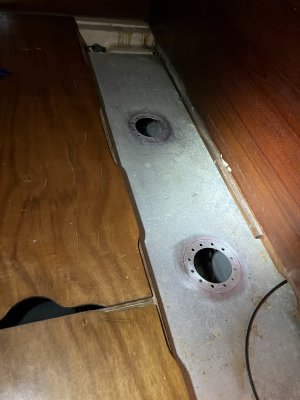
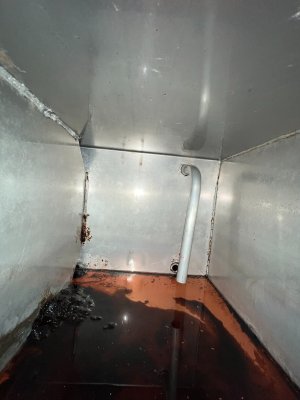
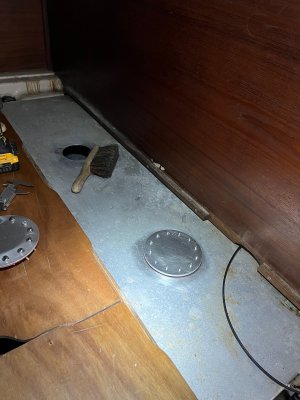
Cleaning diesel tank without an inspection hatch.

potentillaCO32

Well-Known Member
Joined
24 May 2023
Messages
1,039
Visit site
So i have managed to drain the old (at least 5 years) mix of diesel, black squidgy bits and water into 4 gallons worth of black plastic fuel tanks. Probably 1/2 a gallon into the nice clean, freshly painted, bilge as i dropped a bucket of the stuff.

So what is the best stuff to pour into the tank to clean any sludge remaining? Fairy liquid? Or is there a fantastic special product to use to clean tanks?

My basic plan was to pour some cleaning stuff and water down there, let it out after a few hours or days then rinse and let dry. Unless anyone thinks that is not a good idea and just fill with fresh diesel.

Suggestions on product and process welcome.

P.s. not taking the tank out. Anyone who knows contessa 32s knows how hard getting even an arm and head into the fuel tank locker is.
 
I cleaned a jerry can containing old diesel and separated oily residue. Fairy liquid and water given a good shake quickly shifted the residue but it will depend on what your residue is. Bug growth would be harder to shift and a detergent powder may be better but harder to rinse with clean water.
If you are worried about getting the last of the waternout of the tank then add meths or acetone if the tank is compatible. It is miscible with water and diesel and can be used to mop up the last drops.
 
So, it seems that you plan to pour something into the tank, let it sit (because you can't agitate it) and then drain it out.

Does the tank have a drain at the lowest point or is there only a pick up tube at the top for a pump?
If you have a drain you will get 99% of what you put in, out.
With a pick up tube you are left with pumping out of the filler hole if that is the biggest access.
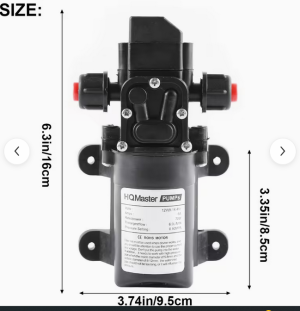
I use a 12 volt diaphragm pump to pump out my engine oil.
It has a semi rigid hose that I can poke around inside the crankcase and pretty good suction, but a slow flow rate.
1777901414922.png

I would be very careful about what to put into the tank to clean the sludge if you are not sure about getting it all out.
Maybe make up a fuel polishing system would be a good move after you clan the tank.
gary
 
So, it seems that you plan to pour something into the tank, let it sit (because you can't agitate it) and then drain it out.

Does the tank have a drain at the lowest point or is there only a pick up tube at the top for a pump?
If you have a drain you will get 99% of what you put in, out.
With a pick up tube you are left with pumping out of the filler hole if that is the biggest access.
I use a 12 volt diaphragm pump to pump out my engine oil.
It has a semi rigid hose that I can poke around inside the crankcase and pretty good suction, but a slow flow rate.
View attachment 210240

I would be very careful about what to put into the tank to clean the sludge if you are not sure about getting it all out.
Maybe make up a fuel polishing system would be a good move after you clan the tank.
gary
There is a drain plug which help hugely.
 
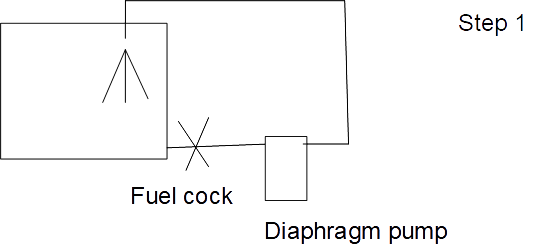
I would do it in three (inexpensive) steps using Chinese components.
As Jake has suggested use diesel fuel.
Step one is to dislodge the contaminants from inside the tank and mix it with fuel.

1777940258954.png

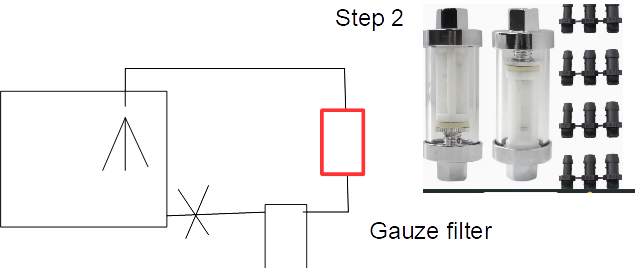
Step two is to remove larger contaminants with a cleanable gauze filter (or two)

1777940658530.png


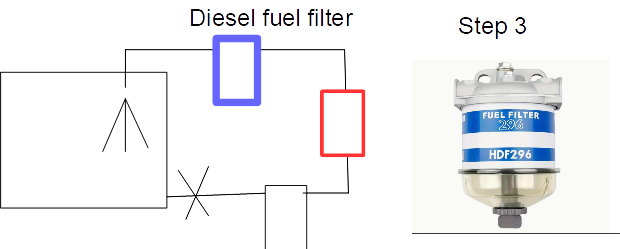
Step 3 would be to fit a proper fuel filter in the loop.
1777940758162.png


gary
 
Can you get a borescope in there?
I also had no inspection hatch, I was able to have a good look around with a scope. I also found that a lint free rag on the end of one of those flexible claw grabber devices was useful for mopping up the bulk of the sludge.
 
I struggled with sludge and bug debris in my tank for a season and the boat ran fine until you were in heavy weather and it was then that the primary filter would block and the engine die. The final straw for me was entering my marina berth and engaging neutral prior to astern to stop the boat and the engine died at that point, making a rather embarrassing clatter as I hit the pontoon dislodging the power outlet stand.

I found no way of cleaning the tank without cutting inspection holes. I say holes as most marine tanks are baffled and single hole would not allow access to the whole tank. Once the holes were cut and the tank drained, I scraped all the sludge out with a fish slice followed by scrubbing with boiling water with fairy liquid. After a few days of drying I wiped the inside out with acetone and never had any issues since.

I was fortunate enough to have easyish access to do this which isn't always the case.

One bit of advice I would give myself if doing it again would be to measure my arm circumference prior to deciding what diameter of hole to cut as lying in the aft cabin with your arm stuck in a tank for 20 minutes wasn't fun.
 

Attachments

  • IMG_2546.JPG
    IMG_2546.JPG
    1.7 MB · Views: 10
  • IMG_2502.JPG
    IMG_2502.JPG
    1.7 MB · Views: 10
  • IMG_2518.JPG
    IMG_2518.JPG
    1.8 MB · Views: 10
I cleaned out a s/s tank with steam from a hired wallpaper stripper. I steamed it for two days and a lot of muck came out so it's an effective way of loosening the sludge. The difference was that I was able remove the tank from the boat and move it into different positions as I steamed it.

You can't do this but steaming might help by loosening the muck, and you can perhaps flush it out with hot water using a hose through the filler tube.

If it was up to me, and it wasn't practicable to remove the tank, I'd consider cutting a hole and fitting an access hatch.
 
I have no access to my tank save the filler hole, so I do this thing of dropping a length of anchor chain into the tank and leaving it for a few days while the boat tosses and turns on the buoy. (It helps if there's a big storm coming.) Then I hoik it out using the bit of string I tied to one end, and recirculate and filter the diesel. Quite a bit of crud comes out this way. Course, I don't know how much is still in there ...
 
I would think that petrol might be a good solvent rather than acetone, in terms of cost, availability etc. With any of these, beware the fire/explosion risk of the fumes. If you subsequently fill the tank with diesel this will expel most of the remaining vapour, and any minor dregs of liquid petrol in pipes or the bottom surface of the tank will, I was advised on here a while back, mix into the diesel without ill effect on the engine.

I am intending to have a go cleaning my own tank. I do have limited access via a small plate in the top of the tank which holds the pick-up tubes for engine and heater, fuel return from the engine, and fuel gauge, but this towards one end of the tank (fortunately the deepest end) and much of it I won't be able to reach by hand.

My aim is just to remove liquid and sludge as far as possible, plus any loose grit in the bottom corner. I am (as yet?) unpersuaded that it will be desirable to try to clean off any solid crud which is attached to the surfaces of the tank. I'm thinking that if it hasn't been washed off by all the violent sloshing about of diesel in the last number of decades it's unlikely to be moving in future.

I am contemplating trying to add an additional permanent pipe to the plate, which would curve down to the very bottom corner of the tank (which is an irregular inverted triangular pyramid shape). This would provide a substitute for a bottom drain - a means of extracting by suction (using a Pela or small hand pump) any water and crud which in future accumulates in the bottom of the tank. I envisage the tube to be in copper, like the existing pipes, and perhaps circa 10mm (rather than the 6mm of the existing fuel supply pipework) to better accommodate any globules of diesel bug. (In an ideal world it could also provide the inlet to a fuel polishing system, but I doubt that will ever happen (and hope it won't become needed!).
 
Top