Choc blocks and rust

I don't, I strip back the wire, fold the stripped wire back over the sleeve and put that into the terminal block with the sleeve side up to the screw, then screw down onto the sleeve.
PS Makes for a good electrical and​ mechanical anti-vibration connection.

I used to do it that way but I use a variation where I push the cable right through to the other side of the block so that both screws are gripping bare wire + the insulation from the other cable.

I've never heard of anyone else doing it this way .... but that's situation normal on the forums. ;)

Richard
 
Choc-blocks are horrible on a boat, and Wagos are little better. In my book, the only way to connect wires is with solder and heat shrink. Chock blocks are Ok for temporary, and test purposes, and that's about it.
 
I used to do it that way but I use a variation where I push the cable right through to the other side of the block so that both screws are gripping bare wire + the insulation from the other cable.

I've never heard of anyone else doing it this way .... but that's situation normal on the forums. ;)

Richard

We've seen your wiring Richard, it should not be used as an example (other than an example of how not to do it) :):):)
 
We've seen your wiring Richard, it should not be used as an example (other than an example of how not to do it) :):):)

Indeed. I know it sounds a bit mad but my logic is that both cables are being clamped by both screws so there's double the physical security. I wonder if it's ever been discovered by anyone else in the world (last 3 words to be spoken in a "Clarkson" voice). :o

Richard
 
Indeed. I know it sounds a bit mad but my logic is that both cables are being clamped by both screws so there's double the physical security. I wonder if it's ever been discovered by anyone else in the world (last 3 words to be spoken in a "Clarkson" voice). :o

Richard

You should apply for a patent Richard :encouragement:
 
I don't, I strip back the wire, fold the stripped wire back over the sleeve and put that into the terminal block with the sleeve side up to the screw, then screw down onto the sleeve.
PS Makes for a good electrical and​ mechanical anti-vibration connection.

That deserves a slap.
The plastic insulation moves under thermal cycling or plain old age and loosens the connection.
Unreliable and a fire risk if there's any current involved.
 
Yes.

It also gives greater and more direct electrical contact area.

Interesting. Thanks Graham.

That's makes 2 of us but maybe others will try it now.

Richard

You two should make sure you both go to the same loony bin :)

Really cannot understand the twisted logic behind these bodge connections.

If you want to put a wire in a connector strip, crimp the correct size ferrule on, then fit it to the connector. Use suitable terminals and connectors. That's it, not need for weird inventions or modifying unsuitable terminals.

I know it's PBO, but the is a limit. You'll be making things out of egg boxes and empty toilet roll holders next and there are no PBO badges :):)
 
You two should make sure you both go to the same loony bin :)

Really cannot understand the twisted logic behind these bodge connections.

If you want to put a wire in a connector strip, crimp the correct size ferrule on, then fit it to the connector. Use suitable terminals and connectors. That's it, not need for weird inventions or modifying unsuitable terminals.

I know it's PBO, but the is a limit. You'll be making things out of egg boxes and empty toilet roll holders next and there are no PBO badges :):)

I think it is time you justified your comments.

My cables have bootlace connectors crimped on the end which, like Richards, pass right through the chic block connector under a similar from the other side. The screws are stainless. They bear on the ferrule. The ferrule bears on its mate. Choc block connectors allow more dense packing than screw terminals and can be cut to length (without ordering specials). They will also fit in spaces which rare tight if necessary.

My zero volt returns are on a copper bus bar using crimped on ring terminals. Guess what - there's corrosion under the ring!

Stop being rude and explain the objections.
 
I think it is time you justified your comments.

No problem with that, see below.

My cables have bootlace connectors crimped on the end which, like Richards, pass right through the chic block connector under a similar from the other side. The screws are stainless. They bear on the ferrule. The ferrule bears on its mate. Choc block connectors allow more dense packing than screw terminals and can be cut to length (without ordering specials). They will also fit in spaces which rare tight if necessary.

My zero volt returns are on a copper bus bar using crimped on ring terminals. Guess what - there's corrosion under the ring!

Stop being rude and explain the objections.

Simple, bodging connectors and bodging connections are both dangerous practice. I see them every day and am continually surprised that there are not many more boats burning to the waterline.

Choc blocks with ferrous screws are a menace.

Choc blocks with no tongues (leafs) under the screws are little better.

Wrapping the conductor under the insulation is even more dangerous.

Not using ferrules is bad practice.

Post #14 "Stripped wire folded back over insulation and fitted as described gives the properties of a solid connection."

Post #21, Richard adds "I used to do it that way but I use a variation where I push the cable right through to the other side of the block so that both screws are gripping bare wire + the insulation from the other cable."

Post #31 you state "It also gives greater and more direct electrical contact area."

Ergo my post #36. The practices described above are all dangerous, anyone suggesting that they are otherwise is sadly mistaken and should not be allowed near electricity.
 
Choc block connectors allow more dense packing than screw terminals and can be cut to length (without ordering specials). They will also fit in spaces which rare tight if necessary.


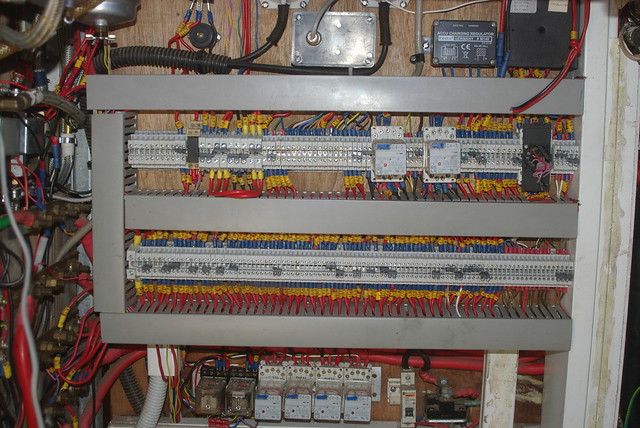
If you want dense packing and proper screw yoke connections use DIN rail mount terminals of the required size which can be mixed and matched. You can even mount relays and other electrical devices on the rails.

The cable can be marshaled and kept tidy with slotted trunking like this and how industrial control panels ad made with wire numbering and crimp terminals, pin or ring.

36086372475_7de02f9d53_z.jpg
 
Last edited by a moderator:
If you want dense packing and proper screw yoke connections use DIN rail mount terminals of the required size which can be mixed and matched. You can even mount relays and other electrical devices on the rails.

The cable can be marshaled and kept tidy with slotted trunking like this and how industrial control panels ad made with wire numbering and crimp terminals, pin or ring.

36086372475_7de02f9d53_z.jpg

Oh no! All my CNC machines are like that and they are a nightmare. (They also have steel screws!). Packed close together and properly tightened they are OK but, if you just want a couple, they are a pain to control. They are something I do know a lot about! They are definitely not for boats (IMHO).

I am sticking with my modified choc blocks. In my experience, they are far from a bodge and have only given trouble when fitted with steel (=rusty) screws.
 
Last edited:
Top