Chines

paulburn

Well-Known Member
Joined
2 Apr 2006
Messages
117
Visit site
Are chines a fashion statement or the shape of boats to come ?

What are the advantages and disadvantages ?

paul

 
If the boat from which they cause aesthetic displeasure might surf or even plane, then maybe a good idea.

If not, then a fashion statement.

Having seriously played with patrol boat hull forms in a towing tank, I can tell you that spray rails are equally effective. Do bear in mind that we ran the patrol boats at zero heel, and then ask how a designer can guarantee the heel angle at which a chine will deliver flow separation.

You already knew that though.
 
I think chines are primarily used in metal boats to enable the hull to be manufactured in either flat plates or in single curvature pieces. Rolling a double curvature onto a sheet is time consuming and expensive and has to be test fitted until it is right. A boat with chines the plates can simply be bent to shape around the structure and welded on.

I guess it also applies to plywood boats.

Ross
 
Claims to increase form stability and provide more area to enourage flat downwind performance. May well have an influence on reducing griping of rudders when wide bummed boats heel. Been used for some time on Thomas designed boats, but caught on recently with some of the big builders in an attempt to improve handling of lighter displacement wide flat bottomed boats. Time will tell if it is a fad or real advance.
 
Are chines a fashion statement or the shape of boats to come ?

What are the advantages and disadvantages ?

paul
I assume you are talking about chines on the quarters of modern round-bilge AWBs, as first seen in cruising boats in smaller British Hunters.

Like the ancient Westerly bow knuckle, first seen on the Centaur, chines aft give a smidgeon more volume inside to use for accommodation. I suspect that making the aft cabin berths less tapered and slightly bigger is a major reason for the trend.

There is also the fact - well known to car makers, that ridges in curved surfaces stiffen the structure, and allow you to get away with slightly less materials for the same overall stiffness. Production boatbuilders are currently working VERY hard to reduce costs and still turn out shiny saleable boxes.

Finally, they may just improve heeled handling in some boats.
 
I used to own a plywood YW People's Boat (sounds very socialist, don't it?) when I was in Hong Kong. She sailed very well and I liked her so much that I seriously considered shipping her back to the UK but it would have cost too much. I bought the plans with the intention of building one here but never did. I disposed of them to someone on this forum a couple of years ago so hopefully he has built one.

The Americans seem to like them (sharpies, they call them). Some of the designs are quite attractive (see books by Howard Chappelle). I suppose there would be more if it hadn't been for the invention of GRP yachts.
 
I was referring to the trend of seeing chines on racing and cruiser/racer sailing boats.

paul

I'm pretty sure the return of chines is all about cost saving.

No mold required, so less set up cost, no mold cleaning and polishing after each hull turn out.

Easy to modify length and width with minimum fuss and low cost.

Speed of production.

And the list goes on.

Good luck and fair winds. :)
 
I'm pretty sure the return of chines is all about cost saving.

No mold required, so less set up cost, no mold cleaning and polishing after each hull turn out.

Easy to modify length and width with minimum fuss and low cost.

Speed of production.
:)

I don't believe it is down to cost.
My previous boat, a Hillyard 8-Ton had hard chines - it is carvel, mahogany on oak construction and I cannot see how the hull design would have presented a saving over a wine-glass contour.
More likely the first owner specified he wanted a flatter shoal draft profile below the water-line for bilge plates with the additional gain of more internal useable space.
The Golden Hind has a similar profile and so (I think) does the Eventide.
 
I also think it isn't cost savings, because they are still laid up in molds.

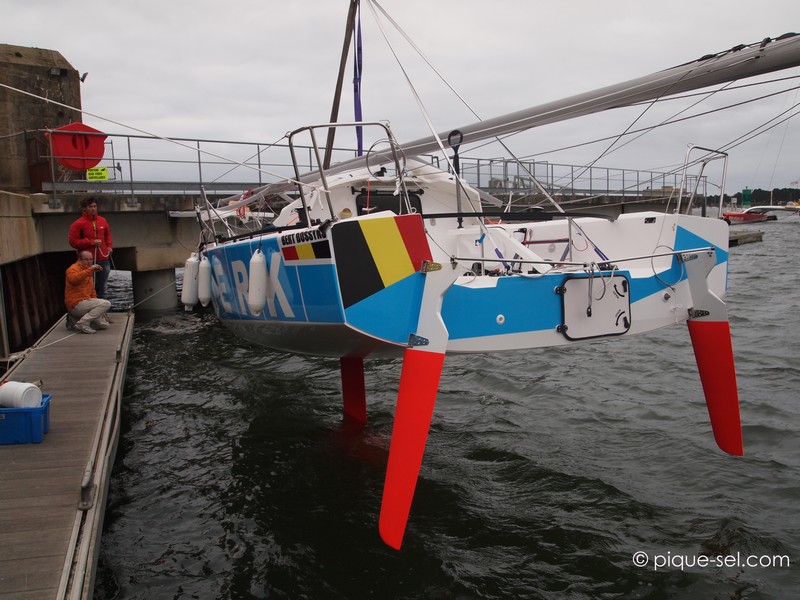
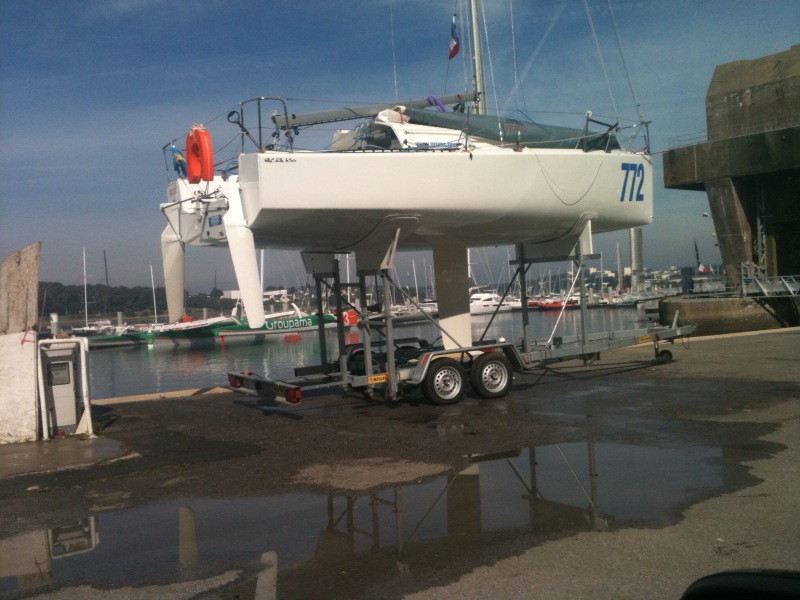
I believe that on race boats the theory is that that - particularly reaching - the boat leans over to a certain angle, then sits on the chine, presenting a flat surface that encourages planing.

mojo.jpg


PC085055web.jpg
 
Last edited:
I don't believe it is down to cost.
My previous boat, a Hillyard 8-Ton had hard chines - it is carvel, mahogany on oak construction and I cannot see how the hull design would have presented a saving over a wine-glass contour.
More likely the first owner specified he wanted a flatter shoal draft profile below the water-line for bilge plates with the additional gain of more internal useable space.
The Golden Hind has a similar profile and so (I think) does the Eventide.

Yes, there is a big difference between "real" hard chine boats and the chines appearing on modern hulls.

Most hard chine designs are designed to be built in sheet materials where it is not possible to create curved surfaces in more than one direction. The simplest forms are something like the Dory - flat bottom, straight sides, designed to be built quickly and cheaply from stock timber, with the additional benefit of being easily stackable.

Hard chine became really popular when plywood became available after WW2 and many designers used the properties of the material to produce boats that could be built without traditional boat building skills. Robert Tucker and Maurice Griffiths were leading exponents of these designs for cruising yachts. Some were ply, some steel and developments were double chine and multichine aimed at reducing the boxiness of the shapes. Similar developments in smaller dinghies and day sailers and still popular today for home construction.

However, in most of these designs chines were for ease of construction, not improved performance, which seems to be the driving force today.
 
More modern designs of International 14 and National 12's,Cherubs, are all planing hulls and designed nowadays with the chines even in GRP;the latter class developed from a clinker form which gradually became flatter in later designs combined with less rocker, almost a paper dart form. The Merlin Rocket class is gradually moving towards this trend also, again in GRP.
Looking at the singlehanded 60 footers's they are basically a dinghy hull scaled up with ballast added.

ianat182
 
first hand experience

I had a GP14, then an enterprise, then an Eboat and now a duck Punt

simple to build of course - although not sure that applies to plastic boats

the chines on the GP and the enterprise were a hang-over from the plywood days

the eboat went brilliantly when loads of wind and sailed flat

when very little wind it also payed to heel it over

but man would it slap in a chop - both on the bottom and the side

noisy boat to sleep on soometimes

the duck punt is all chine of course - no rudder, no centre plate

I think myself that the designers have spotted the inherent beauty of the duck punt and are atttemtping to emulate its graceful lines

mark my word....you will soon be seeing giant oppy rigs and windows below the gunwhale so that people can watch the seals, fish and see if you are sailing too close to the edge

Dylan

 
Mini Transat ??

Dont get sucked into discussions about mini Transat boats and V70's....

Those are as close to a normal sailing boat as an F1 is to a Mondeo.. for a start consider weight... Built entirely of carbon fibre with absolutelly no interrior trim a V70 has the same power to weight ratio as a Sidney Harbour Skiff..... Hence it can easily do 30 kts... But you simply cannot translate that type of weight saving design into a production boat for normal sailing...

Having said that would love a blast on one at full speed...
 
Hard chine became really popular when plywood became available after WW2 and many designers used the properties of the material to produce boats that could be built without traditional boat building skills. Robert Tucker and Maurice Griffiths were leading exponents of these designs for cruising yachts. Some were ply, some steel and developments were double chine and multichine aimed at reducing the boxiness of the shapes. Similar developments in smaller dinghies and day sailers and still popular today for home construction.

However, in most of these designs chines were for ease of construction, not improved performance, which seems to be the driving force today.

All true but in the USA chine boats were being built long before the advent of plywood and WWII. Howard Chapelle devotes a chapter in 'American Small Sailing Craft' to sharpies, flatties, skipjacks, scows and garvies. He traces them back to the 19th century and they were of course planked.

In this country we had the hard-chined spritsail barge for couple of hundred years or more.
 
I think I am missing something. Please Oldsaltoz, how for GRP chined hulls is a mold not needed?

They can be built out of sheets of foam and laminated with a few layers of grp.

Chines are good for planing boats, more stable at speed.
Chined hulls can also have more form stability at some angles of heel. They can also give lift and directional stability when heeled.
Their adoption now may be due to the improvement in foam sandwich techniques of building, as in plain GRP the flatter panels may be less stiff than a curved hull section.
 
Dont get sucked into discussions about mini Transat boats and V70's...

The OP did ask abour racers and cruiser racers ...

And on another thread he did indicate he is about to buy a mini.

I do agree minis and VO70s are not your typical AWB.
 
.........Chined hulls can also have more form stability at some angles of heel. They can also give lift and directional stability when heeled............

Stretching my own 'little grey cells' to the limit, but I remember in the 60s, Alan McLachlan, one of the architects at G L Watson, then in Glasgow, was consultant to the RNLI, and developed the 'ragged chine' hull on the, I think, Arun class lifeboats.

This was certainly associated with stability, as well as speed as another consideration! I believe the RNLI altered his designs, disbelieving his original claims. He had a small mobo on the West Coast, and it certainly went like ****!
 
Last edited:
I am not a big fan of them based mostly on looks, I don't see how you could use any less material, on the contrary you would need extra re-enforcement as a flat surface would be more flexible than a curved one. I also worry about chipping of gel coat on the chines.

Having said that the Ovni i sail on it works very well. The boat feels like it heels a certain amount and sits there very comfortably, you can feel when the boat is over pressed as the chine digs in and its time to reef.
 
Top