Checking the valves on a D2-55 Volvo

asteven221

Well-Known Member
Joined
6 Jul 2003
Messages
1,414
Visit site
This something I have not done for 30 years and back then it was cars!

I want to check the valves on the boat and planned to do the "rule of 9" method, however I have hit on a potential issue where advice is required. I am hoping one of my fellow forumites will have the experience that I don't have and can advise me.

When I put my feeler gauge in to the gap it takes a bit of effort and once in I can move it back and forth. but the issue I have is when I remove the gauge there is a distinct click at the point the gauge comes out from the gap. I get the feeling that the valve spring is being compressed by the feeler gauge. Is that possible? Could the gap be that far out? A pal told me that there is no way I would compress the spring with the feeler gauge. but I am not so sure as I tried compressing it with my finger and it didn't too much effort to compress it slightly.

I have asked the marina to get one of their mechanics to check it out, but after 3 weeks I am still waiting!

Incidentally the feeler gauge is marked 0.203 and the gap spec is actually 0.2 so could the 0.003 make a significant difference?

As always, I am grateful for any advice offered.
 
So its an 8 thou feeler, quite thin. The gauge should pass easily between the valve and the rocker with minimal force. Just the drag from the oil.
Tappets are better slack rather than tight. Err on the slack side if in doubt.
 
Thanks for the info.

Thanks VicS but these guys seem to think the rule of 9's works on a D2-55 which is a 4 cylinder 8 valve engine?


Now you have put a doubt in my mind, so I am more confused on what to do. :).
 
Thanks for the link to the page in the manual. Actually I do have that page, however I don't know how to get TDC after the compression stroke- hence the rule of 9's option. There are timing marks on the engine block, but there are no marks on the pulley. I was expecting to find an arrow or a similar line, but I can't see anything. I would have preferred to do as the manual says, but unfortunately it doesn't explain how to get TDC.

Thanks.
 
Thanks for the link to the page in the manual. Actually I do have that page, however I don't know how to get TDC after the compression stroke- hence the rule of 9's option. There are timing marks on the engine block, but there are no marks on the pulley. I was expecting to find an arrow or a similar line, but I can't see anything. I would have preferred to do as the manual says, but unfortunately it doesn't explain how to get TDC.

Thanks.
TDC is when the either the 1 and 4 cylinder valves are "on the rock", or 2 and 3. So turn the engine over gently (tie the stop lever in the stop position by the way) The firing order is 1 3 4 2
Watch the valves on 1 and 4. You will see no. 4 valves open and close, as you rock the engine back and forth a touch you will see the transition from opening and closing. It is at this point that 1 and 4 are on TDC. I always knew this as the rule of 5, 1 and 4 interacting, 3 and 2 interacting. Turning the engine clock wise brings the next set of valves in to play. So 1 set firstwith 4 rocking , 3 next with two rocking, then 4 with 1 rocking, then 2 with 3 rocking
 
Thanks for the link to the page in the manual. Actually I do have that page, however I don't know how to get TDC after the compression stroke- hence the rule of 9's option. There are timing marks on the engine block, but there are no marks on the pulley. I was expecting to find an arrow or a similar line, but I can't see anything. I would have preferred to do as the manual says, but unfortunately it doesn't explain how to get TDC.

Thanks.
The starting point for you are looking for, for the method described in the manual, is where the valve openings on no4 cylinder "overlap" ie the exhaust valve is just closing and the inlet is just opening

( overlap is "on the rock" as Beneteau describes it )

The long winded way is to adjust each valve one full crankshaft turn from the point at which it is fully open. .......... Involves an awful lot of crankshaft turning

.
 
The starting point for you are looking for, for the method described in the manual, is where the valve openings on no4 cylinder "overlap" ie the exhaust valve is just closing and the inlet is just opening

( overlap is "on the rock" as Beneteau describes it )

The long winded way is to adjust each valve one full crankshaft turn from the point at which it is fully open. .......... Involves an awful lot of crankshaft turning

.
Thats what I said
 
Confusion.
Surely the rule of 9 works on any 4 cylinder engine, firing order 1342 or 1324?
The order or the vales is different
In your old Morris Minor etc where the "rule of 9" applied, they were:-
Exhaust, Inlet, Inlet, Exhaust, Exhaust, Inlet, Inlet, Exhaust.

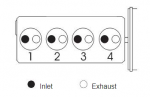
In the engine in question,, and many others, the valve order is alternately Inlet, Exhaust as shown in the link to the workshop manual I posted earlier.

1646339757099.png

ITYWF that with
No 1 fully open you can adjust no 7
No 2 open you can adjust no 8
No 3 open you can adjust no 5
No 4 open you can adjust no 6
No 5 open you can adjust no 3
No 6 open you can adjust no 4
No 7 open you can adjust no 1
No 8 open you can adjust no 2
 
The order or the vales is different
In your old Morris Minor etc where the "rule of 9" applied, they were:-
Exhaust, Inlet, Inlet, Exhaust, Exhaust, Inlet, Inlet, Exhaust.

In the engine in question,, and many others, the valve order is alternately Inlet, Exhaust as shown in the link to the workshop manual I posted earlier.

View attachment 131223

ITYWF that with
No 1 fully open you can adjust no 7
No 2 open you can adjust no 8
No 3 open you can adjust no 5
No 4 open you can adjust no 6
No 5 open you can adjust no 3
No 6 open you can adjust no 4
No 7 open you can adjust no 1
No 8 open you can adjust no 2
Got it. No siamesed ports. Makes a big difference, thanks. Another school day!
 
The order or the vales is different
In your old Morris Minor etc where the "rule of 9" applied, they were:-
Exhaust, Inlet, Inlet, Exhaust, Exhaust, Inlet, Inlet, Exhaust.

In the engine in question,, and many others, the valve order is alternately Inlet, Exhaust as shown in the link to the workshop manual I posted earlier.

View attachment 131223

ITYWF that with
No 1 fully open you can adjust no 7
No 2 open you can adjust no 8
No 3 open you can adjust no 5
No 4 open you can adjust no 6
No 5 open you can adjust no 3
No 6 open you can adjust no 4
No 7 open you can adjust no 1
No 8 open you can adjust no 2

That is a great help. Sorry to be a pain, but can you please clarify if 1 is at the front flywheel end, or at the rear of the engine. Ta.
 
That is a great help. Sorry to be a pain, but can you please clarify if 1 is at the front flywheel end, or at the rear of the engine. Ta.
But not sorry enough ;).......... its in the manual I provided the link for. ....... No 4 Cylinder is closest to the flywheel ......... but puzzled as to which end you call the front.
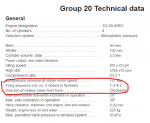
1646663417221.png

In practice, for adjusting the valve clearances, ITYWF that it wont matter which end you count from.
 
Last edited:
It is a convention that No1 is always at the water pump end. Except for air cooled VWs and Citroens, where No.4 is at the flywheel end. Except that Citroen 2CVs only have two cylinders. ?
Suppose the raw water pump and coolant pump are at opposite ends ? :unsure:
 
Top