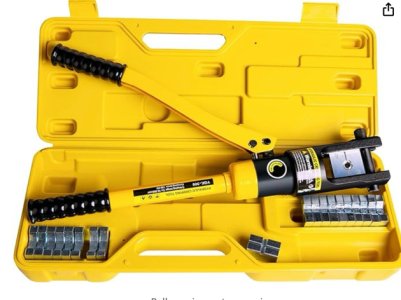
Cheap, hydraulic wire crimpers, any good!

Check your work is the answer. I have seen many sets where the dies are terrible and especially as sizes go up . Many sets I've seen really need you to use one size smaller die to make a good crimp. So check, pull hard on the terminal and give it a good wiggle and if its really secure then good, if not maybe try a smaller die in you set and see if that works better.
 
With the caveat that if the dies in the set don't give a great crimp with the right size die, it's not a great crimp set. On my lever crimps, which are good ones and were nowhere near as economic as the hydraulic (I should have bought the hydraulic), the dies are perfect for the marked sizes and no way could I close them on a smaller one. It's definitely also worth trying looping the crimp round a bolt and seeing if you can haul it off. A good one will probably last longer than the loop on the tube fitting.
 
They're adequate. I have used @GHA's pair and the largest pair of dies don't quite crimp properly - you have to use the next size down; and it's a bit less neat than the correctly-sized ones.
I have had the same experience. Even though the crimp is not quite neat it is still well attached. I used mine without problems on extensive 50sqmm rewiring and also 10sqmm.
 
I have had the same experience. Even though the crimp is not quite neat it is still well attached. I used mine without problems on extensive 50sqmm rewiring and also 10sqmm.
All the other replies saying they work fine if you use good quality crimps, but my crimps are from the local electrical factor (not eBay or AliExpress or somewhere like that) and the same tool works perfectly with all other sizes. I find it very easy to believe that the fault, in this case, is with the dies - they would only need to be a fraction of a millimetre out.
I’ve got that exact set. It’s worked very well but they started to leak hydraulic fluid. I’ve had to top them up and put up with the mess…Not worth buying new ones for the occasional work they do. Maybe I was just unlucky with mine.
Another neighbour in the boatyard had the same thing with his.
 
My preference would be for a good quality hand ratcheting crimp tool. Colour coded (yellow, blue & red) to match crimp terminals. Would be better quality tool than a cheap hydraulic crimper where it looks like you would have guess which size of die to use with a terminal. Probably a bit cheaper and would last longer too. something like Forge Steel Crimping Pliers 9" (220mm) - Screwfix or Minotaur Ratchet Crimping Tool
 
My preference would be for a good quality hand ratcheting crimp tool. Colour coded (yellow, blue & red) to match crimp terminals. Would be better quality tool than a cheap hydraulic crimper where it looks like you would have guess which size of die to use with a terminal. Probably a bit cheaper and would last longer too. something like Forge Steel Crimping Pliers 9" (220mm) - Screwfix or Minotaur Ratchet Crimping Tool
Thanks, Dan. I already have one similar to that, a bit better quality, which gets a reasonable amount of use. I also have the anvil that uses a hammer and brute force on very large cable (when installing boat battery monitor). The hydraulic one I listed fills the gap between those two. Specifically, I need to make a lead with 16mm2 cable.
 
My preference would be for a good quality hand ratcheting crimp tool. Colour coded (yellow, blue & red) to match crimp terminals. Would be better quality tool than a cheap hydraulic crimper where it looks like you would have guess which size of die to use with a terminal. Probably a bit cheaper and would last longer too. something like Forge Steel Crimping Pliers 9" (220mm) - Screwfix or Minotaur Ratchet Crimping Tool
That's perfect for smaller cables. The hydraulic one I have does 10-300mm². I've never used anything above 70mm² though!
 
They are excellent for the money. As others have said, the quality of the connectors/lugs is more important.

There seem to be two common models. The unit pictured in post #1 is fine for most sizes, but if you have larger cables the bigger model (such as the one pictured below) with more dies will accommodate larger wire sizes for not much extra cost (in boat money).

You_Doodle_2024-07-16T20_06_44Z.jpeg
 
Last edited:
But is quite a bit larger to store so smaller might be better on board.
Yes, good point. Hydraulic crimpers are large and heavy pieces of equipment that are not frequently used.

Make sure you buy a model that can accommodate all the required wire sizes. However, if you are storing the crimper on the boat there is no need for a model that can crimp a wider range of wire sizes than you have installed, or anticipate using in the future.
 
Last edited:
Top