Chartplotter in cockpit or Nav station - Opinions

There is a small problem with night vision especially when single handed. I use an autohelm to steer the boat and have the displays close to where I can tweek the heading. I can see the screens from the helm too but not so well. Those displays kill my night vision, making me more dependent on radar and AIS.
I don't know what model(s) of chartplotter you've used, but current models have very good dynamic range - you can turn them down so they're very dim, to the point that more than one thread has been posted on the forum that "the plotter's screen is blank and won't come on, it was fine during the night" (the trick is to put a coat over your head, or just know how to adjust the brightness blind).
 
No one suggested not also looking around you. People are using their plotter software to chart uncharted places and uploading the information to create electronic charts that are far more accurate than paper.
 
Going though the exact same thing now.

Last year I upgraded my electronics and decided to use an iPad as a chartplotter. Great I thought, portable and has everything, navionics, instrument data, AIS. After using it for a while I’ve come to the conclusion the iPad is too fragile in the cockpit and the screen is hard to see in direct sunlight. So, I’m going to fit a chartplotter in the cockpit, Sailing UMA style..
Only thing holding me back at the moment is the price of the bloody charts!
 
Possibly true, but a non-sequitur from my point which was to say that it's good practice to use your eyes to look around you, not spend all your attention on a screen. Charts can be wrong or the surveys very old: it's a bit like delivery drivers turning into fields or into rivers because 'the satnav said so'.
Not sure what your argument is here. Eyes are smashing for the things you can see, but they are famously bad at seeing things which aren't within direct line of sight or which are blocked by things such as the sea. You're right that charts and surveys can be out of date, but they're a darned sight better than using your imagination.
a minuscule one which would be hopeless for radar
But surely better than no radar at all on deck?
 
I have never seen the need for a plotter below if your plotter at helms pairs with your iPad or equivalent. Down below you will on longer passages have your chart on the chart table to plot a position using the read out from the plotter but it’s much easier if you have the device below which as a backup can also run it’s only navionics hence you are not reliant on the chart plotter at helm continuing to function etc. With plotter at helm and 2 wheels one can helm while the other plots etc if preferred of course which helps. When it’s dark and wet you can sit under the hood studying the device if watching ais etc and keeping warmer and dry .
 
Not sure what your argument is here.

I'm not sure I have one really. We're all in agreement that a plotter is a useful thing (I'm not very keen on being quoted out of context, but ho-hum), and I encourage you to put yours anywhere which suits you! If I have a point, it's that I doubt the urgency of seeing the plotter's screen at every moment, as if one were flying a fighter jet at low level and needed the HUD at a closing speed of 600mph. On our sailing boats just go a bit slower, know what you expect to see and take time to look around you. That way, the difference in time needed to glance below or at the screen right in front of you is of less moment, imho, than other considerations about siting the plotter screen. I find it suits me for it to be below at the nav station; you may find it ortherwise. That's fine by me.
 
In fog or at night the difference between seeing the radar in real time and going below, reassessing, making a decision and getting back on deck can make all the difference . A plotter is an instrument designed to give information in real time, not a long term planning tool. I wouldn't mount my wind or depth instruments below for much the same reason. Sailing sideways into Milford Haven (I think it was!) on a strong tide at night I wouldn't want to go below to get course corrections every 5 minutes either, it'd be too late. Seeing the plotter allows the helm to adjust course constantly to avoid rocks and stay in the channel. Without the plotter you'd be lucky to work out your heading let alone how to avoid the unseen rocks below the surface.
As I said in my other post, some boats have no good place to mount one. That doesn't change the fact that on deck is the logical place for it, it just means sometimes it's impractial.
 
Hi Guys,

Currently refitting a new (to me) boat out and wanted to get peoples opinion on chartplotter in the cockpit or the Nav station? The boat previously had the plotter at the nav station but i have to change out the wind and auto pilot controls so considering putting the Garmin in the cockpit with the new controls. The alternative would be to use my Ipad at the cockpit with Navionics linked to a Digital yacht wireless which should give me a lot of the info i need at the cockpit and then the GPS, and RADAR, at the Nav sation. Would save quite a bit of room in the cockpit pod.

Would love to hear peoples experience with either option and the pluses and minuses.

Thanks,

Paul

Too complicated for me to understand. Had a drink and a few sheets to the wind, but nav at helm is the point, as you may have written... just as nav at dashboard in car is needed. Especially if solo.
 
Too complicated for me to understand. Had a drink and a few sheets to the wind, but nav at helm is the point, as you may have written... just as nav at dashboard in car is needed. Especially if solo.
Generally you don't "nav at the wheel" in a car. The "navigation" is done beforehand to plan the journey while the pilotage and feedback are done at the wheel. Plotters serve the same purpose, giving information and a more complete picture at the helm, but the navigation is done beforehand as a preperation exercise (whatever tooling is used). If the MFD suggests your navigational plans are insuficcient it may be wise to "pull over" and make new plans while hove to. In reality most of us aren't doing that sort of sailing so using it like a satnav is more than sufficient. In fact most of us would cope fine with no instruments at all for local trips.
 
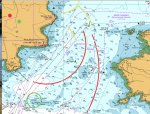
Sailing sideways into Milford Haven (I think it was!) on a strong tide at night I wouldn't want to go below to get course corrections every 5 minutes either, it'd be too late.

Gosh, having sailed into Milford a few times in the days before chart plotters existed I now realise that I don't deserve to live. Which rocks exactly were you worried about hitting? And what speed were you doing? At 6kts it would take ~11 minutes to cross from West Blockhouse to Rat Island (it's over a mile). You had time to make a cup of tea for God's sake!
Screenshot 2022-02-28 at 21.27.34.jpg
 
Last edited:
My mate has his multifunction do everything plotter device mounted below, but its on an articulated arm that swings the screen into the companionway so can be viewed from the helm if required. Its on a 26 foot planing yacht with not a lot of space and for the life of me I've forgotten what make/model the plotter is.
 
There is no doubt that the solution is easier on boats with wheels, where there is usually an obvious place for the plotter in view of the helm. The disadvantage of this is that it is not in view of other crew members or available inside the boat. This can be solved either with a duplicate or use of a tablet.

With a tiller, much depends on the boat and how it is sailed. Some manage with a screen under the sprayhood or on a bulkhead, but neither is ideal, and may be hard for the helm to view or operate. My own solution of a plotter at the chart table and a Graphic repeater with the instruments for the cockpit was dictated by cost and the technology available 20yrs ago. It has turned out to be almost ideal for me in practice, giving me my route information without the need to keep referring to a chart. I also use a tablet as a repeater on rare occasions. On the other hand, I wouldn't dream of trying to tell someone else what they should do, because there are no rights and wrongs. We managed perfectly well, mostly, before plotters existed, and it becomes a matter of choosing whatever arrangement gives the greatest pleasure to you in actual use if you want to fit one.
 
I have a Raspberry Pi behind the Nav station with a 10.1" touchscreen at the Nav Station. I have just bought a 15.6" Daylight readable, IP67 (waterproof) touchscreen for the Helm. it will be fitted once it warms up. the screens will be mirrored and 'Chartplotting' can be done at the helm or navstation or elsewhere and emailed directly to the Raspberry Pi. The Pi reads all my old Raymarine ST1 data (depth, wind, boat speed) and I have an AIS transponder, GPS and a bunch of temperature sensors integrated. Engine sensors will be added next.
 
Gosh, having sailed into Milford a few times in the days before chart plotters existed I now realise that I don't deserve to live. Which rocks exactly were you worried about hitting? And what speed were you doing? At 6kts it would take ~11 minutes to cross from West Blockhouse to Rat Island (it's over a mile). You had time to make a cup of tea for God's sake!
I think it was to the west coming from the Irish Sea but was years ago on a night sail. There obviously are safe ways to do it without a plotter, but those involve a longer passage to avoid the uncertainty in the first place.
 
When you come into an anchorage at 2am in driving rain (thus with strong winds) it is reassuring for the skipper, inevitably at the helm, to have the location of the myriad of anchored yachts, some without anchor lights) clearly located and visually represented on a a screen immediately in front of him, but not too brightly illuminated. (Assumes for sake of argument - the skipper invested in radar). He can change the scale of the display with a twist of a button and switch back again in seconds. He does not need to shout at the lookout on the bow and can deploy the anchor with the flip of a switch. He knows exactly when the anchor touches the seabed, as he has the precise depth in front of him (or her). They know exactly if they have drifted back during deployment - its all displayed, to the nearest metre. Try using that precision running up and down from the confines of the chart table......

Just one example (and how to mention an anchor in a thread on MFDs :). Navigating up a winding, tight, river would be another example - but might not need an anchor :(.

7" screens are fine - you can ramp up or down the scale - you might lose the bigger picture but you don't actually worry about what is happening 20nm away when the unlit rock is 'somewhere' 50m ahead - but clearly marked on the screen, well. charted, and a red blob, radar.

The ideal of course is the tablet connected wirelessly, water proof case (just in case) etc etc - and then you can make the morning toast and a fresh pot of coffee to greet the owner (or wife) when she comes on watch - you have maintained watch, made toast, coffee all in the confines of the galley

and proved men can multitask (if strongly motivated). :)

7" MFD at the helm. save your money and invest the rest in a decent tablet (iPad Pro)- which truly is a MFD and does so much more, emails, websites and games for the grandchildren.

Jonathan
 
Last edited:
Most private yachts I've sailed over the past, say, 15 years, have plotters, when fitted, in the cockpit. Makes perfect sense for ease of use. Plus with modern reliability, for safety too.

Things I've seen though that can kinda spoil the day.
A boat that didnt take care in a gybe, main sheets wrapping round the plotter, bye plotter.
A crew member falling in the cockpit and putting a knee through the screen.
Careless with a winch handle, same result.

Rare incidents indeed, but how to live without one is useful knowledge. :)
 
I can add my two-penneth without fear of being hauled ashore and slung in leg-irons! Boat sold in 2020:(
On my oldish 9m (Javelin) I sailed almost entirely single handed and therefore tried to avoid "going below" for most reasons/needs.
I constructed a simple swivelling mount for the plotter which could be clipped into place for viewing from the helm (tiller) or turned 180 degrees against the bulkhead to face the chart table.
Worked perfectly well. Perhaps a bit "Heath Robinson" but "handsome is as handsome does", IMHO - and cheap;)
 
Last edited:
Personally, I don't need a screen viewable from the helm because in order to use it I would have to get my reading glasses out and peer at it before extracting any information. My nav information is displayed in medium-sized figures on an instrument showing up to four parameters. I can use my iPad in the cockpit but rarely do, becuase it is hard to read, not waterproof unless in its case, anad prone to getting dropped or lost. It also overheats in the sun.
 
I think there are lots of people not using plotters. They perhaps don't see the need at the present time. It does seem to depend on the kind of sailing you do and type of boat/steering.

I use a GPS with waypoints and routes with notes on a pad , covered with clingfilm. These
contain clearing/ back bearings info any tacking angles etc. I use a chart spread out below with a Breton plotter using bearing and distance from the GPS to see where I am.

I purposely do not sail in darkness unless it is somewhere I know. I think that is where a plotter will really earn it's money and will probably have a much more up to date chart. Also, if you had to divert at night time to an unknown port or bad weather. Having said all this I do have a tablet and phone containing MX Mariner but have not used them yet. With my 26' boat I don't think there is a place where I could site it in the cockpit.
 
Our plotter (when in use) lives under the sprayhood and radar just inside the companionway where it can be seen from helm and operated from cockpit. Sailing short handed, we want to see everything without having to go below. Having either at nav station without repeaters would be pointless.
 
Top