

You are using an out of date browser. It may not display this or other websites correctly.
You should upgrade or use an alternative browser.
You should upgrade or use an alternative browser.
Charging a 12v battery from another 12v battery?
- Thread starter Skylark
- Start date

Alicatt
Well-Known Member
The voltage is a bit high on that device.
should be looking for around 13.8V output from the device to charge your battery
Something like this but I think the output current is a bit high.
Amazon.co.uk
PaulRainbow
Well-Known Member
No, that's putting out 19v. Technically, a DC-DC charger would be best, but expensive. Refueler seems to have a solution with the RC stuff, of which i have no experience.
Kelpies idea of two batteries was a good suggestion, but has the drawback that it doesn't charge the car battery, it just increases the time before it goes flat.
Using both ideas seems a good solution to me.
Kelpies idea of two batteries was a good suggestion, but has the drawback that it doesn't charge the car battery, it just increases the time before it goes flat.
Using both ideas seems a good solution to me.
PaulRainbow
Well-Known Member
I've used a few of these on my own boats : 300W 10A DC-DC XL4016 Step Down Buck Converter Power Module 1.2V-35V Output Volt | eBayThe voltage is a bit high on that device.
should be looking for around 13.8V output from the device to charge your battery
Something like this but I think the output current is a bit high.
Amazon.co.uk
Adjustable voltage and current, but i always leave the current at max, wouldn't hurt the battery as it will only take what it needs. You could try it at float voltage of 13.4v, safe enough.
I'm always wary of cheap imports, but i've been using these for several years and never had one give a problem. Just in case though, i wouldn't use one in a mission critical application or use it to power expensive electronics.

billskip
Well-Known Member
Yes I would feel reluctant to connect 19v to the car, it possibly wouldn't do the new alarm system any good even if the car is old and basic electric.The voltage is a bit high on that device.
should be looking for around 13.8V output from the device to charge your battery
Something like this but I think the output current is a bit high.
Amazon.co.uk
Your suggestion of same device but 13.8v output would be ok...the battery demands the current it needs I would think there is more of a problem with under rated current output causing the unit to be overloaded.
billskip
Well-Known Member
I still dont understand why the load.. eg alarm..isnt isolated with a latching relay operated by the n/c door switch....no drain on battery and alarm protection if door /boot is opened.

Refueler
Well-Known Member
I still dont understand why the load.. eg alarm..isnt isolated with a latching relay operated by the n/c door switch....no drain on battery and alarm protection if door /boot is opened.
Because he says Insurers have insisted on a Cat 1 Alarm :
"Category 1 alarm will feature perimeter and ignition detection, and incorporate movement, glass break and/or tilt sensors."
Not exactly just door entry.
Personally - I'd be looking for another insurer ..... if the car is inside a lockup ....
Refueler
Well-Known Member
No, that's putting out 19v. Technically, a DC-DC charger would be best, but expensive. Refueler seems to have a solution with the RC stuff, of which i have no experience.
Kelpies idea of two batteries was a good suggestion, but has the drawback that it doesn't charge the car battery, it just increases the time before it goes flat.
Using both ideas seems a good solution to me.
The DC-DC unit would be better because it will restart when voltage drops ... but the RC charger - although a better charge unit - will reach charge or max time and stop charging. It does not restart when voltage drops ...

Skylark
Well-Known Member
Thanks again to all for the additional input, much appreciated.
I have no problem with getting a Cat 1 alarm fitted (due to be installed on Monday), it's something that was always on my list of jobs.
I already have hardware to try
(1) fully charged additional battery, 800W inverter, 240v mains charger, either 8A or 1A versions available.
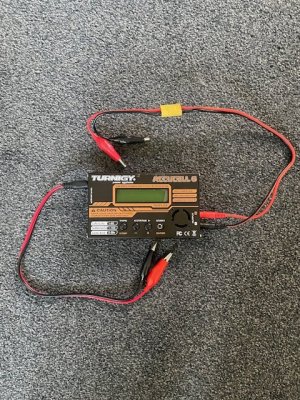
(2) Turnigy model aero DC to DC charger. I'll try this at home first. Current can be set, I'd only use low current looking at the size of the leads.
I have no problem with getting a Cat 1 alarm fitted (due to be installed on Monday), it's something that was always on my list of jobs.
I already have hardware to try
(1) fully charged additional battery, 800W inverter, 240v mains charger, either 8A or 1A versions available.
(2) Turnigy model aero DC to DC charger. I'll try this at home first. Current can be set, I'd only use low current looking at the size of the leads.
PaulRainbow
Well-Known Member
That's a bad idea. The inverter will have a current draw whether it's in use or not. So even if the charger is on float it will waste some power, typically around 0.5a. That will flatten the donor battery in a few days, even if it wasn't charging.Thanks again to all for the additional input, much appreciated.
I have no problem with getting a Cat 1 alarm fitted (due to be installed on Monday), it's something that was always on my list of jobs.
I already have hardware to try
(1) fully charged additional battery, 800W inverter, 240v mains charger, either 8A or 1A versions available.
Does Refuelers post #48 relate to this charger ?(2) Turnigy model aero DC to DC charger. I'll try this at home first. Current can be set, I'd only use low current looking at the size of the leads.
billskip
Well-Known Member
I tend to agree....this seems like chasing perpetual motion....That's a bad idea. The inverter will have a current draw whether it's in use or not. So even if the charger is on float it will waste some power, typically around 0.5a. That will flatten the donor battery in a few days, even if it wasn't charging.
Most of these gadgets uses are suggested in advertising to sell to people that think there is more advantage," that's a good idea I need one of those just in case"
Whilst I understand the op concerns for security...inconvenience to maintain it is not going to be easily reduced
Refueler
Well-Known Member
That's a bad idea. The inverter will have a current draw whether it's in use or not. So even if the charger is on float it will waste some power, typically around 0.5a. That will flatten the donor battery in a few days, even if it wasn't charging.
Does Refuelers post #48 relate to this charger ?
Yes it does ... he has same charger as I have .... user programmable ... Accucel 6
Refueler
Well-Known Member
As others here say - FORGET inverters .... very bad idea .... residual current draw regardless of whether load or not.
The Accucel 6 - will have a residual charge if left connected of course but basically only display ... but you would be disconnecting it anyway once battery charged.
So IMHO .... best is the DC to DC converter with user set UP / DOWN limits .... cheap as chips of Banggood and other online sellers ... small ... compact ... easy to use. Does the job. Yes it will have a small residual current draw to monitor the batterys ... but its tiny and anyway - you would be swapping out donor battery at times to maintain ...
If no DC to DC - then second best is the Acc 6 charger ....
The Accucel 6 - will have a residual charge if left connected of course but basically only display ... but you would be disconnecting it anyway once battery charged.
So IMHO .... best is the DC to DC converter with user set UP / DOWN limits .... cheap as chips of Banggood and other online sellers ... small ... compact ... easy to use. Does the job. Yes it will have a small residual current draw to monitor the batterys ... but its tiny and anyway - you would be swapping out donor battery at times to maintain ...
If no DC to DC - then second best is the Acc 6 charger ....
Skylark
Well-Known Member
Thanks, Paul, appreciate your input.That's a bad idea. The inverter will have a current draw whether it's in use or not. So even if the charger is on float it will waste some power, typically around 0.5a. That will flatten the donor battery in a few days, even if it wasn't charging.
I’m pretty confident that the single 45 AHr LA car battery will be fine for about a month without any attention. The load from the alarm is small. This is based upon long experience with my other car. The only difference is that my home garage houses the boiler within so will be warmer, the lock-up will undoubtedly be colder.
At home, a few hours with an 8 amp multi stage charger and the battery is topped up for another month.
Hence my plan is to charge once per month at the lock-up (there is no mains, hence my OP). I do not want to leave the second battery permanently connected.
Does this change your view?
PaulRainbow
Well-Known Member
How many hours would you be at the lockup on your monthly visit ? It might work with the inverter if you are there long enough.Thanks, Paul, appreciate your input.
I’m pretty confident that the single 45 AHr LA car battery will be fine for about a month without any attention. The load from the alarm is small. This is based upon long experience with my other car. The only difference is that my home garage houses the boiler within so will be warmer, the lock-up will undoubtedly be colder.
At home, a few hours with an 8 amp multi stage charger and the battery is topped up for another month.
Hence my plan is to charge once per month at the lock-up (there is no mains, hence my OP). I do not want to leave the second battery permanently connected.
Does this change your view?
But, you will be heavily cycling the car battery, if it dips below 50% a few times it'll be knackered by the end of Winter.
I don't see a downside to leaving the 2nd battery connected to the car via a DC-DC converter.
Skylark
Well-Known Member
Thanks, again, Paul.How many hours would you be at the lockup on your monthly visit ? It might work with the inverter if you are there long enough.
But, you will be heavily cycling the car battery, if it dips below 50% a few times it'll be knackered by the end of Winter.
I don't see a downside to leaving the 2nd battery connected to the car via a DC-DC converter.
The lockup is quite literally a 3 minute walk from home.
I’d be happy to connect battery/inverter/charger and walk away for a few hours. Monitoring second battery to prevent <50% SoC is understood.
Nevertheless, I think that I’ll go ahead and buy one of your linked DC-DC converts as I can see an advantage to leaving a 2nd battery connected, removing it and topping up its charge once per month at home.
Appreciate your counsel, thank you
