Change to LifePO4 - Emergency engine starting ?

Hmm, good question. I also say no for the following reasons, but it would be a good test to do. It does raise some questions about configuration & fusing if considering emergency use.
Our LiFePO4 BMS is rated at 200A. No idea if it has a peak load of not, but that indicates it won't work for a starter motor due to the inrush current. It's probably around 1kW on a big engine, and 500-700W on a typical yacht engine.
We have a 350A fuse (cable protection) on our domestic side. Even if the BMS could handle the peak load, the fuse would do it's job and blow.

My 'napkin' thoughts are that, assuming the BMS could handle the inrush, an emergency parallel system could be something as rudimentary as jumper cables as there would certainly need to be a way to bypass the fuse temporarily. If the BMS can't handle the inrush then some kind of soft-start system may be needed to help out, but this would add complexity and more failure links into an emergency system.

My takeaway - I will keep a jump pack on board in case the start battery goes flat. We have a 50hp diesel and sails, so should be able to figure something out if needed.
 
Ive done it on my md2040 and it works fine with 1x 300Ah 12V.
Whether yours will work, who knows. I’m going for yes.
 
The BMS is usually the limiting factor rather than the cells. That’s because most of them use MOSFETs to control the battery connection. The cells themselves will be fine with short duration high current discharge. For example Envision 305Ah cells have a continuous discharge current of 0.5C, but a 30s discharge of 2C or 610A. There are other cells such as Winston which can discharge at 3C constantly with a 10C peak.

There are BMS which use a contactor rather than MOSFETs so can use the full discharge capacity of the cells but most prepackaged batteries do not use them.

If it was a real emergency then jumping directly from the cells and bypassing the BMS would work and is unlikely to do any long term damage, but again in a prepackaged battery that might not be possible.

Jumping directly between batteries and leaving it for a few minutes or so will likely provide enough to the starter battery to get the engine running assuming the start battery isn’t completely knackered and is just at a low state of charge.

You do run the risk of damaging the MOSFETs if the inrush current is huge though so it might be an idea to measure the normal starting current of the engine with a clamp meter so you have an idea of what you are dealing with. It might not be as high a current as you think.
 
Assuming your BMS is the 200A continuous:
JK-B2A8S20P. 200A cont 350A peak
I've seen the "peak" described as for 2 minutes.

Also a new similar footprint 300A version is now available:
JK-B2A8S30P. 300A cont, 450A peak

I have a 12V 314Ah EEL kit with the JK 200A BMS and carry a 300A BMS as spare.

I have a BEP 1-2-both to select house or starter to power my windlass and also doubles as "both" emergency link. 1000W windlass has no issues of the lithium house (60 Amp continuous),
 
Not answering the original question but is adding another engine start battery an option?

Our boat used to have one standalone engine start battery with the other engine using the domestic battery bank and with a link between the two. I was always a little concerned that in the event that our domestics ran down (eg when at anchor or swing mooring for a few days) we might have problems with engine start. As a consequence, when we increased the capacity of our domestic battery bank we also re-wired so that each engine has its own start battery and we changed the link so that it would connect the two engine start batteries. We have a split charger so the alternators keep the lot topped up and our AC battery charger also does all three banks. Keeping the domestic bank away from engine start just seemed a better solution to me.
.
 
Not answering the original question but is adding another engine start battery an option?

Our boat used to have one standalone engine start battery with the other engine using the domestic battery bank and with a link between the two. I was always a little concerned that in the event that our domestics ran down (eg when at anchor or swing mooring for a few days) we might have problems with engine start. As a consequence, when we increased the capacity of our domestic battery bank we also re-wired so that each engine has its own start battery and we changed the link so that it would connect the two engine start batteries. We have a split charger so the alternators keep the lot topped up and our AC battery charger also does all three banks. Keeping the domestic bank away from engine start just seemed a better solution to me.
.

I agree this is the “best” solution in my mind.

1 start battery per engine with the engine’s respective alternator charging it.

Parallel switch to join them both together if necessary in emergency (if one alternator packs up etc).

Then have dc/dc converters from both start batteries to a lithium house bank.

Ideally then have a smallish AGM battery powering critical loads that’s fed by a dc/dc float charger from the house bank but with a switch to feed it from an engine battery, so even if your main house bank goes down you still have emergency lighting and VHF / GPS etc.
 
The BMS current limit will have a time delay characteristic and as it is electronic, it could be quite short. The motor will have a short initial current of about 6 times the running current until it is up to speed.. Where the falling motor current intersects with the BMS limit will determine whether the BMS will cut out.
Without details of the BMS characteristics and a scope on the motor current it is impossible to guarantee the result.
All fuses and MCBs have published time delay characteristics so you can match them to the load so perhaps a BMS should have the same information and maybe an option to allow a short delay before cutting out. I assume that the emergency engine start packs must have been designed to allow a short peak current before cutting out.
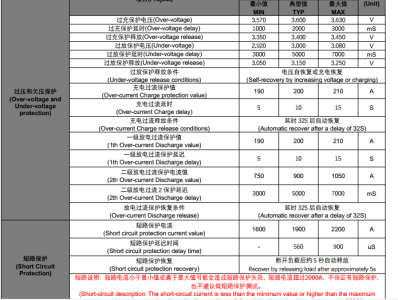
I have no experience of these installations but found the following from a Fogstar BMS
1759842969496.png
It looks like the delay is of the order of seconds for a reasonable overload so I think the engine would start.
 
Well here is an interesting thing. My boat has had seperate NH00 fuses for alternator, windlass and starter motor since it was built in 1980.
The starter motor is rated at 6.5kw, 24v isolated type. its a 4.4L diesel. I don't know why it's such a big starter motor but that's what the specification says. I hwve taken the part number and looked up the specification and it does tally with the Perkins spec sheet.
NH00 fuses are limited to 160A maximum in that size fuse holder. I just checked the fuse and it's 160A gG. It's not even specifically rated as a motor fuse.
It's quite possible that my pair of 24v 280Ah lithium batteries will start the diesel engine through the pair of 200A BMS. They can take 350A for a short duration so I have 700A to play with at bms level and an inline fuse of 160A.
I can only think that the starter motor is massively over specified and never pulls anything like the motor rating even with the inrush load.
I know these starter were fitted to trucks so I am assuming they were used to start some pretty hefty engines.
I just did a search for what trucks the starter motor was used on. It appears they went in to Perkins Phaser engines between 4.0L and 7.0L. I guess my starter gests an easy time starting a 4.4L
 
Well here is an interesting thing. My boat has had seperate NH00 fuses for alternator, windlass and starter motor since it was built in 1980.
The starter motor is rated at 6.5kw, 24v isolated type. its a 4.4L diesel. I don't know why it's such a big starter motor but that's what the specification says. I hwve taken the part number and looked up the specification and it does tally with the Perkins spec sheet.
NH00 fuses are limited to 160A maximum in that size fuse holder. I just checked the fuse and it's 160A gG. It's not even specifically rated as a motor fuse.
It's quite possible that my pair of 24v 280Ah lithium batteries will start the diesel engine through the pair of 200A BMS. They can take 350A for a short duration so I have 700A to play with at bms level and an inline fuse of 160A.
I can only think that the starter motor is massively over specified and never pulls anything like the motor rating even with the inrush load.
I know these starter were fitted to trucks so I am assuming they were used to start some pretty hefty engines.
I just did a search for what trucks the starter motor was used on. It appears they went in to Perkins Phaser engines between 4.0L and 7.0L. I guess my starter gests an easy time starting a 4.4L

If you look at the datasheet for a typical 00 you can see that it will actually take way more than 160A.

For instance, it can take 500A for 10 seconds and over 1000A for 100ms

On a typical engine starter motor, the inrush current might be 10x more than the normal current. So even if your starter drew 1000A for 50 milliseconds the fuse still wouldn't blow.
1759845546408.png
 
If you look at the datasheet for a typical 00 you can see that it will actually take way more than 160A.

For instance, it can take 500A for 10 seconds and over 1000A for 100ms

On a typical engine starter motor, the inrush current might be 10x more than the normal current. So even if your starter drew 1000A for 50 milliseconds the fuse still wouldn't blow.
View attachment 200409
Thanks. I never bothered to look at the time/current graph. Interestingly, the gFF fuse is fast blow compared to the gG that is on my starter. My fuse will blow even more slowly.
 
It wouldn't be a flat engine battery for very long once the parallel switch was turned ! It would have the quickest charge of its life I expect.
A couple of people have suggested this, but a LFP battery at 80% SOC is only at 13.3V, that's less than the normal float voltage of a LA battery, i'm not sure it would do any fast charging.
 
I think you have to try it and see.

My guess is that your lithium batteries would start a yacht-sized engine, but a 7-litre engine is going to be marginal.

One consideration is that even if it works, the stress on the BMS is such that repeated attempts may ultimately damage this component.

It is a common problem and there are many solutions, including some intriguing new options such as using ultra-capacitors or LTO lithium in the starting circuit.
 
Last edited:
Just spent half an hour typing a reply and when i hit the post button it vanished, Grrrrr

Will retype it tomorrow, but thanks to all who replied so far.
 
yeah it's probably only 50ms or so. does that mean it started ok then?
No, the BMS instantly shut down.

I have it sorted now though, will post details tomorrow (see post #37). I've been using the LFP setup for just over a year now, using an experimental LFP/LA setup in parallel, which worked surprisingly well in most respects, despite wht you'd read on the internet. But i've finished what i wanted to do with that and removed the LA batteries, fitting a new Victron XS1400 DC-DC charger. This just left me with the issues of emergency starting and an emergency backup for domestic systems in the event of an issue the with LFP batteries or BMS.

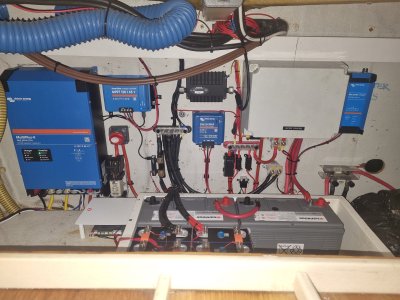
This is the completed system. The battery box has a GRP lid with the blue ducked fitting in the top of it for ventilation. the battery temps are usually circa 20 degrees C. Oh, there's also a Victron Cerbo just out of shot on the left.


20251006_174631.jpg
 
I'd change the electrical system.
My view is that the starter battery should only be used for starting. Normally this will only take a few joules of energy ( a fraction of a kWh or a few amp hours .... which isn't really a unit of energy unless you know the voltage)
I connect all the charging circuits to the LiFePO4 battery bank, through appropriate charge controller and fuses). Because LiFePO4 batteries are far more effective at storing energy that lead acid.
The starter battery is charged by a B to B with the correct charging profile. That way the starter battery is always fully charged. The single point of failure is the B to B.
This can always bypassed with a mechanical switch, which brings you back to Paul's original question. The answer to which is it depends on the specific electrical system he has installed. There's no general answer to the question.
It's a how long is a piece of string question.
However, by using a B to B to charge a dedicated starter battery, you are much less likely to have a "dead" starter battery.
For the record, I have 4 @ 105 amp hr at 12v LiFePO4 batteries, connected in parallel. Each battery has an internal BMS which limits the maximum discharge current to 200 amps, so 800 amps total.
 
Top