Cast iron keel leading edge repairs

Bradders

Well-Known Member
Joined
11 Sep 2005
Messages
113
Location
Duxford,Cambridgeshire
Visit site
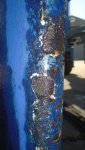
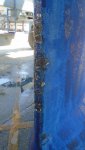
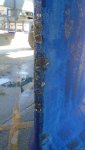
I have a cast iron keel that needs some attention, its on a Jeanneau 44 and the damage is on the leading edge of
the keel - does anyone have any advise on what grinding disk/flap disk to use and what filler and primer would be the most suitable, any advice would be most welcome

Thanks in advance

1619463374931.jpeg


1619466122026.jpeg1619463374931.jpeg
 

Attachments

  • 1619463398094.jpeg
    1619463398094.jpeg
    747.6 KB · Views: 2
We've recently tackled the rusty cast iron keel on our Jen 42'. A lot worse than that and ultimately it required blasting back to bare metal, re-coating with a zinc-phosphate based epoxy primer, filling/fairing, epoxy barrier coating, etc.

From this, I can certainly convey a few pointers we came across:
what grinding disk/flap disk to use
Flap discs (of 'fibre' sanding/grinding discs) can be used - but they have the potential disadvantage of 'polishing' the rust beneath and not actually removing all the corroded material as a result. It is amazing how sanding will polish rusty cast iron to a misleading silver colour! Flap discs also have the added disadvantage of being quite expensive! But people report using them to good effect for this...

The 'best' tool might be an old fashioned welder's chipping hammer. It will knock all the flakes and pits of rust off - that might otherwise be missed by sanding.

We also used a combination of twisted knot style wire grinding wheels - try to go for the type that look like a wheel, rather than a cupped-brush (as the former is better at chipping/throwing off the rust). However, all wire/metal tools have a potential disadvantage of contaminating the surface with small particles of dissimilar metal that might lead to further corrosion.

Therefore, instead of the wire grinder attachments, the nylon/'poly' preparation discs (the black 'non-woven' fibre type) can be good as they are a) rough enough not to polish the rust and instead to throw the chunks/flakes off the surface, but b) non-metallic so cannot further contaminate the surface.

what filler and primer would be the most suitable
I wouldn't be tempted to fill before priming, as many fillers (inc. thickened epoxy) can hold moisture and this may lead to issues later. 'Microballoon' or low-density fillers are particularly bad at this and you don't want anything on the surface of the metal than can hold moisture.

Once the metal is clean of rust, you may wish to use a rust converter. Try to find/use the chemical ones (that are washed off after) rather than the silicone-based ones (that claim to also be 'primers' - but don't be fooled, they aren't, and offer poor adhesion).

Either way, an epoxy-based primer - ideally one with an anti-corrosion additive like zinc phosphate - is the best to apply straight to the metal. We used Jotun Penguard Express ZP (the ZP = zinc phosphate). We applied 5 coats!

On top of the primer, you can then use your choice of filling/fairing compound. Just remember that the filler may need to be sealed itself with a barrier coat (more epoxy primer/resin). This is advised by West and others because fillers can be porous. Again, you don't want porous things on that casting!

Finally, a tie coat (such as Vinyguard or Primocon) is a good idea before antifoul.

If the boat has just been lifted (you can see what looks like a travelhoist in the photo) bear in mind that the cast iron itself is porous and may need a few weeks to dry out. If possible, clean the rust off first and then get on with something else for a while to see whether it leaches out any additional moisture.

At the end of the day, the 'damage' is minor and actually mainly cosmetic. Some may tell you to use a cheap rust converter, vinyl primer, antifoul and go sailing. That's fine! But that way it will be back... It really just depends what you want to achieve.

Good luck!
 
Last edited:
Unless you're going to do the full bhuna and get it blasted, I'd be inclined to go over with a needlegun rather than a chipping hammer, treat with anti-rust unction of choice(Vactan, Hydrate 80, etc), then primer and fill; Dan has covered most of the bases already.
 
Top