
Mark-1
Well-Known Member
I've just made a mental note to check my lock nuts. I suspect I might not be the only one. 


VisuallyYou are welcome to come and see my rigging. All pairs of stays were checked before they were installed, they were perfect. I use a digital caliper between the end of the swaged screw thread and the rigging screw on each pair to ensure the mast is perpendicular. How else would you know that the mast is upright?

That happened to me, I think in Warsash, back in the 80's...a convoy, three cars and runabouts on trailer, I arrived first and drove onto the slip beach, tide was out, and did a U turn which took me off the hard into the putty.all fine till he got near the waters edge and found car sinking into the water logged sand ... needed another car - 4x4 - to rescue him and trailer.
At least we have memory's and tales to tell, unlike those that are so perfect....We were all newbies once, don't be so harsh on them.

How does using a halyard make any difference to using a tape if one wants to check if the 2 dimensions are the same?We hoist a tape measure up the mast to check it’s perpendicular to the boat. Regularly, as it’s a one design race boat. People do just use the halyard, find on a cruiser where you’re not worried about a few mm.

Plenty of ways. Halyard locked off and measured to each chainplate is the easy way. Sighting up the mast track is also very important. Do that at rest to check it's straight when at the dock, but also do it when sailing upwind with everything trimmed correctly to check that the mast is still in column when actually sailing. If it isn't then the balance of your lowers and caps is out.You are welcome to come and see my rigging. All pairs of stays were checked before they were installed, they were perfect. I use a digital caliper between the end of the swaged screw thread and the rigging screw on each pair to ensure the mast is perpendicular. How else would you know that the mast is upright?


I once bought a 4 year old car for £3000. It looked fine and was cheap so I bought it.Pal of mine had his car roll down a slip and ended up with seawater past the sills .... when he claimed on insurance - their reply was "Write Off" .. and explanation that any work to re-instate the car was most likely wasted effort as the seawater would have started corrosion.
Because the difference you are looking for once the mast is rigged is well inside the margin of error you had in measuring an un-tensioned stay of say 10m or more before you rigged it. Not to mention the question of if the mould your boat popped out was exactly to the mm symmetrical, and if your mast is exactly in the middle of the boat, or if your spreaders are exactly the same length, and mounted in spreader brackets that protrude exactly the same amount from the mast each side. And then are your chainplates mounted exactly equally on a vertical plane... etc etc.If you know the stays are of equal length what is the point of either, halyard or tape? Perhaps discontinuous rigging might introduce differences?
At least we have memory's and tales to tell, unlike those that are so perfect....
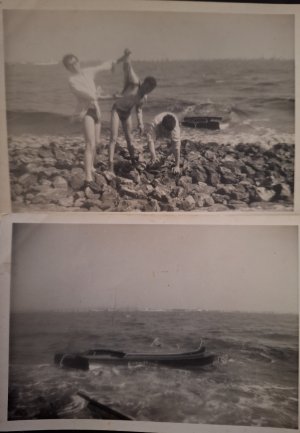
Back in the 50's, I had to replace a few strikes after this.....
View attachment 177918

Did it have a towbar ?I once bought a 4 year old car for £3000. It looked fine and was cheap so I bought it.
After about 5 years the rear wheel arches were rusting, not something you see often on that make, and by the time I had it 10 years, it failed an MOT on a rusted sill. I got it patched up and then started looking for my next car.
I strongly suspect it might have been used for boat launching and dunked in the sea, but it was cheap enough when i bought it that it was a cheap car for the 10 years I had it. I would love to have known the back story.
I was very young....tiz me in the middle...but I remember it well..Isle of Grain just past Allhallows..Thames estuary..I think this tale is worthy of a new thread with some detail about what happened (and where!).

40 odd years ago I was the sucker that bought a bilge keel yacht without the keels..At least we have memory's and tales to tell, unlike those that are so perfect....
Back in the 50's, I had to replace a few strikes after this.....
View attachment 177918
I was very young....tiz me in the middle...but I remember it well..Isle of Grain just past Allhallows..Thames estuary..
It wasn't from the Thames was it...I knew a guy who bought a bilge keel and cut the keels off to use it on the Thames..40 odd years ago I was the sucker that bought a bilge keel yacht without the keels..
No it was in West Wales up on bricks. Me and my brother fabricated steel hollow keels in the shape of the keels on the boat next door and filled them up with shot blast and bolted them on. It sailed like a house brickIt wasn't from the Thames was it...I knew a guy who bought a bilge keel and cut the keels off to use it on the Thames..

Doesn’t guarantee your mast is upright. Uprightness depends on whether your hull and chain plates are perfectly symmetrical. Etc.You are welcome to come and see my rigging. All pairs of stays were checked before they were installed, they were perfect. I use a digital caliper between the end of the swaged screw thread and the rigging screw on each pair to ensure the mast is perpendicular. How else would you know that the mast is upright?
I'm actually surprised you think your chainplates are that symmetrical on an XOD.Halyard or tape…..
Stretch in the halyard? Innaccuracy on where exactly you are measuring to, etc. A measure is best, that’s all. We’d ideally like to be within 2mm, certainly within 5

