Can I use an inverter to run a smart charger?

pandos

Well-Known Member
Joined
15 Oct 2004
Messages
3,202
Location
Ireland, (Crosshaven)
Visit site
Might be a silly question. I have a faulty DC DC charger, I am not buying another one. Whilst I wait for the distributor to do the right thing I need to do something.

As I have a 30amp mains charger I was thinking if I had an inverter I could use this to power the mains charger to charge my LifePO4 batteries when motoring.

Mightn't be the most efficient method but it would provide a backup method and potentially a useful facility to run something else which is mains operated..
 
Yes should be no problems. The power drain of the charger will vary with actual charge current. At 30 amps and 14v output that is 420 watts add a bit for inefficiencies and you are looking at about 40 amps plus from engine alternator in to inverter. ol'will
 
The answer actually depends on which inverter you use ... bargain inverters are not clean enough and usually square wave which will cause any smaret charger to refuse to work. If the inverter is true sine wave and mimics mains closely enough - then yes it should work. It can also be a matter of the Hertz ...

This is a common problem when people power computers on board ... they wonder why the mains adaptor fails to power the computer ... where the wave or Hertz is suited to the adaptor.
 
You can but note what has been said above. When you get your DCDC back the would then want to rewire the inverter to work off the house batteries rather than the engine battery. It's an inefficient and somewhat expensive way to do it. A £20 VSR would do the job probably using the same cables and fuses as the DCDC just not quite so well as the DCDC but probably better and certainly cheaper than the inverter set up.

I have a forward windlass battery that I charge with a Victron charger from the inverter - but the inverter is a pricey pure sine wave Victron that powers the boat anyway and it was much easier to get a Victron charger to plug in right next to the windlass battery than run heavy cable down the boat to do the DCDC. So with a good pure sine inverter it can work perfectly but in your case as a temporary measure I'd go with the VSR
 
You can but note what has been said above. When you get your DCDC back the would then want to rewire the inverter to work off the house batteries rather than the engine battery. It's an inefficient and somewhat expensive way to do it. A £20 VSR would do the job probably using the same cables and fuses as the DCDC just not quite so well as the DCDC but probably better and certainly cheaper than the inverter set up.

I have a forward windlass battery that I charge with a Victron charger from the inverter - but the inverter is a pricey pure sine wave Victron that powers the boat anyway and it was much easier to get a Victron charger to plug in right next to the windlass battery than run heavy cable down the boat to do the DCDC. So with a good pure sine inverter it can work perfectly but in your case as a temporary measure I'd go with the VSR
The vsr will not work as when the lithiums are near empty they will pull unlimited amps from the alternator when the engine is running at high revs..I need the safety of having a current reducing device.
 
The answer actually depends on which inverter you use ... bargain inverters are not clean enough and usually square wave which will cause any smaret charger to refuse to work. If the inverter is true sine wave and mimics mains closely enough - then yes it should work. It can also be a matter of the Hertz ...

This is a common problem when people power computers on board ... they wonder why the mains adaptor fails to power the computer ... where the wave or Hertz is suited to the adaptor.
Not sure what you mean by that Nigel, All the adaptors I have come across are rated 50/60 Hz. I am not aware of any inverters that would produce any other frequency, apart from special purposes which may run at 400Hz.
 
The vsr will not work as when the lithiums are near empty they will pull unlimited amps from the alternator when the engine is running at high revs..I need the safety of having a current reducing device.
The start battery in between ensures that and VSR's have ratings _ I ran a 700 ah lithium bank for 3 years with just 2 VSRs off the engine banks with no issues, no heat, no faults
 
If you’re using your batteries to power the inverter to run the charger, to charge your batteries with a net positive result, then you will indeed have established a whole new realm of physics and be well on your way to becoming a multi- billionaire! Do let us in on your secret! ;-)
 
If you’re using your batteries to power the inverter to run the charger, to charge your batteries with a net positive result, then you will indeed have established a whole new realm of physics and be well on your way to becoming a multi- billionaire! Do let us in on your secret! ;-)
Helps if you read the OP "Motoring" maybe a clue! :unsure: :ROFLMAO:
 
If you’re using your batteries to power the inverter to run the charger, to charge your batteries with a net positive result, then you will indeed have established a whole new realm of physics and be well on your way to becoming a multi- billionaire! Do let us in on your secret! ;-)
I think you have discovered my secret already...
 
The start battery in between ensures that and VSR's have ratings _ I ran a 700 ah lithium bank for 3 years with just 2 VSRs off the engine banks with no issues, no heat, no faults

I don't think a vsr can restrict flow of current.

Without something to throttle back the rate of current flow from the alternator at high revs I would need to rewrite the system to carry in excess of 50 amps.

I experienced this first hand when the lithiums were flat.

System is wired with the alternator and wiring protected by the Orion following good advice received on here.
 
Not sure what you mean by that Nigel, All the adaptors I have come across are rated 50/60 Hz. I am not aware of any inverters that would produce any other frequency, apart from special purposes which may run at 400Hz.
I suspect he might have meant voltage or frequency as that makes sense.

Been many years since I worked for HP but their chargers used to cope pretty well with rubbish modified sine wave inverters (i.e. square wave). Don't know about current units.
 
The vsr will not work as when the lithiums are near empty they will pull unlimited amps from the alternator when the engine is running at high revs..I need the safety of having a current reducing device.
The batteries cannot "pull unlimited amps" from the alternator. At the very worse, if the alternator was connected directly to the Lithium batteries it could run at it's maximum rating for longer than it's designed to do, causing it to overheat.

If the alternator is connected to the engine battery alone and a VSR parallels that with the Lithium bank i don't think the alternator will put it's max current out. I have LA permanently in parallel with my Lithium bank with the alternators connected to the lead acids via diodes. I have never seen more than 20A from the pair of 60A alternators. You can test this by fitting a length of, say 6mm, wire between the positives of each bank and running the engine, look at the battery monitor and see how many amps are going into the Lithium bank. Remember, the Lithium battery will be able to take the same charge current at 89-90% SOC as it will at 20%.
 
The batteries cannot "pull unlimited amps" from the alternator. At the very worse, if the alternator was connected directly to the Lithium batteries it could run at it's maximum rating for longer than it's designed to do, causing it to overheat.

If the alternator is connected to the engine battery alone and a VSR parallels that with the Lithium bank i don't think the alternator will put it's max current out. I have LA permanently in parallel with my Lithium bank with the alternators connected to the lead acids via diodes. I have never seen more than 20A from the pair of 60A alternators. You can test this by fitting a length of, say 6mm, wire between the positives of each bank and running the engine, look at the battery monitor and see how many amps are going into the Lithium bank. Remember, the Lithium battery will be able to take the same charge current at 89-90% SOC as it will at 20%.
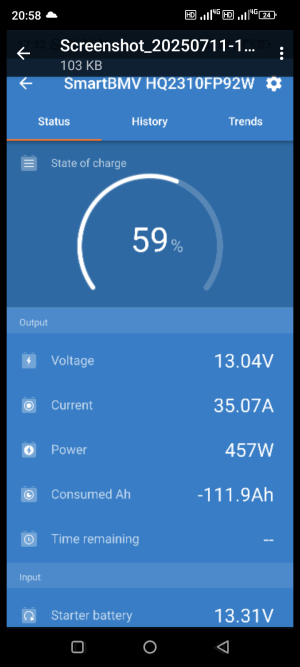
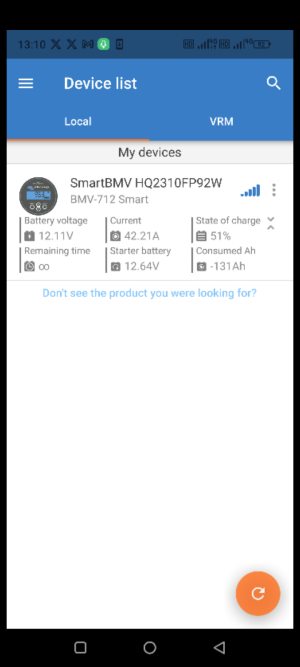
When I was acting as a vsr, with the flat lithiums I felt the wires warming, according to the battery monitor just looking at it, I was drawing 50 amps. I reduced the throttle and I was drawing in excess of 30 when I screenshot it...see below..

The conditions required high revs for motoring so there was no option to allow things to stay connected.

I cannot see that an alternator which is capable of giving out 50 amps is connected to a bank that is capable of accepting 50 amps and wants to draw 50 amps, will not result in a draw 50 amps...

I am an amateur and may be a bit pig head but I cannot see how the above is not true.

If the batteries are kept well charged and topped up this will not occur...so I understand I am talking about an extreme position..
 

Attachments

  • Screenshot_20250725-205825.png
    Screenshot_20250725-205825.png
    149.5 KB · Views: 2
  • Screenshot_20250725-205757.png
    Screenshot_20250725-205757.png
    121.5 KB · Views: 2
The answer actually depends on which inverter you use ... bargain inverters are not clean enough and usually square wave which will cause any smaret charger to refuse to work. If the inverter is true sine wave and mimics mains closely enough - then yes it should work. It can also be a matter of the Hertz ...

This is a common problem when people power computers on board ... they wonder why the mains adaptor fails to power the computer ... where the wave or Hertz is suited to the adaptor.
I was reading recently that most modern chargers (DC ones for electronics such as laptops is what i was reading about) start with a rectifier anyway followed by a DC-DC converter of some kind. The article suggested that pure sine is therefore irrelevant and cheap sine would potentially produce a cleaner DC from the rectifier anyway. There were comments about pure sine being kinder to diodes but no firm evidence to back that up.
 
When I was acting as a vsr, with the flat lithiums I felt the wires warming, according to the battery monitor just looking at it, I was drawing 50 amps. I reduced the throttle and I was drawing in excess of 30 when I screenshot it...see below..

The conditions required high revs for motoring so there was no option to allow things to stay connected.

I cannot see that an alternator which is capable of giving out 50 amps is connected to a bank that is capable of accepting 50 amps and wants to draw 50 amps, will not result in a draw 50 amps...

I am an amateur and may be a bit pig head but I cannot see how the above is not true.

If the batteries are kept well charged and topped up this will not occur...so I understand I am talking about an extreme position..
If, for example, you have a battery bank that due to its state of charge will draw a current of 60 amps and you have an alternator rated at 50 amps you will overload the alternator by 20% (the alternator should cope with that for a limited period, circa 20min.) This will cause the alternator to overheat, and probably, try to slow down, the engine governor may be able to cope with that and maintain the revs.
Needn't be a battery any load that draws more current than the rated current output of the alternator will have the same effect.
 
If, for example, you have a battery bank that due to its state of charge will draw a current of 60 amps and you have an alternator rated at 50 amps you will overload the alternator by 20% (the alternator should cope with that for a limited period, circa 20min.) This will cause the alternator to overheat, and probably, try to slow down, the engine governor may be able to cope with that and maintain the revs.
Needn't be a battery any load that draws more current than the rated current output of the alternator will have the same effect.
My issue is that the wiring is only good for about 30 amps...I need a valve in the system which will choke the flow down to 30amps.. that's the significant reason for the Orion.

If the alternator was not capable of more than 30amps or the wiring was good for 100 or the bats had a programmable BMS to reduce demand to below 30, things would be fine.
 
Top