
lampshuk
Well-Known Member
Thought I would post this out of interest for others who, like me, assume that wiring only fails at connectors or when abraded.
I noticed that my bow nav light had stopped working and did some investigating.
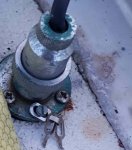
The nav light is fed from a very robust-looking 2-pin socket (the eagle-eyed may already spot signs of trouble in this first picture):
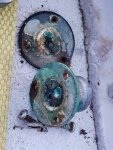
On removing the deck socket, the apparent culprit became quite obvious:
So I replaced the (notoriously unreliable) plug/socket with a through-deck gland and joined it to the old twin-core multi-strand cable down below.
Still no light.
So I started ripping out the headlining and tracking back to "good" cable.
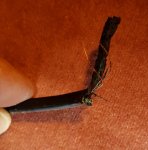
I found one obvious break roughly where the cable went through a small bulkhead hole (without conduit, of course)
But still no power to the nav lights.
Working my way back, I established there was another break in the cable leading from the saloon into the forecabin.
To cut a looong story short, I replaced the old cable with tinned multi-core cable so the nav lights are now working again.
I could see no obvious fault in the old twin-core cable, even after stripping the outer insulation, so out of curiosity I isolated the broken section and stripped the inner insulating layer to find the break:
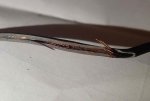
You can see that the conductors have completely disintegrated in that short section.
Of course, they have oxidized and blackened everywhere, but there is still a sound connection.
The cable appears to be original and therefore 30+ years old.
It's multi-stranded, but not tinned, and much less flexible than the cable with which I replaced it. I don't think that the cable was in a location particularly vulnerable to vibration (it was buried in the top of the forecabin-saloon bulkhead) but like the other more obvious break it may have been in a narrow hole through the bulkhead.
Anyway, I just thought others might appreciate seeing this.
I'd be interested if any of the experienced electrical engineers or metallurgists on the forum have any insights in to the mechanism for this failure.
I noticed that my bow nav light had stopped working and did some investigating.
The nav light is fed from a very robust-looking 2-pin socket (the eagle-eyed may already spot signs of trouble in this first picture):
On removing the deck socket, the apparent culprit became quite obvious:
So I replaced the (notoriously unreliable) plug/socket with a through-deck gland and joined it to the old twin-core multi-strand cable down below.
Still no light.
So I started ripping out the headlining and tracking back to "good" cable.
I found one obvious break roughly where the cable went through a small bulkhead hole (without conduit, of course)
But still no power to the nav lights.
Working my way back, I established there was another break in the cable leading from the saloon into the forecabin.
To cut a looong story short, I replaced the old cable with tinned multi-core cable so the nav lights are now working again.
I could see no obvious fault in the old twin-core cable, even after stripping the outer insulation, so out of curiosity I isolated the broken section and stripped the inner insulating layer to find the break:
You can see that the conductors have completely disintegrated in that short section.
Of course, they have oxidized and blackened everywhere, but there is still a sound connection.
The cable appears to be original and therefore 30+ years old.
It's multi-stranded, but not tinned, and much less flexible than the cable with which I replaced it. I don't think that the cable was in a location particularly vulnerable to vibration (it was buried in the top of the forecabin-saloon bulkhead) but like the other more obvious break it may have been in a narrow hole through the bulkhead.
Anyway, I just thought others might appreciate seeing this.
I'd be interested if any of the experienced electrical engineers or metallurgists on the forum have any insights in to the mechanism for this failure.


 )
)


