
Cable Rot

lampshuk

Well-Known Member
Joined
10 Sep 2013
Messages
456
Location
Solent
Visit site
Thought I would post this out of interest for others who, like me, assume that wiring only fails at connectors or when abraded.

I noticed that my bow nav light had stopped working and did some investigating.

The nav light is fed from a very robust-looking 2-pin socket (the eagle-eyed may already spot signs of trouble in this first picture):
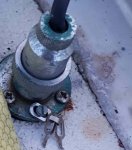
20180907_195409a.jpg

On removing the deck socket, the apparent culprit became quite obvious:
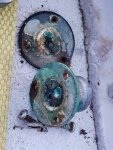
20180907_195231.jpg


So I replaced the (notoriously unreliable) plug/socket with a through-deck gland and joined it to the old twin-core multi-strand cable down below.

Still no light.

So I started ripping out the headlining and tracking back to "good" cable.

I found one obvious break roughly where the cable went through a small bulkhead hole (without conduit, of course)
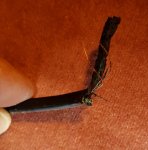
20181212_162611.jpg

But still no power to the nav lights.

Working my way back, I established there was another break in the cable leading from the saloon into the forecabin.

To cut a looong story short, I replaced the old cable with tinned multi-core cable so the nav lights are now working again.

I could see no obvious fault in the old twin-core cable, even after stripping the outer insulation, so out of curiosity I isolated the broken section and stripped the inner insulating layer to find the break:
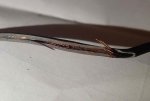
P2250005.JPG

You can see that the conductors have completely disintegrated in that short section.
Of course, they have oxidized and blackened everywhere, but there is still a sound connection.

The cable appears to be original and therefore 30+ years old.
It's multi-stranded, but not tinned, and much less flexible than the cable with which I replaced it. I don't think that the cable was in a location particularly vulnerable to vibration (it was buried in the top of the forecabin-saloon bulkhead) but like the other more obvious break it may have been in a narrow hole through the bulkhead.

Anyway, I just thought others might appreciate seeing this.

I'd be interested if any of the experienced electrical engineers or metallurgists on the forum have any insights in to the mechanism for this failure.
 
I'm neither of those, but an interesting bit of trivia is that the people who worked in the high speed wind tunnel at Farnborough were trying to find the source of an irritating high-pitched whistling sound in their control room. It was air coming through the instrumentation cabling.

When I heard that story I gave up in trying to seal cables - and always buy tinned!
 
I hope I am imagining things, but some of that wiring looks like copper-plated steel. In which case, are some other cables time-expired ?
 
...It was air coming through the instrumentation cabling.

Definitely interesting! I will endeavour to avoid conditions windy enough to blow throughthe wires.

Sarabande, I don't think it's copper-plated.

I have a bit of the faulty wire in front of me and just tortured it with a pair of scissors.
It seemed ductile and pinkish right through to the middle.
And didn't reveal any secrets.
 
I have 2 stories of wire failure. The first was in the boat where i had run a pos wire under the carpet edge. It seemed someone had troden on it and damaged the outer insulation. Such that much later corrosion got in eventually causing a failure. When I pulled the wire out it had a tell tale bulge of corrosion.
The other failure was in a purpose made 5 core sheathed cable for my trailer lights. One wire was open circuit somewhere in the middle. By cutting and testing I eventually found the failure where apparently in the factory they had joined wires simply twisting the wires together. Then the join was covered in the outer sheath. I didn't imagine they could be so slack in a factory. ol'will
 
My bow bicolour stopped working and found corrosion at the end of the cable on the black lead (copper inner). After cutting back 6 inches and still finding corrosion I replaced the cable. If a cable end is left exposed then corrosion can go back a very long way inside the core. I was amazed the light worked as long as it had, but then it was a LED bulb so current draw was minimal.
 
... found corrosion at the end of the cable on the black lead (copper inner). After cutting back 6 inches and still finding corrosion I replaced the cable.

Just for clarification: when you talk about corrosion, do you mean the disintegration shown in my last photo, or blackening of un-tinned copper conductors, which I believe is just the black form of copper oxide and doesn't actually stop the copper from conducting. I have found that by scraping the black layer off it's quite straightforward to solder to the bright copper underneath.

I've also been interested to see how far the CUO penetrates. It seems to be end-to-end down the wire, which makes me think that the necessary oxygen is actually coming through the wall of the cable. Can anyone shed any light on that?

(I do agree with your general principle of completely replacing old, blackened with tinned - it's just that when cables have been run without ducting it's a mammoth task to get the new one in. Not to mention expensive)
 
The cable appears to be original and therefore 30+ years old.
It's multi-stranded, but not tinned,.

So what you are saying is that buying tinned is a waste of time & ordinary wire will last quite a long time before replacement becomes necessary. If one leaves a bit of spare so the ends can be shortened all should be Ok & it will see most owners on this forum out :encouragement:
 
Just for clarification: when you talk about corrosion, do you mean the disintegration shown in my last photo, or blackening of un-tinned copper conductors, which I believe is just the black form of copper oxide and doesn't actually stop the copper from conducting. I have found that by scraping the black layer off it's quite straightforward to solder to the bright copper underneath.

I've also been interested to see how far the CUO penetrates. It seems to be end-to-end down the wire, which makes me think that the necessary oxygen is actually coming through the wall of the cable. Can anyone shed any light on that?

(I do agree with your general principle of completely replacing old, blackened with tinned - it's just that when cables have been run without ducting it's a mammoth task to get the new one in. Not to mention expensive)

It was black all the way through so just fell apart as I cut back. Must have been working on the remains of the strands for a while.
 
So what you are saying is that buying tinned is a waste of time & ordinary wire will last quite a long time before replacement becomes necessary. If one leaves a bit of spare so the ends can be shortened all should be Ok & it will see most owners on this forum out :encouragement:

You might very well say that, but I couldn't possibly comment...

If it wasn't for those two unexplained breaks mid cable-run I think I probably would be saying that, but if there's a finite lifespan for un-tinned wire - of, say, 30-and-a-bit years, I might be bracing myself for a rash of similar hard to find problems.
I'm fairly sanguine about exposed ends deteriorating, it's when the bits in the middle go that I'm puzzled.

30 years is not old by boat standards, and there seem to be plenty of older ones floating around with their lights happily shining away, so for now I'm happy to fix the problems as they occur, and go sailing (at night, too :-) )
 
Trying to tempt one of our experts to comment on this ...

It's interesting that the black coating could be Cupric Oxide CuO whereas the red crumbly stuff could be cuprous oxide, Cu2O.

So perhaps there's something in the process by which each is formed that means it's either benign (black) or break-inducing (red).

Having said that, it also appears that CuO is formed by heating copper in air at between 300 and 800 Celsius. I know it gets a bit warm in the forecabin, but not that warm.

And those are red and black, which copper compound is the green one?
 
I use single core copper wire (from mains wire).

I know everybody says it will vibrate/break, but my Dad put a bunch in his boat in the early '70's and it's still going strong...
 
Not sure about the chemistry, there will possibly be chloride in there from salt water and maybe odd stuff from the breakdown of the plastic insulation over time.
Maybe iron contamination from manufacturing the wire.

Personally, I 'll use tinned wire if possible, but I think the greater influence is keeping the insulation intact, keeping the ends dry and not overheating the wire.
Tinned wire is still prone to corrosion. A few microns of tin buy you a few months of exposure to 'dry' air, not 30 years of seawater.
When you've got volts on the wire, worse things can happen: electrolysis, tin whisker growth and other bizarre effects conspire to ruin the day of anyone who provides a warranty.
 
Tin whisker growth :confused:
The things you (can) learn from this forum are amazing!
Next time I am on the boat I shall have a very careful search for itinerant High Aspect Ratio Sn Whiskers.
Peter
 
Tin whisker growth :confused:
The things you (can) learn from this forum are amazing!
Next time I am on the boat I shall have a very careful search for itinerant High Aspect Ratio Sn Whiskers.
Peter

You learn something new every day.
If you're not careful!
 
Thought I would post this out of interest for others who, like me, assume that wiring only fails at connectors or when abraded.

I noticed that my bow nav light had stopped working and did some investigating.

The nav light is fed from a very robust-looking 2-pin socket (the eagle-eyed may already spot signs of trouble in this first picture):

View attachment 76157

On removing the deck socket, the apparent culprit became quite obvious:

View attachment 76156


So I replaced the (notoriously unreliable) plug/socket with a through-deck gland and joined it to the old twin-core multi-strand cable down below.

Still no light.

So I started ripping out the headlining and tracking back to "good" cable.

I found one obvious break roughly where the cable went through a small bulkhead hole (without conduit, of course)

View attachment 76158

But still no power to the nav lights.

Working my way back, I established there was another break in the cable leading from the saloon into the forecabin.

To cut a looong story short, I replaced the old cable with tinned multi-core cable so the nav lights are now working again.

I could see no obvious fault in the old twin-core cable, even after stripping the outer insulation, so out of curiosity I isolated the broken section and stripped the inner insulating layer to find the break:

View attachment 76159

You can see that the conductors have completely disintegrated in that short section.
Of course, they have oxidized and blackened everywhere, but there is still a sound connection.

The cable appears to be original and therefore 30+ years old.
It's multi-stranded, but not tinned, and much less flexible than the cable with which I replaced it. I don't think that the cable was in a location particularly vulnerable to vibration (it was buried in the top of the forecabin-saloon bulkhead) but like the other more obvious break it may have been in a narrow hole through the bulkhead.

Anyway, I just thought others might appreciate seeing this.

I'd be interested if any of the experienced electrical engineers or metallurgists on the forum have any insights in to the mechanism for this failure.

40 years ago when those plugs & sockets the height of technology, they were rubbish, then the Dri plug was invented
 
Yup, those plugs are a pain in the ass for corrosion. They look nice and traditional. In fact I used them on a classic motorboat that we finished last year but to seal them up completely, used some 2 part cable jointing compound that I'd normally use underground. Problem solved, although where possible in day to day use, I'll use the modern plastic stuff as very good water resistance.
 
Top