Cable Ferry Collision in Sweden

I get to wonder how offen Garmin update there charts ,
below is the entrance to a Netherlands we entered the other day ,
as you can see the buoyage channel goes over the shallows the white area which is marked 6 to 8 mts has only a mts or so over it , anyone thinking there plenty to cutting the corner would be in trouble.
in reality any of us sailing anywhere using these charts are sailing bind ,
what are we paying for ? Not safe reliable for sure .
The clue is in the written warning. Variable depths changing frequently. If you switch on the crowd-sourced sonar depths do you see a major difference?
 
I always work on the assumption that electronic maps / charts are produced by nerds in California or elsewhere with no understanding of cartography or hydrography.

On the west coast of Scotland I "discovered" a rock with 2 metres or less in an anchorage. It was not shown on the nice coloured chartlet in the latest edition of the pilot guide, proudly produced with the aid of digital cartography according to the blurb. However, reference to the early hand drawn CCC guide (the old blue hardback book) and individual CCC anchorage charts did show it.

Where I lived in Orkney friends' car GPS maps showed a road that had been disused and grassed over as part of a field umpteen years before, and did not show an actual road that had been in use for those umpteen years. Farm names were given the prominence of villages and an important village was not named. One afternoon a car arrived in my drive at the end of a single track road looking for the Stones of Stenness using the car GPS. He was in the correct parish, just, but about three miles from his destination. Driver error or cartography?

Edit - Google Maps was, perhaps still is, missing an (admittedly uninhabited) Orkney island.

No so long ago a rock was discovered near here. Right in the middle of the route you would expect boats to take as well.

Sète: the mysterious rock
 
I get to wonder how offen Garmin update there charts ,
below is the entrance to a Netherlands we entered the other day ,
as you can see the buoyage channel goes over the shallows the white area which is marked 6 to 8 mts has only a mts or so over it , anyone thinking there plenty to cutting the corner would be in trouble.
in reality any of us sailing anywhere using these charts are sailing bind ,
what are we paying for ? Not safe reliable for sure .
Garmin update their charts at least twice a year, as do Navionics (owned by Garmin now), most other electronic chart producers will do the same or similar i suspect. But, they can only update using the latest survey data, which they take from the likes of the UKHO and other official bodies around the World.

Your chart does warn you that the depths change frequently, you surely don't expect all frequently changing entrances will be surveyed and updated on charts several times a year ? For such entrances you should be using local pilotage guides etc.
 
I get to wonder how offen Garmin update there charts ,
below is the entrance to a Netherlands we entered the other day ,
as you can see the buoyage channel goes over the shallows the white area which is marked 6 to 8 mts has only a mts or so over it , anyone thinking there plenty to cutting the corner would be in trouble.
in reality any of us sailing anywhere using these charts are sailing bind ,
what are we paying for ? Not safe reliable for sure .
What does the official Netherlands hydrographic office chart say for the depths? If the NL HO office chart is correct then it may be a Garmin issue.
But check the official chart first. Many places in UK waters last surveyed 100 years ago by UKHO.
 
Don't forget the three chain ferries at Torpoint. That appear to leave at random times just to snag any passing yacht.

Love there Restricted in Ability to Manoeuvre signs and lights even though they do head off to Falmouth from time to time for servicing.
The incompetently procured and intermittently useless Cowes ferry had to go to Falmouth for its out of water inspection.

They crashed it into the breakwater on the way back into Cowes harbour to add to its tales of woe.

They didn’t try to blame Garmin though.
 
What does the official Netherlands hydrographic office chart say for the depths? If the NL HO office chart is correct then it may be a Garmin issue.
But check the official chart first. Many places in UK waters last surveyed 100 years ago by UKHO.
Exactly. A chart is a snapshot in time.

The data, some done by lead line by a bloke in a rowing boat, goes to Italy where a woman on minimum wage in the mountains transposes it into electronic chart format.

Then people treat it as fact.

It is not, and never can be, anything more than a useful guide to good navigation and pilotage.
 
Garmin update their charts at least twice a year, as do Navionics (owned by Garmin now), most other electronic chart producers will do the same or similar i suspect. But, they can only update using the latest survey data, which they take from the likes of the UKHO and other official bodies around the World.

Your chart does warn you that the depths change frequently, you surely don't expect all frequently changing entrances will be surveyed and updated on charts several times a year ? For such entrances you should be using local pilotage guides etc.
Agree chart do show of moving depth ,
the area is survey regular and the channel moved three years ago locals say ,
so why is the charts so far behind , is my question .
the new buoy are shown on the chart which mean Garmin or who ever update charts must known .
 
We had a case some years ago we came across some off lying rocks above water that wasn’t charted off an islandin Greece .
we sent photo and a snapshot of the chart to Navionics ,
the reply we got back was the island was a private island and as so they cant get up to dated reading ,
rubbish the island wasn’t private and the next island that was private everything was charted .
after telling them that , the next reply was we could have a free chart next year when it be up dated .
guess what the following chart still nether shown the rocks .
 
Agree chart do show of moving depth ,
the area is survey regular and the channel moved three years ago locals say ,
so why is the charts so far behind , is my question .
the new buoy are shown on the chart which mean Garmin or who ever update charts must known .
It is not only the digital charts that remain unchanged, but it has always been the case on paper charts that the buoyage will be correctly placed but the contours and depths may not be. We used to do the section from Norderney to Delfzijl across the wat from time to time, much of it across charted shallows or even drying areas. Dutch and German buoyage can always be relied on though, even if the channel divisions between Norderney and Juist take quite a bit of working out.
 
Against the ferry operator as he'd be liable. Not Garmin.

Added: The signage should be as below. If not in place you may have a chance in court
View attachment 160913


Not only the signs but a cable ferry is so distinctive in design that it is usually obvious it is attached to something and
not free floating and using props. Your insurers may be considering this point.

Only knowledgable locals try to beat the Higher Dart Ferry. Which is similar.
 
Re: updating charts.

Back in the days of paper charts UKHO published weekly Notices to Mariners. This included chart updates, simple changes were made by drawing the appropriate symbol in the correct position with a magenta pen, more complicated ones had a paper print to be pasted on to the chart in the correct location. The date and number of each correction would be recorded along the bottom margin of the chart. Commercial vessels had to keep all the charts carried up to date, a job for the OOW while on passage. How many yachts kept their charts right up to date?

I did have a chart system on a laptop some years ago that allowed simplistic manual updates by the user. My current C-map chips however have to be sent to an agent to be rewritten for updates. But they do give a warning on startup after a year or so that the charts are out of date.
 
Re: updating charts.

Back in the days of paper charts UKHO published weekly Notices to Mariners. This included chart updates, simple changes were made by drawing the appropriate symbol in the correct position with a magenta pen, more complicated ones had a paper print to be pasted on to the chart in the correct location. The date and number of each correction would be recorded along the bottom margin of the chart. Commercial vessels had to keep all the charts carried up to date, a job for the OOW while on passage. How many yachts kept their charts right up to date?
Guilty as charged.
 
  • Like
Reactions: srm
Hi All
I was unfortunately involved in hitting the cable of a cable ferry in Sweden in a British Registered boat. Lost the rudder. Replacement cost about £ 7500 through insurance. Uninsured losses approx £ 1500.

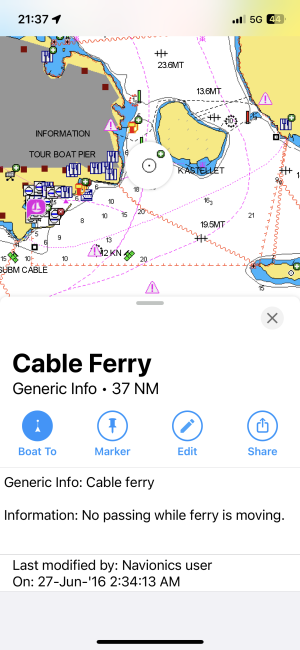
I was using a garmin plotter. The plotter showed a ferry, but not a cable ferry. Garmin have confirmed it wasn't on the chart. The ferry folk swear it's on the chart.

My chart info and track is shown on the attached picture. I was heading North and struck the cable where my track crosses the pink ferry line, just South-West of the green channel marker. Keeping to left of channel to avoid large oncoming commercial vessel. Managed to get into dock with the bow thruster.

I would like to have a stab at getting my uninsured losses back.

Questions :
Can I use English law?
Is Garmin liable?
Is the Ferry operator liable?
Should I just forget it?

Your thoughts would be very welcome.

Matt
If the insurer isn’t interested in recovering its costs it’s a fair bet that you shouldn’t be, either.
 
Top