Bulldog Clips 80% of Wire Strength-Is that additive?

https://e-rigging.com/collections/w...-forged-wire-rope-clip?variant=39721883500617

I assume this is per clip, and thus that a conventional 3-clip loop should be roughly 240% of something that is probably already well overspecified

Rather struggling to come up with a reason not to use them for shroud terminations, at least at deck level.

Simple, cheap, maintainable, re-usable
I think your assumption is incorrect.
But if you do use them, remember not to saddle a dead horse.
 
Fof ducks sake don't use those to hold up your mast! They're zinc plated and will not be good bedfellows with your stainless steel rigging.
 
https://e-rigging.com/collections/w...-forged-wire-rope-clip?variant=39721883500617

I assume this is per clip, and thus that a conventional 3-clip loop should be roughly 240% of something that is probably already well overspecified

Rather struggling to come up with a reason not to use them for shroud terminations, at least at deck level.

Simple, cheap, maintainable, re-usable

Is this a wind up or have I misunderstood? You think each clip increases the strength by 80%?
 
https://e-rigging.com/collections/w...-forged-wire-rope-clip?variant=39721883500617

I assume this is per clip, and thus that a conventional 3-clip loop should be roughly 240% of something that is probably already well overspecified

Rather struggling to come up with a reason not to use them for shroud terminations, at least at deck level.

Simple, cheap, maintainable, re-usable
No, it is NOT additive. And the 80% figure means that the overall strength is 80% of the strength of the wire alone.

Assuming that some of the loss of strength arises from the deformation of the strands of the wire by compression in the bulldog clamp, I'd expect multiple clamps to be somewhat WEAKER than a single one - but of course, more susceptible to sudden failure.
 
No, it is NOT additive. And the 80% figure means that the overall strength is 80% of the strength of the wire alone.

Assuming that some of the loss of strength arises from the deformation of the strands of the wire by compression in the bulldog clamp, I'd expect multiple clamps to be somewhat WEAKER than a single one - but of course, more susceptible to sudden failure.

Agreed. I'd expect the rope to fail at first or last clip. Assuming they're tightened correctly and don't slip the number doesn't make any difference.
 
Last edited:
Also very important to fit them the right way round - ribbed piece (which must fit the wire size and number of strands) on the standing part, u bolt base on the tail.
 
No, it is NOT additive. And the 80% figure means that the overall strength is 80% of the strength of the wire alone.

Assuming that some of the loss of strength arises from the deformation of the strands of the wire by compression in the bulldog clamp, I'd expect multiple clamps to be somewhat WEAKER than a single one - but of course, more susceptible to sudden failure.
I find this interesting in comparison to copper ferrules that also crimp upon standing wire.

Would I be correct in that it has been stated that the fittings in the OP are poor because they damage the standing rigging wire BUT copper ferrules whilst still crimping the standing rigging DO NOT do such damage because the copper is softer than the fittings in the OP?

Copper ferrules and the tool to use them can be purchased.

BUT swaged end terminals that are fitted to standing rigging with hydraulic compressors have always imo been the best and what I have had fitted with toggles ( 2nd thought - HOW come this hard stainless fitting does not damage the wire in the manner the OP fittings have been claimed to by some posters?

I am a bit confused about that. Perhaps failure of rigging occurs at the point the swaged fitting compresses upon the wire via fatigue / flex / movement?

copper ferrules for standing rigging - Google Search

I have also used Norseman (and Staylock - if spelling is correct) terminals for DIY rigging - particularly when beefing up the forestay through a roller feeding foil.

So have I simply added more confusion to the OP?

I am sure someone more sensible can explain it.
 
Would I be correct in that it has been stated that the fittings in the OP are poor because they damage the standing rigging wire BUT copper ferrules whilst still crimping the standing rigging DO NOT do such damage because the copper is softer than the fittings in the OP?
Yes. The op,s fitting may be 8mm but clamping on a curve gives it a small clamping surface area . The swaged fittings shape internally to the shape of the rigging wire and cover a much larger area. You would (hypothetically) have to unscrew a swaged end to get the wire out.
 
Also not mentioned thus is that 1x19 can only go round a thimble up to 4mm after that is 7x7 maybe to 6mm then 7x19 which is unsuitable for standing rigging. It's the sort of poverty arrangement that one might find say on a certain pink boat that is regularly discussed. If you came to sell the boat it would be condemned by a surveyor and you'll pay for proper rigging but for someone else to enjoy. Honestly when swaging is available so reasonably from certain companies e.g. GS it's not worth the thought.
 
Fof ducks sake don't use those to hold up your mast! They're zinc plated and will not be good bedfellows with your stainless steel rigging.
On that site (just the first example search found, and in the US, so probably not a good source to supply the UK) they are available in stainless steel, hot dipped galvanized,(apparently 2 grades) and plated.

The existing wire is stainless steel, swaged, so I would use stainless clips with that, unless it was just a temporary lash-up. The existing turnbuckles appear to be galvanized.

If I replace the wire, I'm considering replacing it with galvanized 7X7, though this may not be appropriate for the forestay.

DIY alternatives would seem to be learning to splice, Talurit or wire seizing. Learning to splice is a possibility though it might be a challenge for the arthritus. There's a Taiwan maker of big hand crimpers for the Talurit-type swages, but the weight would make them expensive to ship. I probably wouldn't have sufficient confidence in (my) wire seizing alone.

80% overall should still be OK. I suppose one could put wire seizing between the clips but with frapping that would put the cables out of parallel, possibly weakening them at the clips. Perhaps thats why it doesn't seem to be done.
 
On that site (just the first example search found, and in the US, so probably not a good source to supply the UK) they are available in stainless steel, hot dipped galvanized,(apparently 2 grades) and plated.

The existing wire is stainless steel, swaged, so I would use stainless clips with that, unless it was just a temporary lash-up. The existing turnbuckles appear to be galvanized.

If I replace the wire, I'm considering replacing it with galvanized 7X7, though this may not be appropriate for the forestay.

DIY alternatives would seem to be learning to splice, Talurit or wire seizing. Learning to splice is a possibility though it might be a challenge for the arthritus. There's a Taiwan maker of big hand crimpers for the Talurit-type swages, but the weight would make them expensive to ship. I probably wouldn't have sufficient confidence in (my) wire seizing alone.

80% overall should still be OK. I suppose one could put wire seizing between the clips but with frapping that would put the cables out of parallel, possibly weakening them at the clips. Perhaps thats why it doesn't seem to be done.
By the time you've gone up 25% in size to compensate for the loss of 20% of the strength you would probably have paid for the actual required size with swaged fittings done by a pro - and have a proper job rather than a leg-shredding lash up.
 
No, it is NOT additive. And the 80% figure means that the overall strength is 80% of the strength of the wire alone.

Assuming that some of the loss of strength arises from the deformation of the strands of the wire by compression in the bulldog clamp, I'd expect multiple clamps to be somewhat WEAKER than a single one - but of course, more susceptible to sudden failure.
Some lack of clarity here since the last part of the sentence refers to the multiple clamps. I'm guessing this is a mistake, and you meant a single clip would be stronger but more susceptible to sudden failure.

This implies that multiple clips, which seem to be standard practice, are simply there to add redundancy, as insurance against one of them slipping

Also suggests not applying excess torque might be rather important. I'll probably have to leave my torque wrench in Taiwan, I can get another one, but its easy enough to make a calibrated puller, and I could tailor it specifically for the required torques, which seem to be quite low
 
Last edited:
Is this a wind up or have I misunderstood? You think each clip increases the strength by 80%?
Well I'd LIKE to suggest it was a wind up

But in fact I wasn't thinking of the cable strength being reduced and it failing at 80%. I was thinking of a single clip slipping at 80%, which I now understand is not the case.

In such a case, (slippage at 80%) I think the clip strength would be additive, the combo wouldnt slip, and the cable would fail, but at closer to 100% of its rating.

You could probably approach such a situation by reducing the torque on the clips or applying, say, an aluminium wrap on the cable at the clip saddle, but not reliably without extensive testing, if at all.
 
Last edited:
Not sure why you're even considering this. Maybe if was an old Wharram or something with light rigging loads it would be be acceptable. I assume (maybe wrongly that this is not the case) your boat is a manufactured design. The original designer will have stipulated rigging loads and type. If you change it for something questionable I would doubt your insurance would look too kindly on it in the event of any claim. Some things can be skimped on but certainly not rigging, which is fundamental to boat safety, in my opinion. Or maybe, as some one has already alluded to, this is just a wind up to get people going.
 
I would stick with copper ferrules and get them swaged. Cable clamps are a bodge and the hard narrow clamp area is the reason for the reduction in strength.

As an early teen, I earned my pocket money by making the rigging for my father's boats, kit or completed and made hundreds of shrouds and halyards. We had a Talurite 25 ton press and went up to 5 or 6mm. Galv in those days.

More recently, I made a frame and use a hydraulic jack with DIY swages. Works a treat. Again, up to 5mm. Also used Norseman for rigging a big ketch, 12mm.
I would suggest you get The Riggers Apprentice by Bryan Toss. Everything you need to know

Galv will go round tighter corners and a friend hand spliced all the rig for his 13 t gaff ketch. Quite hard work and finger scarring..
 
I would stick with copper ferrules and get them swaged. Cable clamps are a bodge and the hard narrow clamp area is the reason for the reduction in strength.

As an early teen, I earned my pocket money by making the rigging for my father's boats, kit or completed and made hundreds of shrouds and halyards. We had a Talurite 25 ton press and went up to 5 or 6mm. Galv in those days.

More recently, I made a frame and use a hydraulic jack with DIY swages. Works a treat. Again, up to 5mm. Also used Norseman for rigging a big ketch, 12mm.
I would suggest you get The Riggers Apprentice by Bryan Toss. Everything you need to know

Galv will go round tighter corners and a friend hand spliced all the rig for his 13 t gaff ketch. Quite hard work and finger scarring..
Well, THIS is embarrassing.

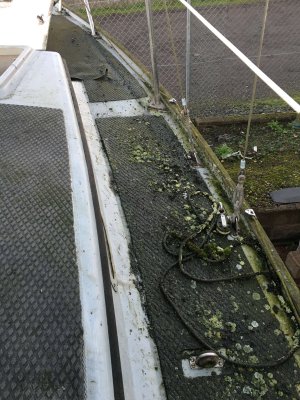
Had another look at a photo taken last year, which happens to show the shrouds at deck level. Zoomed in (more detail on the original than on the forumsized copy) its clear they have a Talurit-type crimping, a rather wide one, It doesnt look like copper, though I suppose it could be plated, and/or covered in verdegris. Its grey rather than blue/green though

If it is in fact aluminium, that would seem to imply that the wire is galvanized, rather than stainless, I would have expected to notice that, though I didn't examine it closely.

IF the standing rigging is galvanized I didnt notice any rust at the time, and there isnt any visible in the picture, so perhaps I wont have to replace it yet, assuming its also OK aloft, and when looked at closely.


StbdSdeckCut60.jpg
 
Last edited:
Not sure why you're even considering this. Maybe if was an old Wharram or something with light rigging loads it would be be acceptable. I assume (maybe wrongly that this is not the case) your boat is a manufactured design. The original designer will have stipulated rigging loads and type. If you change it for something questionable I would doubt your insurance would look too kindly on it in the event of any claim. Some things can be skimped on but certainly not rigging, which is fundamental to boat safety, in my opinion. Or maybe, as some one has already alluded to, this is just a wind up to get people going.
Its hardly an original idea on my part. IIRC Moitessier rigged his boat that way. and its mentioned as an option in various places online. Here's an example.

https://classic-marinestanding-rigging/.co.uk/

"I’ll move straight to the Bull Dog grip approach. This may not give the tidiest splice, but it is quite satisfactory so long as you put three grips on the right way round. The figure below shows the right and wrong way to do it. This method has the advantage that you can make up a splice in situ with simple tools, and if you don’t have grips it is also possible to use wire seizings to the same effect"

Wire seizings ought to be better, cable-weakening wise, IF done properly, but there doesnt seem to be much detail on the technique readily available. I THINK I;ve seen it descibed in a book on gaff rig which I bought in Australia, so if I find that I'll look into it further

If the strength is reduced by 20% (as opposed to the 10% often stated for other methods,) it should be possible to compensate for that and get back to the 1960 specifications.

Its not as if I'm considering doing something bizarrely modern, like, for example, using Dynema
 
Last edited:
Top