

Baggywrinkle
Well-Known Member
The inescapable fact is that no mater how thick the laminate is, or how seaworthy or well built old salts think a boat is, the boat as a whole will deteriorate with time and eventually lie abandoned in a boatyard. That's what happens to old boats - all of them - with the exception of those "rescued" by doting owners with deep pockets. The seals start to give, the water gets in, the interior gets damp and old, the mould and rot gets a hold, the metal bits start to corrode and value drops - the boats get sold on to less affluent owners who are looking to go boating on a budget - owners who can't afford to maintain them properly, they bodge repairs, and the boats migrate from marina berth, to moorings, and eventually to the hard in a cheap boatyard somewhere where they lie out in all weathers, unloved and abandoned for the elements to take their toll.
If it was not that way then the laws of supply and demand should be pushing the prices of older "seaworthy" boats up, not down, there should be a healthy boat-restoration industry recycling all these bombproof hulls - showrooms with restored 80s classics looking for new owners - but the prices aren't going up, and there isn't a thriving restoration industry. The owners who value older designs are disappearing at the same rate as the boats themselves. The entire spectrum of boats in a 70s Bristows guide should be visible today, gleaming in marinas and estuaries up and down the country - but they're not - they are far outnumbered by their modern replacements. I'm not saying that there isn't a market for such boats, this forum proves there are owners willing to invest the time, effort and money to keep them afloat, but at a guess I would say that they are all older sailors, who remember the '79 Fastnet race, formed their opinions around that time, and haven't changed them since. The others I guess are younger - cash strapped newcomers who are forced into old boat ownership out of necessity - all part of a boats journey from shiny Boat Show exhibit to abandoned hulk at the back of a boatyard.
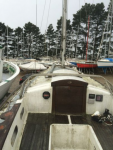
How else does a Rustler 31 end up like this ...
Go and race a First 40, or spend a day on one of the modern boats that have replaced all the ageing sailing school boats - the schools haven't curtailed their activities because they no longer have their trusty old Westerly - they still go out in all weathers - just as they always did. Charter fleets get massive abuse, and the boats survive, the ARC fleets always contain large numbers of AWBs with Bavaria, Jeanneau, Sun Odyssey etc. always to be found on the start line. Cats feature strongly too ... in the 70s they were way too dangerous 'cos they had a tendency to fall to pieces - shock horror, they were also stable when inverted - but Sea Child has spent the last 10 years circumnavigating without incident - the World ARC is full of cats from the usual AWB builders.
Interestingly, what always gets ignored by the "older is always better" brigade is the safety aspect associated with boat size - bigger is safer. There is a reason why the ARC Europe/ARC Portugal has a minimum boat length of 27ft , ARC Caribbean 1500/ARC Bahamas is 35ft and World ARC is 40ft - smaller boats will be considered but they don't get the automatic nod the bigger boats get.
Designs have changed, materials have improved, build methods have improved and are more consistent - you have to accept that the boat builders have learnt something in the last 50 years? - much as the old boat brigade lament the fact that they can't buy a new Nicholson 32 or whatever other old classic they grew up with, the fact is that in every aspect of life, including boats, the world moves on. Is it wrong to want hot and cold running water, fridges, microwaves, navigation aids, anchor windlasses, cockpit tables, transom showers, powerful engines, bathing platforms, separate cabins instead of bedding down in the saloon - and the space to put all these things. Of course not .... and that is what sells boats alongside their ability to actually sail and get their crews from A to B in one piece.
In the process of development, there will be designs, construction methods or particular companies that don't deliver - it's normal - and they pay the price. Huzar delivered some very poorly built sandwich construction, Bavaria got the keels on their Match 42 wrong, but it doesn't mean composite sandwich construction is the wrong way to go, or that bolt-on keels are inherently flawed as a concept.
Classic boats are no different to classic cars, lovely to look at, oozing nostalgia, but fundamentally out-dated - and the old adage that the crew will give up before the boat does is as true today as it ever was.
That's the last I'm going to say on the subject, when my current AWB starts to get tired, I'll trade her in for a newer one - and it will be just as much fun, and just as capable as anything that went before it. IMO you can't live your life in the past - look forward, not back - longing for a past that will never return is a recipe for resentment and unhappiness - embrace the future, celebrate the advances and laugh at the failures. Without change, life is boring.
Baggy out.
If it was not that way then the laws of supply and demand should be pushing the prices of older "seaworthy" boats up, not down, there should be a healthy boat-restoration industry recycling all these bombproof hulls - showrooms with restored 80s classics looking for new owners - but the prices aren't going up, and there isn't a thriving restoration industry. The owners who value older designs are disappearing at the same rate as the boats themselves. The entire spectrum of boats in a 70s Bristows guide should be visible today, gleaming in marinas and estuaries up and down the country - but they're not - they are far outnumbered by their modern replacements. I'm not saying that there isn't a market for such boats, this forum proves there are owners willing to invest the time, effort and money to keep them afloat, but at a guess I would say that they are all older sailors, who remember the '79 Fastnet race, formed their opinions around that time, and haven't changed them since. The others I guess are younger - cash strapped newcomers who are forced into old boat ownership out of necessity - all part of a boats journey from shiny Boat Show exhibit to abandoned hulk at the back of a boatyard.
How else does a Rustler 31 end up like this ...
Go and race a First 40, or spend a day on one of the modern boats that have replaced all the ageing sailing school boats - the schools haven't curtailed their activities because they no longer have their trusty old Westerly - they still go out in all weathers - just as they always did. Charter fleets get massive abuse, and the boats survive, the ARC fleets always contain large numbers of AWBs with Bavaria, Jeanneau, Sun Odyssey etc. always to be found on the start line. Cats feature strongly too ... in the 70s they were way too dangerous 'cos they had a tendency to fall to pieces - shock horror, they were also stable when inverted - but Sea Child has spent the last 10 years circumnavigating without incident - the World ARC is full of cats from the usual AWB builders.
Interestingly, what always gets ignored by the "older is always better" brigade is the safety aspect associated with boat size - bigger is safer. There is a reason why the ARC Europe/ARC Portugal has a minimum boat length of 27ft , ARC Caribbean 1500/ARC Bahamas is 35ft and World ARC is 40ft - smaller boats will be considered but they don't get the automatic nod the bigger boats get.
Designs have changed, materials have improved, build methods have improved and are more consistent - you have to accept that the boat builders have learnt something in the last 50 years? - much as the old boat brigade lament the fact that they can't buy a new Nicholson 32 or whatever other old classic they grew up with, the fact is that in every aspect of life, including boats, the world moves on. Is it wrong to want hot and cold running water, fridges, microwaves, navigation aids, anchor windlasses, cockpit tables, transom showers, powerful engines, bathing platforms, separate cabins instead of bedding down in the saloon - and the space to put all these things. Of course not .... and that is what sells boats alongside their ability to actually sail and get their crews from A to B in one piece.
In the process of development, there will be designs, construction methods or particular companies that don't deliver - it's normal - and they pay the price. Huzar delivered some very poorly built sandwich construction, Bavaria got the keels on their Match 42 wrong, but it doesn't mean composite sandwich construction is the wrong way to go, or that bolt-on keels are inherently flawed as a concept.
Classic boats are no different to classic cars, lovely to look at, oozing nostalgia, but fundamentally out-dated - and the old adage that the crew will give up before the boat does is as true today as it ever was.
That's the last I'm going to say on the subject, when my current AWB starts to get tired, I'll trade her in for a newer one - and it will be just as much fun, and just as capable as anything that went before it. IMO you can't live your life in the past - look forward, not back - longing for a past that will never return is a recipe for resentment and unhappiness - embrace the future, celebrate the advances and laugh at the failures. Without change, life is boring.
Baggy out.


