Brown Rusty Stuff Coming From Rudder

The Real Flipper

Well-Known Member
Joined
16 Feb 2022
Messages
185
Visit site
As though I don't have enough issues posted at the same time- suddenly this showed up as a priority before she goes in the water.
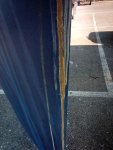
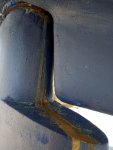
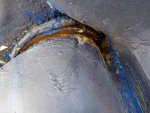
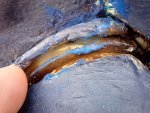
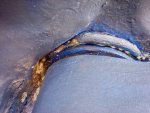
So the Rudder has an orangish, sometimes whiteish stuff that comes out of the bottom of the rudder attachment when it rains.
Two 'experts' the surveyor and an experienced guy in the boat yard said the rudder was good.
Both did a sort of inspection where they bent knees and grabbed the rudder and tried to muscle it around in different directions, then said it was good.
One said this apparently bad and apparently home repaired with some kind of silicon- rubber seal is not a problem.
Now I'm not so sure.

As usual any thoughts appreciated.
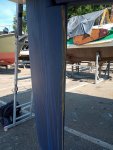
Rudder (1)_720x960.jpgRudder (6)_720x960.jpgRudder (2)_720x960.jpgRudder (3)_1280x960.jpgRudder (4)_1280x960.jpgRudder (5)_1280x960.jpgRudder (7)_1280x960.jpg
 
Looks like it is running down over the rudder but originating in the rudder post tube and bearing. You will need to drop the rudder to inspect which might mean digging a hole under the rudder . Maybe you have a non stainless rudder post and/or tube. The lower bearing appears deformed.
 
I suspect the rudder is similar to that on the slightly smaller Fulmar. In which case the whole lot is held in place in a tube that goes from the hull to the deck. The tiller will come off by un bolting it from the brass fitting that bolts on to the rudder to hold the rudder up and stop the shaft disappearing down the rudder tube.
All pretty easy to take apart on land but a bit of a embuggerance to drop the rudder completely out unless you can raise the boat up in the air by a further 5ft or dig a hole for the rudder to drop into.
However I suspect that dropping it just 30 cm will give you enough sight up the rudder tube to check that the shaft is intact. I would suspect that there has been some seawater in the tube that has reacted with the stainless steel to give you a rust mark but it is unlikely to be more than surface discoloration. Stainless steel is not immune to rust ! In your previous posts you indicate that the boat has been laid up and not used for some time and a while ashore.
The Waggeling of the rudder is to check that the bearings, top and bottom are not significantly worn which is a pretty standard test and unless you can detect significant play I would not worry with this simple tiller system.
If this were my boat and the list of excitements you have with it I would not worry much about this issue, these tiller steered westerlys are pretty well built rudders with a massive solid stainless steel shaft.
Of course all this is IMHO. Good luck
 
I suspect the rudder is similar to that on the slightly smaller Fulmar. In which case the whole lot is held in place in a tube that goes from the hull to the deck. The tiller will come off by un bolting it from the brass fitting that bolts on to the rudder to hold the rudder up and stop the shaft disappearing down the rudder tube.
All pretty easy to take apart on land but a bit of a embuggerance to drop the rudder completely out unless you can raise the boat up in the air by a further 5ft or dig a hole for the rudder to drop into.
However I suspect that dropping it just 30 cm will give you enough sight up the rudder tube to check that the shaft is intact. I would suspect that there has been some seawater in the tube that has reacted with the stainless steel to give you a rust mark but it is unlikely to be more than surface discoloration. Stainless steel is not immune to rust ! In your previous posts you indicate that the boat has been laid up and not used for some time and a while ashore.
The Waggeling of the rudder is to check that the bearings, top and bottom are not significantly worn which is a pretty standard test and unless you can detect significant play I would not worry with this simple tiller system.
If this were my boat and the list of excitements you have with it I would not worry much about this issue, these tiller steered westerlys are pretty well built rudders with a massive solid stainless steel shaft.
Of course all this is IMHO. Good luck
I applaud your attempt to downplay the evidence but to me the rust stain looks far more than would be generated by a bit of surface corrosion. Lowering the rudder for inspection of the shaft immediately above the rudder will take no more than an hour and involve no equipment other than a couple of spanners.

As I said in an earlier post, quite recently I saw photographs of a similar shaft from which the rudder was lost due to corrosion. I think it would be worth spending an hour to be certain that this was not imminent here.

In a previous case two identical Jeanneaux were berthed next to each other. The rudder shaft of one was deeply pitted, the other was untouched. Corrosion failures are very difficult to predict
 
Not easy to absolutely positive but can I see a crack extending down from the top of the leading edge of the moulding for some distance at the point of the stock exit point. If so then the rudder could be suffering from separation of the two halves caused by excess stress of the rudder stock/rudder moulding entry point. This also allows seawater to gain access to the rudder core and creates a very damp but oxygen starved stainless stock and corrosion staining.
If cracking is evident, it might be wise to investigate further.
 
Last edited:
Right. So it seems the consensus is the lower the rudder and inspect. If it's an hour job I should get it done in a day :)
So just curious it seems the way to go is: 1. Support the rudder 2. Remove the tiller 3. Loosen the brass fitting 4. Lower the rudder to the ground on a rubber mat 5. Inspect rudder post and tube for source of corrosion 6. clean everything and hope and pray that small crack isn't a major issue.

Not easy to absolutely positive but can I see a crack extending down from the top of the leading edge of the moulding for some distance at the point of the stock exit point. If so then the rudder could be suffering from separation of the two halves caused by excess stress of the rudder stock/rudder moulding entry point. This also allows seawater to gain access to the rudder core and creates a very damp but oxygen starved stainless stock and corrosion staining.
If cracking is evident, it might be wise to investigate further.

Good eye. I see it now that you mention it. Also now I remember a guy on the Westerly forums saying the Storm had a common issue with the rudder cracking in this area. I checked it by eye (before the rain and the rust stream) and it looked good. Now I'm not so sure. Will have to get back with him as well and see what the suggested fix is. Anyway I'll clean it up, lower, and inspect and report back.

BTW, how heavy is a rudder of this kind? Approximately? Seems like I may need a shop tech to help with this one.
 
BTW, how heavy is a rudder of this kind? Approximately? Seems like I may need a shop tech to help with this one.
If you are at the top undoing the bolts you will not be able to hold it underneath and it will drop with a bump.
How about a barrel hitch round the rudder and lower it under control using the winches. You will need some means to hold it up after the inspection while you refix the bolts.
1661464765932.png
 
Real Flipper, there could be another cause of the rust that has not been mentioned. Occasionally water can enter the rudder blade and the welds on the tangs can start to rust. Dropping the rudder is certainly a wise move as you can then check the join of the two halves of the rudder blade are not cracked, this would rule out the possiblity of it being the tangs.
 
To drop the rudder completely you will need to have enough clearance, obviously. It depends on cost but digging a big hole or lifting the whole yacht are the options. If you are on a concrete pad I have this nasty idea the boatyard will not support the idea of you digging it up :).. Depending on what you find you may need to lift the yacht anyway. But if Concerto is right (and welds corroding is not uncommon) you need a major re-build - and I would not want to sail in her till this is ruled out or repaired (I support Vyv's comments).

You seem to have 'just' noticed this issue - which suggests that the rush of manky water is recent - and that amount of manky water implies a lot of corrosion - I'd lift the yacht and drop the rudder completely.

I stand to be corrected but examining the tangs means splitting the rudder (they are commonly made in 2 halves, glued together with a glass tape round the join) - and having a look inside.

It may sound complicated - but it is not.

Jonathan
 
Right. So it seems the consensus is the lower the rudder and inspect. If it's an hour job I should get it done in a day :)
So just curious it seems the way to go is: 1. Support the rudder 2. Remove the tiller 3. Loosen the brass fitting 4. Lower the rudder to the ground on a rubber mat 5. Inspect rudder post and tube for source of corrosion 6. clean everything and hope and pray that small crack isn't a major issue.


Good eye. I see it now that you mention it. Also now I remember a guy on the Westerly forums saying the Storm had a common issue with the rudder cracking in this area. I checked it by eye (before the rain and the rust stream) and it looked good. Now I'm not so sure. Will have to get back with him as well and see what the suggested fix is. Anyway I'll clean it up, lower, and inspect and report back.

BTW, how heavy is a rudder of this kind? Approximately? Seems like I may need a shop tech to help with this one.
The weight of the rudder on my Sadler 34 is well within my ability to lift it. Story at Sadler 34 and 32 rudder bearings
 
You should also check above the rudder tube inside the stern of your boat. My rudder stock is actually supported by a collar around the stock, not by the brass head fitting that the tiller fastens to.
 
For a start I would clean up the entire area around the top of the rudder, get rid of all the old antifoul then you will know if there is a crack in the top of the rudder after which dropping it a little and it doesn't look like you have much clearance, should enable you to see the state of the rudder shaft or at least the lower part of it.
The water / rust staining seems to emanate from the rudder tube rather than the rudder itself so it seems unlikely that there is a problem of water ingress into the rudder structure. Have you looked inside the cockpit locker? is it full of rusty water that has over topped the rudder tube and bearings.
I think you are going to find many little puzzles along this journey and that you will be better off using the next 9 months solving as many of them as you can rather than trying to get out on the water.
To completely remove the rudder will require dropping it at least 750 cm perhaps more and it doesn't look like you will be able to dig that sort of hole so you may eventually need to lift the boat.
You are going to find all the reasons the boat was so cheap, basically a lack of maintenance with a make do and mend or ignore it attitude of the previous owner. It won't hopefully be too expensive or extensive to rectify but it is going to take you time (years?) to work through the boat and get her to where you want her. Start off by cleaning her stem to stern get inside all the lockers and hard to reach places which will allow you to get to know her and unravel or expose some mysteries.
 
Last edited:
Thanks for the detailed feedback all. I'm off to the boat tomorrow to have a look.
Will put my detective hat on, check everything suggested, and report my findings.
Thanks again!
 
Thanks for the detailed feedback all. I'm off to the boat tomorrow to have a look.
Will put my detective hat on, check everything suggested, and report my findings.
Thanks again!

If I may make a suggestion and possibly repeat my self:

You have several items that you have identified some potentially more complex and difficult than others but without doubt there will be more.
Make a list by identifying the problem and what needs to be done, the list will grow and the work will be determined by funds, cost and your abilities which will grow as you gain confidence working through the items. Best to start off with the simple things first.
Clean the boat get rid of the years of accumulated detritus, it will make identifying problems easier and make you feel better about the boat. If you take my advice about not putting her in the water this year then remove the heads completely and clean and disinfect the the area so that it smells sweet then you can reinstall a refurbished heads with new pipework and perhaps a holding tank which is essential for the Dutch inland waters.
I repeat don't lunch this year get the boat right you will enjoy the work and learning process and be happier and more confident for it.
 
Top