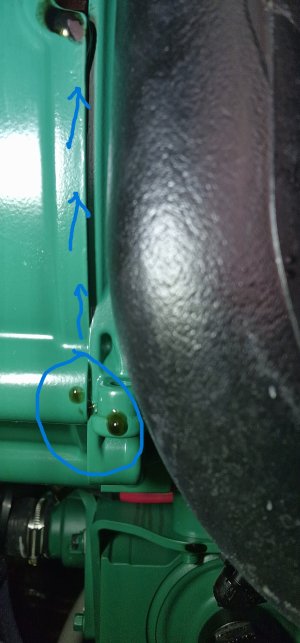
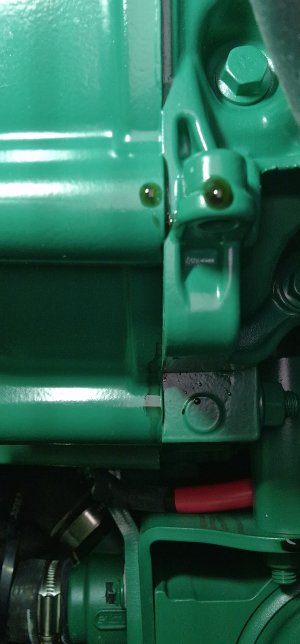
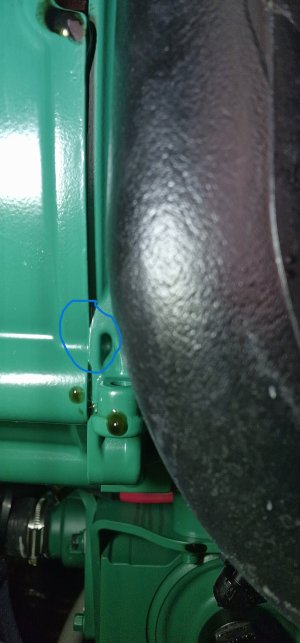
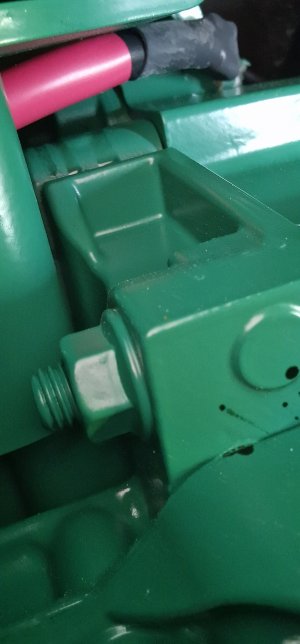
Both engines (only 150 hours) sudden oil leaks from crankshaft o-rings???

just out of interest, changing the RMS seals in a commercial workshop, how much each engine ?
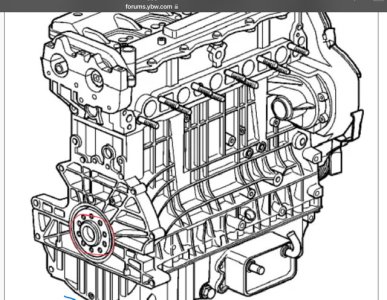
It all depends how much access there is .
4C4AE251-774F-4207-9BC2-1465EFB71E51.jpeg
Normally - You ( the technician) need to get this flange circled in red off .Normally and say “ normally “ not familiar with this Volvo D3 design the seal is behind that and easy to switch out.

NORMALLY you split the gearbox , drop that on a car like doing a clutch / flywheel job leaving the engine in situ .RMS are a twenty quid part “ normally “ and 15 mins Labour “ while you are in there doing a flywheel + clutch .

How ever if it’s outdrive etc access tight at the transom then ……it could well be an engine out job .
Some one more familiar with Volvo D3 like Volvo Paul and others will know there preferred method .
 
before panicing about a failed crank shaft seal, I would clean the engine up everywhere - especially underneath, then go for another run another day.
That's not a lot of oil for a failed crank seal either. Modern crank seals are not always spring loaded lip seals but teflon sleeves that run dry and I believe rarely fail. It could be a minor leak from somewhere else on the engine, cam cover, a pump or flange for something else like oil pressure valves etc and the oil over time has worked its way to the lowest point on the engine, acccumulated and todays blast about has just shaken it off.

I had a leak on a D9, it dripped at the back of the oil pan. The source was eventually found at the cam shaft cover.
 
before panicing about a failed crank shaft seal, I would clean the engine up everywhere - especially underneath, then go for another run another day.
That's not a lot of oil for a failed crank seal either. Modern crank seals are not always spring loaded lip seals but teflon sleeves that run dry and I believe rarely fail. It could be a minor leak from somewhere else on the engine, cam cover, a pump or flange for something else like oil pressure valves etc and the oil over time has worked its way to the lowest point on the engine, acccumulated and todays blast about has just shaken it off.

I had a leak on a D9, it dripped at the back of the oil pan. The source was eventually found at the cam shaft cover.
Its identical on both engines happened simultaneously .Oil ( no pic unfortunately) was in the bilges under both engines .

Agree if it was only that drip on one engine + nothing in the bilge then simmer down Chillax etc but it isn’t.

The pic in post #1 indicates to me it’s coming from inside that weep hole ,i cant see it running down the outside of the casing either side .
Indeed from the pic it looks like it’s coming from behind the what appears to be a rusty toothed flywheel exactly like a RMS leak should present .
 
Worth doing for sure before anything expensive.

Otherwise, I'm kinda inclined to agree with Porto here. And the fact that it's manifested in both engines simultaneously suggests it's a common trigger; usage-related (potentially combined with another factor eg oil level or composition) seems a possibility given the OP says he ran the boat at WOT for some time after a layup and a service.

Getting to that flange means removing the engines, it's a sterndrive boat so that connects to the inside face of the transom shield. My boat (same make, similar model, D4/300s) had an engine out, it was quick and easy via a soft patch in the cockpit floor.

I'd suggest the OP follows this route.
 
Back in 1997, we had a brand new Sealine S37 with twin Mercruiser diesels. At 60 hours it had its first service, and a few days later we went to Guernsey. Next day, I checked the engines, and was horrified to find a load of oil in the bilge. Dipping the oil, it was still over an inch above the full mark, despite obviously losing a lot. Turns out the Mercruiser agent had wildly overfilled the units, which blew the rear crankshaft seals on both engines. Result, both engines removed and bottom ends rebuilt. We were without the boat for 8 weeks. Ran well after that.
 
Back in 1997, we had a brand new Sealine S37 with twin Mercruiser diesels. At 60 hours it had its first service, and a few days later we went to Guernsey. Next day, I checked the engines, and was horrified to find a load of oil in the bilge. Dipping the oil, it was still over an inch above the full mark, despite obviously losing a lot. Turns out the Mercruiser agent had wildly overfilled the units, which blew the rear crankshaft seals on both engines. Result, both engines removed and bottom ends rebuilt. We were without the boat for 8 weeks. Ran well after that.
Now we are widening the debate into dipstick calibration( engines tilted ) and further more how many can be arsed to check before firing up , and even further more interpreting what they see .I mean was it supposed to be filled inbetween the marks 1/2 way or up to the top mark ? Hmm .

Further more , the 4 th thing folks when dip sticking - is it read stone cold , or a certain time after shut down to allow oil to drain down .

It all in respective manuals RTFM .


So if you has followed the RTFM seen the elevated levels you wouldn’t have blown his RMS s

For those lost / wooshed thus far = seen the dip stick level before firing up .
 
Last edited:
Now we are widening the debate into dipstick calibration( engines tilted ) and further more how many can be arsed to check before firing up , and even further more interpreting what they see .I mean was it supposed to be filled inbetween the marks 1/2 way or up to the top mark ? Hmm .

Further more , the 4 th thing folks when dip sticking - is it read stone cold , or a certain time after shut down to allow oil to drain down .

It all in respective manuals RTFM .


So if you has followed the RTFM seen the elevated levels you wouldn’t have blown his RMS s

For those lost / wooshed thus far = seen the dip stick level before firing up .
Agreed, but the boat had just been serviced by a Mercruiser agent ready for the Guernsey trip and had not been run since. My fault for assuming the agent had’nt left the job to a blooming’ apprentice
 
Thank you everyone for the valuable inputs.

I changed the oil today properly and checked the levels to be correct after warming up. the engines. The cold start oil pressure was 500 kpa and after 5 minutes of running it began to gradually decrease. After a 15 minute warmup, the pressure dropped to 340 kpa on both engines. Not sure if it is too low or normal.
Before changing the oil, i ran the port engine at idle raving up to 1500 rpm to see it the leak continued and it actually did. I was than thinking, the crankshaft seal shouldn't have such oil pressure pushing on it, am I correct? I inspected everywhere around the area and here is a new picture that may suggest the leak coming from somewhere else as seen on the picture below. The drain hole is positioned lower than the place where the drops are. It is very strange, but those drops are just hanging there and there is no trace where they're sourced from.
 

Attachments

  • 20231009_160214-2.jpg
    20231009_160214-2.jpg
    1.8 MB · Views: 30
Thank you everyone for the valuable inputs.

I changed the oil today properly and checked the levels to be correct after warming up. the engines. The cold start oil pressure was 500 kpa and after 5 minutes of running it began to gradually decrease. After a 15 minute warmup, the pressure dropped to 340 kpa on both engines. Not sure if it is too low or normal.
Before changing the oil, i ran the port engine at idle raving up to 1500 rpm to see it the leak continued and it actually did. I was than thinking, the crankshaft seal shouldn't have such oil pressure pushing on it, am I correct? I inspected everywhere around the area and here is a new picture that may suggest the leak coming from somewhere else as seen on the picture below. The drain hole is positioned lower than the place where the drops are. It is very strange, but those drops are just hanging there and there is no trace where they're sourced from.
Oil pressure is highest when it cold Your 340kpa equates to 49 psi .That’s on the high side but quite ok for a cold ish engine .40-45 psi is about right so 49 isn’t that far out .It won’t fully warm up @ the dock @ 1500 rpm the oil .How ever heat causes metals to expand faster than the rubber seals .

The pic suggests the gasket marked in red is leaking .
442DA117-CA39-4837-96A5-01AAA62BC8E9.jpeg
The oil globules form before they drip into the bilge .That what you are seeing it’s running to the lowest point and surface tension causes the globules.Eventually the weight of the globule ….it can’t defy gravity so drips .
 
One more pic. I am now looking at the photos taken, discovering more leaks. It seams that this is a separate leak from the crankshaft seal which may also leak. The greasy surface suggests it is old.
20231009_160324.jpg
 
Last edited:
Here, I can see there is no trace leading to the original hole, so must be a completely different leak source.
 

Attachments

  • 20231009_160214-3.jpg
    20231009_160214-3.jpg
    1.8 MB · Views: 19
It is probably the camera glitch as the same very place pictured on post 32 has no grease as on the other pic below. So confused.
 

Attachments

  • 20231009_161824.jpg
    20231009_161824.jpg
    766.3 KB · Views: 24
Last edited:
I would start looking all around the top of the engine and work your way down. Check the horizontal joints where parts meet up - oil will run along the groove until it hits a stop then it will go down. It might have a surface path or it might be dripping from higher up.
Yes you have a bit of a leak but it doesn't look serious, take your time/give it time and you wil find it.
 
An update:

Today I went for a 1 hour passage at various speeds monitoring the crankcase seal and here is what i noticed. On cold start, there were a few drops of oil coming out directly from the hole in the first picture on both engines when the pressure was 500 kPa. Upon reaching operating temperature the oil stopped dripping completely when the oil pressure went down to 220 kPa at idle and at full revs not exceeding 440 kPa on both engines. I recorded the video of the oil coming out directly from that drain hole, so there is proof it is the crankcase back seal.

I am not sure if the 500kPa is normal on cold start and if a drop to 220kPa at idle when warm is too low? Trying to figure out the oil pressure pattern. This happens to both engines.
 
Last edited:
An update:

Today I went for a 1 hour passage at various speeds monitoring the crankcase seal and here is what i noticed. On cold start, there were a few drops of oil coming out directly from the hole in the first picture on both engines when the pressure was 500 kPa. Upon reaching operating temperature the oil stopped dripping completely when the oil pressure went down to 220 kPa at idle and at full revs not exceeding 440 kPa on both engines. I recorded the video of the oil coming out directly from that drain hole, so there is proof it is the crankcase back seal.

I am not sure if the 500kPa is normal on cold start and if a drop to 220kPa at idle when warm is too low? Trying to figure out the oil pressure pattern. This happens to both engines.
Those oil P figures seem normal to me .Typical .

Heat expands stuff that’s why it stops when up to full oil temp circa typically 100* c + or - 15

Still need to rule out higher up .Talcum power helps if sprinkled about .But as mentioned oil leaks are notoriously difficult to pin because it runs and seeps long ish distances .
 
Those oil P figures seem normal to me .Typical .

Heat expands stuff that’s why it stops when up to full oil temp circa typically 100* c + or - 15

Still need to rule out higher up .Talcum power helps if sprinkled about .But as mentioned oil leaks are notoriously difficult to pin because it runs and seeps long ish distances .
I found the source of other traces of oil. Believe it or not but when I opened the top plastic cover of the port engine, there was a pool of new clear engine oil sitting in between the injectors, I think it was the mechanic who missed the spilled the new oil when changing it.
It is frustrating to see all that happening, considering I bought the boat almost new with only 42 hours on the engines, I bout it 2 years ago and everything was fine until the mechanics got hold of the engines.
 
I found the source of other traces of oil. Believe it or not but when I opened the top plastic cover of the port engine, there was a pool of new clear engine oil sitting in between the injectors, I think it was the mechanic who missed the spilled the new oil when changing it.
It is frustrating to see all that happening, considering I bought the boat almost new with only 42 hours on the engines, I bout it 2 years ago and everything was fine until the mechanics got hold of the engines.
You have no proof the leak is the crankshaft seal - and it is unlikely both crank seals would fail together. On your engines the crank case is split into two halves and the crank seal is half in the upper section and half in the lower section with the oil feeds and main bearings.
But you do have evidence of a cack handed mechanic who has left an oil spill on top of the engine(s). I would take both engine covers off and clean everything up.
 
and your oil pressures look great.
Have you checked the dipsticks for oil level. It may be overfilled. If so pump some out until iteh level is halfway between full and low. Then try again
 
Top