Boom preventer

cmedsailor

Well-Known Member
Joined
10 Sep 2007
Messages
1,830
Location
East Med...
Visit site
The correct way to rig a preventer line is supposed to be from boom end, towards the bow and back to the cockpit. But, is the boom end position the correct one if the main sheet line is (or I better say the main sheet blocks are) at the middle of the boom? Does the preventer line also need to start from that mid point?
 
If the preventer is rigged down the boom the leverage is much greater and there's also a chance of breaking the boom in heavier weather
 
OK, let me add my thinking thus my question; will the boom preventer line act against an opposite force of the main sail outhaul (end of boom) or the main sheet line (middle of the boom)? Or both are irrelevant.
 
If you consider that the forces on a boom due to a crash gybe would be where the sail connects to the boom which is 1) at the mast and at the outhaul which will be close to the boom end.
 
I rig my preventer where the mainsheet attaches, because I can reach it from there whilst sitting on the cabin top or standing reasonably safely on the deck. I cannot reach the end of the boom. Saves having to round up into the wind & catch a flailing boom end. whilst standing on the cockpit seats. Once I get the line through the eye I do a big loop with a bowline so I can easily undo it without reaching outboard too much. As far as I am concerned that is it. If I have to reef the clew is more over the mainsheet point anyway, so no point in going to the end of the boom
 
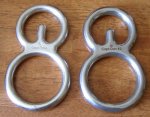
I’ve recently purchased a climbing “figure of eight” device on eBay for the princely sum of £6. It slows the boom during a gybe, rather than ‘preventing’, so to speak. I haven’t tried it out yet but I like the idea of not having to re-rig a preventer if you wish to sail with boom on the other side.
 
I’ve recently purchased a climbing “figure of eight” device on eBay for the princely sum of £6. It slows the boom during a gybe, rather than ‘preventing’, so to speak. I haven’t tried it out yet but I like the idea of not having to re-rig a preventer if you wish to sail with boom on the other side.
That’s what I did a few years back. It takes all the energy out of the boom in an accidental gybe and doesn’t need removing and replacing in the opposite tack after a planned gybe. I don’t use a winch on the line, so it can’t be tightened enough to stop the boom moving. I use it when we’re day sailing. If I were doing a long passage with a steady wind, I’d use a preventer as it gives a bit more peace of mind.
Brake is mounted where the mainsheet attaches at the centre of the boom, preventer always to the boom end.
 
I rig my preventer where the mainsheet attaches, because I can reach it from there whilst sitting on the cabin top or standing reasonably safely on the deck. I cannot reach the end of the boom. Saves having to round up into the wind & catch a flailing boom end. whilst standing on the cockpit seats. Once I get the line through the eye I do a big loop with a bowline so I can easily undo it without reaching outboard too much. As far as I am concerned that is it. If I have to reef the clew is more over the mainsheet point anyway, so no point in going to the end of the boom

Thats what I generally do for inshore sailing, for the same reasons (and amazing how much the big bowline helps to undo it safely).

BUT

If ever get into a situation where the wind or waves are such that the boom end can go in the water (eg after a mini broach), the forces will be enormous and much more likely to break the boom. That’s why it should go to the boom end, if at all possible.
Seen a lot of apparently very robust booms broken in this way.
 
I’ve recently purchased a climbing “figure of eight” device on eBay for the princely sum of £6. It slows the boom during a gybe, rather than ‘preventing’, so to speak. I haven’t tried it out yet but I like the idea of not having to re-rig a preventer if you wish to sail with boom on the other side.
Any chance of a link to show what the device looks like?
 
I cannot safely reach my boom end, so I keep my boom preventer lines permanently installed, connected to a soft shackle at the boom end. The line returns to blocks on the forward legs of the pushpit and back to cleats near the winches. It works for me and also is great at keeping the boom tight when at anchor.
 
I’ve recently purchased a climbing “figure of eight” device on eBay for the princely sum of £6. It slows the boom during a gybe, rather than ‘preventing’, so to speak. I haven’t tried it out yet but I like the idea of not having to re-rig a preventer if you wish to sail with boom on the other side.

I'm not persuaded to loop lines forward as per the classic preventer plan - potential for snagging rather obvious.
The involuntary jibe must be slowed to avoid breaking stress at the gooseneck. The suggested use of a climber's figure of 8 abseiling stopper is good. A specialist marine version is also on offer to slow a jibe but costs about a tonne!
Most will apply the preventer where the main attaches the boom. I do, and run the line via a strong point - middle mooring cleat - and back to the helm position.

I suspect that attaching to the boom end is capable of inflicting injury on the helm in stronger winds - seen it happen whilst crewing for others.

PWG
 
a. If you cannot reach the ends, leave them pre-rigged and tensioned to the front of the boom with a bungee. Morgan's Cloud introduced me to this idea.

b. All the meaningful force is transferred to the boom at the clew. Look at the sail reinforcements. Ask a sailmaker. The bolt rope foot of the sail is only an air dam.

c. If you Google "climbing figure 8" you'll see these. Yes, they sort of work on small boats, but not as well as purpose-built boom brake. I have used both.
0119cbb2-0fd0-44cd-9c1a-2f152d1df5f8_1.de86242dec670374a438373f07bd9434.jpeg

d. I know of one case where a boom brake resulted in a broken boom. It was probably over tightened.
 
a. If you cannot reach the ends, leave them pre-rigged and tensioned to the front of the boom with a bungee. Morgan's Cloud introduced me to this idea.

b. All the meaningful force is transferred to the boom at the clew. Look at the sail reinforcements. Ask a sailmaker. The bolt rope foot of the sail is only an air dam.

c. If you Google "climbing figure 8" you'll see these. Yes, they sort of work on small boats, but not as well as purpose-built boom brake. I have used both.
0119cbb2-0fd0-44cd-9c1a-2f152d1df5f8_1.de86242dec670374a438373f07bd9434.jpeg

d. I know of one case where a boom brake resulted in a broken boom. It was probably over tightened.
I used to get warning of too much strain - the preventer line would squeal and visibly stretch. Don't under-estimate the forces
 
I use a "figure of eight" too. I find it is important to remember that it is not a boom preventer but a boom brake that depends on friction. On smaller boats, one turn of the line may give enough friction but you can use two wraps if you need more on larger yachts. It's helpful to have one end of the line to hand because it needs adjustment to get the tension and friction right. I'll add some pictures soon.
 
I have a line permanently fixed to the boom's clew end, which is led forward to a point on the boom that I can reach from the companionway at any point of sailing. The line is terminated with a spring hook. When not used it is restrained by a bungee cord undeneath the boom. Prior to sailing I rig preventer lines port and starboard, each line being long enough to stay in place regardless of tack. They are joined with a soft shackle. When running downwind I attach the end of the permanent line from the boom end to the soft shackle conjoining the preventer lines. When gybing, it is then comparitively easy to allow, what becomes the windward preventer line, to hold the boom whilst taking in the slack on the mainsheet, thus controlling the manoevre. Having said that, i usually prefer to tack rather than gybe, but the setup doesn't inhibit that anyway.
Mike
 
I have a line permanently fixed to the boom's clew end, which is led forward to a point on the boom that I can reach from the companionway at any point of sailing. The line is terminated with a spring hook. When not used it is restrained by a bungee cord undeneath the boom. Prior to sailing I rig preventer lines port and starboard, each line being long enough to stay in place regardless of tack. They are joined with a soft shackle. When running downwind I attach the end of the permanent line from the boom end to the soft shackle conjoining the preventer lines. When gybing, it is then comparitively easy to allow, what becomes the windward preventer line, to hold the boom whilst taking in the slack on the mainsheet, thus controlling the manoevre. Having said that, i usually prefer to tack rather than gybe, but the setup doesn't inhibit that anyway.
Mike
+1 for rigging a permanent line from clew end to a clip at the gooseneck. No way I am going to try and attach a line to the boom end in conditions likely to need a preventer. Also regarding best attachment point, my boom end fitting has the word preventer cast into it so I’m pretty sure that’s what Selden recommend.
 
Top