Boom end rollers - hammer, fire, oil?

antaris

Well-Known Member
Joined
12 Jul 2012
Messages
249
Location
Athens, Greece
astarteginfizz.wixsite.com
Hello to all,

I am trying to bring my mizzen boom up to standard (and get rid of that wire - replace with dyneema).

How do I revive the (totally) stuck rollers of the outhaul? I tried WD40, heatgun and hammer action... not moving at all:
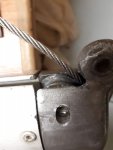
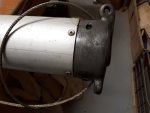
20200516_203700.jpg 20200516_195346.jpg

Axles are tubular, rollers are metal. Boom is 1978 vintage, French. And there are 2 of the buggers.

I can always drill them out and get over with it - and then spend 1 year looking for a tube axle that fits.... sensible solution, anyone? Or is there a standard replacement-parts procedure, after violent session?

Ta!
 
Hello to all,

I am trying to bring my mizzen boom up to standard (and get rid of that wire - replace with dyneema).

How do I revive the (totally) stuck rollers of the outhaul? I tried WD40, heatgun and hammer action... not moving at all:

View attachment 90398 View attachment 90399

Axles are tubular, rollers are metal. Boom is 1978 vintage, French. And there are 2 of the buggers.

I can always drill them out and get over with it - and then spend 1 year looking for a tube axle that fits.... sensible solution, anyone? Or is there a standard replacement-parts procedure, after violent session?

Ta!

Might it be steel and aluminium?

I had something similar last year. After I tried heat, I paid the yard to do it. They used heat like "owners sometimes tell us they tried heat, we REALLY use heat". Then some persuasion.
 
I had the same problem a few years ago and drilled a radial hole in the pulley towards the shaft. Then insert a suitable rod or screwdriver and work it back and forwards to free the pulley. Thereafter keep it well lubricated so it doesn't happen again. The small (4mm) hole doesn't seem to have any effect on the operation of the pulley and if the hole stops exactly on the shaft it can be used as an oiling point.
 
I normally find it easier to remove the fitting from, in this case the boom. Are you able to drill the axle out? or cut between the pulley and casing so that you can get the pulley out. This might make it easier to 'press' out the axle. If you are able to get replacement pulleys, if the axle is a different size this can always be got over by bushes or over drilling the holes.
 
With them old fittings, I am even sceptical of removing the rivets (maybe the boom end does not want to move even without said rivets removed)... we're taking 43 years of salt and electrolysis here!

Dear me, by the sounds of it, this is going to be... - heeey we love our boats!
 
I had the same problem a few years ago and drilled a radial hole in the pulley towards the shaft. Then insert a suitable rod or screwdriver and work it back and forwards to free the pulley. Thereafter keep it well lubricated so it doesn't happen again. The small (4mm) hole doesn't seem to have any effect on the operation of the pulley and if the hole stops exactly on the shaft it can be used as an oiling point.

Sounds like a good idea - yet the whole thing (all 3 parts, boom end, shaft and pulley) are totally seized up!
 
I had the very same issue on the base of a dinghy mast with 3 sheaves that refused to move.
Boiling water to try and remove any salt and crud, but if that, wd40 force and heat wont shift it you are going to have to remove the axle. Drill it out or can you get a fine metal hack saw blade in through the spring tube ?
 
I had the same problem a few years ago and drilled a radial hole in the pulley towards the shaft. Then insert a suitable rod or screwdriver and work it back and forwards to free the pulley. Thereafter keep it well lubricated so it doesn't happen again. The small (4mm) hole doesn't seem to have any effect on the operation of the pulley and if the hole stops exactly on the shaft it can be used as an oiling point.
Seems a very good idea...

usually if you can get any movement at all, with wd40 or my favourite (acetone and ATF) you will eventually get things free,

drilling out is usually the start of needing a new part as without a workshop and total control it is nigh on impossible to drill out s/s from aluminium without losing your way and to subsequently keep the replacement parts properly aligned.
 
The sheave having possibly been seized for some time I'd imagine that the wire has chewed the unseen part badly enough to make it a hostile environment for a dyneema replacement, so don't ditch the wire until you have the option of renewing the sheave.

I'd get the casting out and attack it on a bench, but failing that I too like the radial hole idea.
 
I had the same problem a few years ago and drilled a radial hole in the pulley towards the shaft. Then insert a suitable rod or screwdriver and work it back and forwards to free the pulley. Thereafter keep it well lubricated so it doesn't happen again. The small (4mm) hole doesn't seem to have any effect on the operation of the pulley and if the hole stops exactly on the shaft it can be used as an oiling point.

This method worked for me too. Once it's moving, I rotated the pulley by tapping with a screwdriver and hammer, plenty of lubrication until it spun freely.
A lot easier than drilling out the rivets and re-reveting again.
 
The sheave having possibly been seized for some time I'd imagine that the wire has chewed the unseen part badly enough to make it a hostile environment for a dyneema replacement, so don't ditch the wire until you have the option of renewing the sheave.

I'd get the casting out and attack it on a bench, but failing that I too like the radial hole idea.

Most likely the case: the sheave could not possibly be round (if anybody actually bothered to use the mizzen outhaul).
 
Replacement sheaves of a variety of sizes are reasonably easy to source.
(Google ‘replacement sheaves’ ...)

And drilling out the rivets and re-riveting is easy too.

A bit of heat and a parallel punch should remove the roll pin (I assume that’s what’s in there but can’t quite make it out on the photo and if it not a roll pin what’s holding it in place?)

SS rollpins are easily available. Other options available.
 
Last edited:
Most likely the case: the sheave could not possibly be round (if anybody actually bothered to use the mizzen outhaul).
Our spinnaker hoists used to be a little fraught.

WhatsApp Image 2019-06-08 at 18.20.17 (2).jpeg

RrpIxSKgCsuGU84M33cW75n4xCS7iWRDCUFTYehkddvlpn2UwR4vY5_6lgdvLLAHfveQEUkOSPdAFj5Nl1cjPjZdgjlrE9JaLFkjHSLhl0VqMRqm0ECQQ47Sg9oB1hFuJGR_2lSChWis9BY3pRcgXTO2KTds0uYJAxcNpT29P4YY6jHMY1SLXhPOhvNddtcsf0158NHtF1Rm-mI7jMVn8ydtpoi_0RHn9u4C2n_bEu-JgVkPQWHjKlR_7Dqfq66JQ7OkYRT9TTTlOeLE9GczU9vU9XGXLZLsRRNHWayoT7fZ9ePunsNysyj5SA-bbIjuK0-bg_AbOxMy9k94pdGEYZkpdEoJg6kNRcXMOyPObwFM6Kucs6InxAurPqCNjLy0aQcHyfckGsx-UZeM9VkiGqMutQ9XaFPVu3GQD99gngUnUpb-fymWYFeYVpVTRDNh-2yAgUiULAqZmyVFdEiGrrz_k8V3C8GpwPcFgP2iqe6JIGQLFr8lh8fu1LIy9DIzEfkl58D9kOMQcwJY_N8v7Tn5wLUDHdBj1anRskdRfHNJfW2oSKXNz0SFJjY4fnj1fxUBCLTBditcLu6WACTQ1bpp45uY-1Q4yeIgQuaOMoyzFRG9ER8gc5c4gej7kS6nK4tINDsner45bcUOGfS9wFBkr5L3ZT72Rwj1p8aQ48WBv6EnbrvhCAawX587=w426-h757-no
 
Last edited:
Examine the hollow shaft very carefully. I doubt its a roll pin, which can be identified because roll pins are made from flat steel rolled into a circle and do not usually make good bearings. They can be identified because of the visible point where the ends meet. I cannot see that in the photo. More likely is that a tubular shaft has been inserted and its ends expanded, Probably by hammering a drift into them. In that case the only option is to drill down to remove the tapered end, then hammer out the remainder with a suitable punch. I would not attempt to remove the boom end fitting, but instead take the whole boom to a workshop where it can be held by two people and drilled with a pillar drill. If its possible to find a piloted drill of the correct size, so much the better. Perhaps one of these special end mills? M3.2-M12.4 HSS Counterbore End Mill Cutter CNC Bit Tool Accessories from Tools, Industrial & Scientific on banggood.com
EDIT: Also easy to find on ebay, they are standard sizes made for sinking the heads of Allen screws, but quite useful if you need to drill out a tube.
 
Last edited:
I had similar issues when i bought my current boat.
I do suggest removing the end by drilling out the rivets and getting it into the workshop. the exact strategy to remedy the seized axle and sheeve will depend on the construction and people have already advised appropriate solutions. All of them will be easier in the workshop rather than on the boom.
Sheeves used for wire can be sharp edged and hard on a rope replacement, but sheeves of various sizes in "plastic" are readily available.

My contribution is to suggest that instead of riveting the fittings back on, drill and tap threads into the aluminium casting where the rivets were. Then use a countersink bit on the boom itself and re attach the end using a short countersunk head machine screw. (The loads are actually taken by the spigot or difference in diameters of boom tube and end piece. The rivets or screws just hold things in place. )

I have done the fittings on both ends of my boom like this and it makes disassembly for future maintenance really simple.
In my case 6 mm slot headed stainless steel countersunk machine screws were the right thing.
I have a 3:1 purchase tackle actually inside my boom for the out-haul plus the two clew reefing lines and things do wear out.
Simple disassembly has paid off.
Cheers
John
 
Top