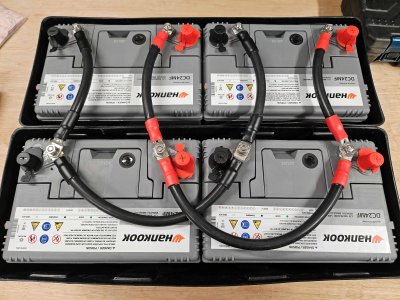
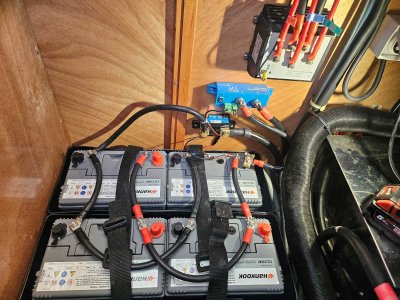
Boat Wiring Simplify and Upgrade - Beneteau Antares

So the 1st stage of the plan is:

1. Fit a -ve busbar to the side panel - I have room there and access is much better than trying to squeeze under the isolation switch. I will then run a feed from the open side of the -ve isolation to this busbar and use this to relocate the plethora of -ve's for windlass, thrusters, and ancillaries. That will take all the stacking of the isolation switch terminal but still allow me to have a -ve isolation (which I know is a bit unusual but will leave it as per Benetteau original)
2. Replace the 4 x house batteries with FLA lesisure batteries. Only thing to decide is whether to go 4 x type 24 85aH or 2 x "big batteries 130aH or 180aH" same size as the starter batteries. The latter is much simpler cabling as you are not having to link 4 batteries together. Any views?

@PaulRainbow The +ve for the thrusters/windlass/starter are currently on the engine isolation switches post open side so I am planning to keep them there as the stacking isn't bad (3 per post) and they need to be switched rather than direct to battery. Does that make sense? Its a load of hassle to extend all these 95mm cables to take them to a busbar and as you said doesn't really add a lot of value.

Cheers,

TC
 
label the cables as you go
i put a big -ve bus bar in 4 a similar setup
and took the -ve isolator switch out
went for trojan lead acid, but looking at the tight spaces, you need to check out what fits first
Agreed Simon, that was my first job, labelling and tracing wires as everything looks the same and had no labelling at all :rolleyes:

See note above re replacing the house batteries

Cheers
TC
 
So the 1st stage of the plan is:

1. Fit a -ve busbar to the side panel - I have room there and access is much better than trying to squeeze under the isolation switch. I will then run a feed from the open side of the -ve isolation to this busbar and use this to relocate the plethora of -ve's for windlass, thrusters, and ancillaries. That will take all the stacking of the isolation switch terminal but still allow me to have a -ve isolation (which I know is a bit unusual but will leave it as per Benetteau original)
-VE switch is common on French production boats. I'd put the battery, windlass and thruster cables on the same busbar stud, so those heavy loads are not running through the busbar.
2. Replace the 4 x house batteries with FLA lesisure batteries. Only thing to decide is whether to go 4 x type 24 85aH or 2 x "big batteries 130aH or 180aH" same size as the starter batteries. The latter is much simpler cabling as you are not having to link 4 batteries together. Any views?
Whichever gives the most AH
@PaulRainbow The +ve for the thrusters/windlass/starter are currently on the engine isolation switches post open side so I am planning to keep them there as the stacking isn't bad (3 per post) and they need to be switched rather than direct to battery. Does that make sense? Its a load of hassle to extend all these 95mm cables to take them to a busbar and as you said doesn't really add a lot of value.

Cheers,

TC
I would also leave those as they are.
 
Thanks, that all makes sense. As it turns out I ended up fitting the busbar exactly where you suggested under the isolation switches as some of the cables wouldn't reach to the new location.

Only challenge with mounting the heavy loads on one stud is I have 2 x thrusters plus battery plus windlass, and all are run in 95mm which means trying to get them all on the same stud is a nightmare cause the cables are so thick :(

The bar is rated at 250A although this is combined, the individual rating is 62.5A - is that normal?

Cheers,

TC
 
Thanks, that all makes sense. As it turns out I ended up fitting the busbar exactly where you suggested under the isolation switches as some of the cables wouldn't reach to the new location.

Only challenge with mounting the heavy loads on one stud is I have 2 x thrusters plus battery plus windlass, and all are run in 95mm which means trying to get them all on the same stud is a nightmare cause the cables are so thick :(

The bar is rated at 250A although this is combined, the individual rating is 62.5A - is that normal?

Cheers,

TC
Not usually.
 
So atter spending the weekend mostly upside down in the battery compartment 🙃 I have an initial layout. Still a bit of tidying up to do with the cables on the right and a few more cable ties to add.
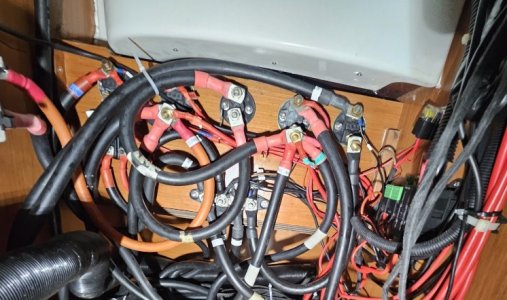
Still need to decide what I will do with the -ve busbar, no way I can see to stack 3 x 95mm terminals on one stud.

Bizzareley it almost looks worse, but is actually a lot more logical and tidied away, its just I have the heavy cables out front rather than hidden behind all the various other wires!


2025-01-26 16.55.49 (Medium).jpg

Next stop ordering 4 x FLA Leisure batteries

Cheers,

TC
 
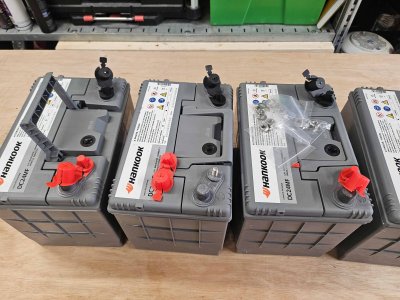
Quick question, new house batteries are here and just about to make up the patch leads. Is there any advantage/disadvantage to using the post terminals or the studs?

Cheers,Batteries.jpg


TC
 
Tempting though it is for logical tidiness, avoid daisy chaining your leads off from the ends of your jumper leads. Better to connect the set via the bottom left or right battery in your image so the load is taken as close to the centre of your paralleling leads as possible to distribute the charge/discharge through the cables better.
 
Tempting though it is for logical tidiness, avoid daisy chaining your leads off from the ends of your jumper leads. Better to connect the set via the bottom left or right battery in your image so the load is taken as close to the centre of your paralleling leads as possible to distribute the charge/discharge through the cables better.
The connections should be made to the top left negative and top right positive.
 
House batteries installed with new Victron battery protect to hopefully stop them destroying themselves when I forget to turn on the charger!

What disconnect voltage do people suggest for the battery disconnect?

House Battery Install.jpg

Cheers,

TC
 
Second question, the house batteries are charged through the +ve lead that goes from the "out" of the battery protect to the isolator swicth.

Just reading the battery protect instructions it says you can't use it for "reverse current". Does that mean I need to run seperate leads from the chargers (A/C and Engine) direct to the +ve terminal on the battery bypassing the battery connect?

Cheers,

TC
 
Second question, the house batteries are charged through the +ve lead that goes from the "out" of the battery protect to the isolator swicth.

Just reading the battery protect instructions it says you can't use it for "reverse current". Does that mean I need to run seperate leads from the chargers (A/C and Engine) direct to the +ve terminal on the battery bypassing the battery connect?

Cheers,

TC
Chargers go straight to the batteries, suitably fused.

11.8V cut off is about 30%. You don't ideally want to run the batteries down to 30%, but if you set it much higher you could have the loads cut by a heavy load that pulls the terminal voltage low enough to "trip" the battery protect, although the batteries are really at a higher SOC.
 
Cool, thanks Paul. I will terminate the AC charger and alternator (via battery isolator) direct to battery rather than to isolation switch then.

At the moment none of the AC or Alternator charging circuits are fused, they all terminate straight onto the isolator switches. Would you recommend fusing them all and if so at source or at battery? Max output in the Victron charger is 30A so guess something a bit higher than that?

Cheers

TC
 
Cool, thanks Paul. I will terminate the AC charger and alternator (via battery isolator) direct to battery rather than to isolation switch then.

At the moment none of the AC or Alternator charging circuits are fused, they all terminate straight onto the isolator switches. Would you recommend fusing them all and if so at source or at battery? Max output in the Victron charger is 30A so guess something a bit higher than that?

Cheers

TC
Mains charger connects to each bank, fused close to the batteries, 40A should be OK.

How/where is the alternator connected ?
Any split charging to allow the alternator to charge all banks ?
 
Alternators (twin engines) go into a Cristec RCE 100/2E - 3 Battery Isolator and then spread over the 3 banks. Currently these wires are going to the switched (output) side of the engine and house isolation switches (un-fused)

The AC charger (Victron BlueSmart) is going to the un-switched (input) side of the engine and house isolation switches (un-fused)

Thanks for the help :)

TC
 
Alternators (twin engines) go into a Cristec RCE 100/2E - 3 Battery Isolator and then spread over the 3 banks. Currently these wires are going to the switched (output) side of the engine and house isolation switches (un-fused)

The AC charger (Victron BlueSmart) is going to the un-switched (input) side of the engine and house isolation switches (un-fused)

Thanks for the help :)

TC
OK, connect the mains charger and the Cristec unit to the battery side of the isolators and fuse all connections at source to protect the wiring.
 
Top