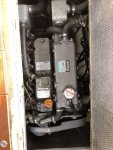
Boat owners’ near universal whinge

My manual bilge pickup is on the end of a long hose which is not visible in the pic ..... I can slide it to the port or starboard side of the boat and pump out in the situation you describe (y) :) ..... haven't needed to do it yet though, both pumps, manual and electric, get tested once a year or so because they've never been needed - the vacuum cleaner sees more use in the bilge than the pumps.
Yes that was the same for my previous Bav 38 and my current Bav 33, dust bunnies were the biggest problem I had :D
 
Until you are sailing across an ocean, on the same tack for a week or more, when the water that's collected in the bilge is nowhere near the bilge drain until the next time the boat is level, and you need to wear wellingtons every time you stand at the gallery to cook a meal. :rolleyes:
Actually my boat does not leak.
However, I have inserted a hoselock fitting in the shower pump line & have a long wandering hose fitted which can be inserted just before the pump. With this I can " hover" up any spillages .( typically under the engine, or for when I clean the log impeller) It also has a 6mm copper pipe, for the end, which I insert through an 8mm hole in the cabin floor when the boat is upright & can suck up even the smallest amounts of water that may have collected in the bilge without raising the boards.
 
A magnet is handy and we used to use a piece of locking wire locked to a spanner and the other end around the wrist so it could be retrieved from an impossible retrieval point....or when working in snow on excercise in case we dropped a small spanner......back in the day working on helicopters......couldnt lose any tools because of strict tool control. I spose a bit of string would do the job equally well....
 
A magnet is handy and we used to use a piece of locking wire locked to a spanner and the other end around the wrist so it could be retrieved from an impossible retrieval point....or when working in snow on excercise in case we dropped a small spanner......back in the day working on helicopters......couldnt lose any tools because of strict tool control. I spose a bit of string would do the job equally well....
There was a time we wished we'd had a magnet on a stick - we were reassembling the cylinder head after stripping it down, and dropped a washer down the hole for the push-rod. Not something you want to take a chance on! It took us ages to recover it using the usual resources of bits of wire coat hanger; after that I purchased one of those things with a magnet on a telescopic stick. A magnet on a string wouldn't work in that situation - not in a hole through a cast iron block!
 
All the dodgy wiring under the transom that I inherited with the boat is only accessible through a tiny hatch that I can just about get my head and hands through when lying on my back. Of course, being follicly challenged I inevitably cut my head on a sharp projection every time I went down there. Dug out my old scrum cap and I don it whenever I think "I'll be ok!" :)
 
A Bavaria 36, 1999 vintage with very good engine/saildrive access from front and both sides.

The engine is also a little 3 cylinder D1-30 producing a whopping 29 hp. We removed the old MD2030 in 2016 and it wasn't very heavy - 2 man lift.

Obviously everything depends on how the boat builder has decided to install the engine/saildrive and how big and unwieldy the engine is.

In mine, disconnect exhaust and a few hoses, slide the engine forward and the saildrive lifts up and out the side into one of the stern cabins. Replace the seal and as Haynes says, reassembly is simply the reversal of this procedure.


View attachment 84854

Thanks for sharing your experience, informative and appreciated. You seem quite "laid back" that disconnecting the exhaust, a few hoses, jacking the engine and sliding it forward is all part of routine maintenance. I think it's bloody ridiculous, hence my vote for boat owners whinge.

Yanmar period is said to be 5 years. I've asked Yanmar and Beneteau for real life cycle information and been ignored by both. One Dealer told me to "think about it after 10 years"

I like to keep my boat in good condition and I fear collateral damage, scratches etc due to the nature of the work. As I've said many times before, saildrives offer eloquent design solutions but most (not all) builders pay scant regard to maintenance, hence my conclusion that they are an abomination ;)

DSC_0004.JPG
 
Thanks for sharing your experience, informative and appreciated. You seem quite "laid back" that disconnecting the exhaust, a few hoses, jacking the engine and sliding it forward is all part of routine maintenance. I think it's bloody ridiculous, hence my vote for boat owners whinge.

Yanmar period is said to be 5 years. I've asked Yanmar and Beneteau for real life cycle information and been ignored by both. One Dealer told me to "think about it after 10 years"

I like to keep my boat in good condition and I fear collateral damage, scratches etc due to the nature of the work. As I've said many times before, saildrives offer eloquent design solutions but most (not all) builders pay scant regard to maintenance, hence my conclusion that they are an abomination ;)

When I was a teenager I used to whip the engines and gearboxes out of my various cars in an evening, reinstallation was just as fast - one of my cars had three different engines in the two years I owned it. Clutches were service items which usually involved seperating engine and gearbox (but not in my Maxi).

Getting a saildrive out, if it is easily accessible, is not something that particularly scares me - maybe that explains my laid back attitude. It's no more difficult or prone to damage than dropping the mast over winter IMHO.

Everyone has a different experience and opinion I guess.
 
When I was a teenager I used to whip the engines and gearboxes out of my various cars in an evening, reinstallation was just as fast - one of my cars had three different engines in the two years I owned it. Clutches were service items which usually involved seperating engine and gearbox (but not in my Maxi).

Getting a saildrive out, if it is easily accessible, is not something that particularly scares me - maybe that explains my laid back attitude. It's no more difficult or prone to damage than dropping the mast over winter IMHO.

Everyone has a different experience and opinion I guess.
But I, and I guess quite a lot of others, wouldn't consider dropping our mast without the use of a boatyard crane and skilled assistance - there's too many ways things can go badly pear-shaped. I remember from when I was about 9 or 10 things very nearly going fatally wrong when my Dad tried to lower the mast on our first "big boat"!
 
When I was a teenager I used to whip the engines and gearboxes out of my various cars in an evening, reinstallation was just as fast - one of my cars had three different engines in the two years I owned it. Clutches were service items which usually involved seperating engine and gearbox (but not in my Maxi).

Getting a saildrive out, if it is easily accessible, is not something that particularly scares me - maybe that explains my laid back attitude. It's no more difficult or prone to damage than dropping the mast over winter IMHO.

Everyone has a different experience and opinion I guess.

I get your point but I think that a saildrive hull seal is a different issue. I started my apprenticeship in 1971 and, like you, have removed engines from Lambrettas and from my first few cars. The cars were old, barely saved from the scrap yard because I had the ability to put them back on the road. Hardly routine, scheduled maintenance.

Fast forward a lifetime, my (new) boat had a fairly high price tag. If you bought a couple of new Porsche 911s would you expect to have to move the engines forward in order to service something (that should be) basic and simple at 5 years?

Also, remaining with the car analogy, I’d buy a Workshop Manual before embarking upon something major like moving an engine. Try getting any help from the boat maker ?

I wholeheartedly agree with tour final paragraph. The world would be a dull place if we were all the same ?
 
When I was a teenager I used to whip the engines and gearboxes out of my various cars in an evening, reinstallation was just as fast - one of my cars had three different engines in the two years I owned it. Clutches were service items which usually involved seperating engine and gearbox (but not in my Maxi).

Getting a saildrive out, if it is easily accessible, is not something that particularly scares me - maybe that explains my laid back attitude. It's no more difficult or prone to damage than dropping the mast over winter IMHO.

Everyone has a different experience and opinion I guess.
Here's the real problem if you don't mine me saying , most of us are no longer boys we can't get into places we use to be able , we I was a boy ( god I sound like my old dad now god rest his sol I use to lid on my back under a Thames van And slide the gear box out on my chest then me and the box use to wiggle from under the van , I don't thing I get under a van now .
 
Here's the real problem if you don't mine me saying , most of us are no longer boys we can't get into places we use to be able , we I was a boy ( god I sound like my old dad now god rest his sol I use to lid on my back under a Thames van And slide the gear box out on my chest then me and the box use to wiggle from under the van , I don't thing I get under a van now .
Yes, that's the real problem - anno domini gets to us all! I too no longer have the flexibility to get into spaces I once could.
 
Here's the real problem if you don't mine me saying , most of us are no longer boys we can't get into places we use to be able , we I was a boy ( god I sound like my old dad now god rest his sol I use to lid on my back under a Thames van And slide the gear box out on my chest then me and the box use to wiggle from under the van , I don't thing I get under a van now .

Good point, I haven't got to that stage yet - when I do, I'll probably feel the same. The issues are however associated with aging, and it's us that age, the difficulty of the job hasn't changed, just our ability to do it - so one persons 5 minute job can be anothers impossible task.

Unfortunately, "service items" assume that the person doing the servicing is up to the job, both mentally and physically, and that they have the correct tools - as far as accessibility is concerned, that's the yacht designers job, but not everything can be designed to be serviced by an octogenarian with mole grips and a screwdriver (not in any way intended as an insult to octogenarians by the way).

This may go some way to explaining why some see a saildrive seal replacement as a mammoth job and others don't - I'd put it up there with clutch replacement on a car, and that is accepted as an infrequent service item.

If I buy a VP saildrive boat aged 40 and give up sailing 35 years later at 75, I will have done 4 seal changes ... with the 5th one pending. That's not too bad IMO - and in all the time I've owned mine, it has never leaked so much as a drip and the old seals have shown no sign of wear or damage when they were replaced.
 
Changing my seal wouldn't be a problem although I not done one for 15 years now on another boat , is moving the engine forward enough to be able to remove the sail drive , I think I would have to take the engine and drive out in one go through the cockpit floor.
 
Drift: lifted the engine out of my Bedford Beagle van, Vauxhall Viva basically, with a chain hoist on a tree. had to change the distributor drive as I remember, it was an offset slot which would break off and make the timing very random. Maybe clutch as well.
On refitting a gale had sprung up, I had the engine in and out eleven times before I got a bolt in.
Another clever trick, changing brake pads, I lifted the front with the trawler gilson, by Penryn quay. The boat slowly rolled upright, (Lenten will remember the JPA, later named Llamedos) the car rolled forward so I had it front hanging over the boat, back wheels on the quay, and the tide going out, no more engine when it does. Had to get a very worried passer by to reverse the car while I lowered away.
 
Top