Boat owners’ near universal whinge

Who else remembers the little 2" heater hose in the BLMC Mini..... that always split and needed replacement in February/March, at night, on a Motorway?
Perhaps the designer of that now works for Beta Marine, and invents the parts one can see but not quite touch as well as the parts one can touch but not see....


The main memory of the Mini - was stupid idea of placing the distributor in front of engine - guaranteeing water in it !!

I was more clever ... I let my mates have Mini's ... I had a Sunbeam Imp Sport ... Coventry Climax engine ... twin strombergs, powered brakes, oil cooler ... brilliant machine.
 
You’ve just described a “sail drive”.

Disconnect and/or remove most ancillaries and in some cases the engine itself, then remove gearbox just to change a rubber seal. I’m not sure if it shows lack of regard to maintenance or contempt for the owner. Absolutely crazy design for an AWB.

... and yet it seems to be the go-to solution for most modern yachts. A 7 year maintenance item .... I paid to have mine done - it wasn't particularly expensive and was done in half a day while the boat was out for anti-fouling. No stern glands, balance or alignment problems and no bent P bracket. Not much to choose in terms of hassle and maintenance between a saildrive or shaft - so it can be left to personal preference IMO.
 
... and yet it seems to be the go-to solution for most modern yachts. A 7 year maintenance item .... I paid to have mine done - it wasn't particularly expensive and was done in half a day while the boat was out for anti-fouling. No stern glands, balance or alignment problems and no bent P bracket. Not much to choose in terms of hassle and maintenance between a saildrive or shaft - so it can be left to personal preference IMO.

That’s good to hear. I can see the advantages for the boat builder but I don’t believe that maintenance was high, if at all, on their list of considerations. Mine is said to be a 5 year cycle and I’ve been told “a couple of days” by a yard with a fairly expensive price tag attached. Plus, there’s a fair amount of hardware to be removed with quite a chance for collateral damage. Goes against the “if it ain’t broke, don’t fix it” philosophy.

What boat do you have?
 
Who else remembers the little 2" heater hose in the BLMC Mini..... that always split and needed replacement in February/March, at night, on a Motorway?
Perhaps the designer of that now works for Beta Marine, and invents the parts one can see but not quite touch as well as the parts one can touch but not see....
Oh yes!
 
That’s good to hear. I can see the advantages for the boat builder but I don’t believe that maintenance was high, if at all, on their list of considerations. Mine is said to be a 5 year cycle and I’ve been told “a couple of days” by a yard with a fairly expensive price tag attached. Plus, there’s a fair amount of hardware to be removed with quite a chance for collateral damage. Goes against the “if it ain’t broke, don’t fix it” philosophy.

What boat do you have?

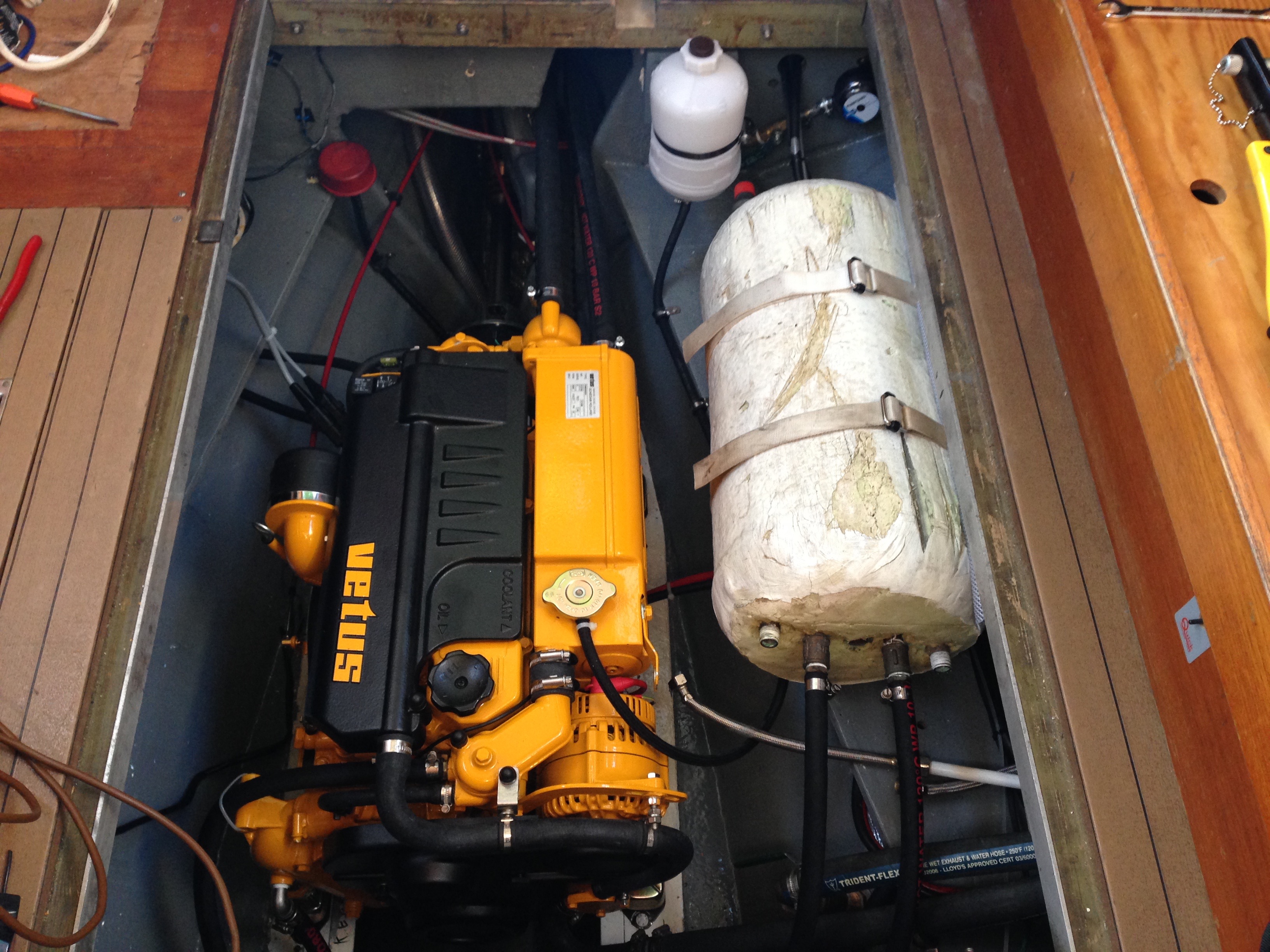
A Bavaria 36, 1999 vintage with very good engine/saildrive access from front and both sides.

The engine is also a little 3 cylinder D1-30 producing a whopping 29 hp. We removed the old MD2030 in 2016 and it wasn't very heavy - 2 man lift.

Obviously everything depends on how the boat builder has decided to install the engine/saildrive and how big and unwieldy the engine is.

In mine, disconnect exhaust and a few hoses, slide the engine forward and the saildrive lifts up and out the side into one of the stern cabins. Replace the seal and as Haynes says, reassembly is simply the reversal of this procedure.


IMAG2848.jpg
 
I must be incredibly lucky apart from a primary fuel filter under the rear bunk, now moved to somewhere sensable. and the afterthought of a hot water tank hidden in the locker behind the heads everything is within easy reach.
 
The local fishermen even in their smallest boats have a dedicated engine room even if some crew have to shelter on de k.Probably in a 35 foot yacht there is space for proper engine access and access to tanks etc.Probably have to give over some volume in the galley or shower but the space to properly maintain essential stuff would mean more satisfaction to the owner and stuff would be better maintained.
We have a 31' motorsailer; once the engine hatch on the wheelhouse floor (very un-nautical, deck is correct) is open I can stand on either side of my engine and get at all the bits and without the yoga.
My father had a C&C 25 with an inboard petrol Vire engine. To change the spark plug you had to lay head-down, on your back, head facing inboard, in the cockpit locker with your feet sticking up and out. It took over an hour to get the plug out since one could only make less than a quarter turn with the wrench as there was zero space between the engine and the cockpit floor. The boat was kept on a fairly rolly mooring; I usually do not get sick on boats ... To do a major service, the engine had to be disassembled and handed out in bits - we only did that once, then we put an outboard on the back.
 
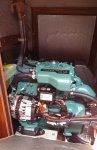
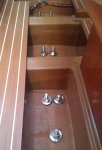
Feeling naively hopeful about this

img_3100.jpg


Much more accessible than current boat, which involves about 30 minutes of disassembling things and walking on the top of the engine, plus an inaccessible isolated bilge for some reason that has a tendency to fill from rainfall and needs a lift pump now and then.
 
A Bavaria 36, 1999 vintage with very good engine/saildrive access from front and both sides.

The engine is also a little 3 cylinder D1-30 producing a whopping 29 hp. We removed the old MD2030 in 2016 and it wasn't very heavy - 2 man lift.

Obviously everything depends on how the boat builder has decided to install the engine/saildrive and how big and unwieldy the engine is.

In mine, disconnect exhaust and a few hoses, slide the engine forward and the saildrive lifts up and out the side into one of the stern cabins. Replace the seal and as Haynes says, reassembly is simply the reversal of this procedure.
Sexy though it is you should have bought a Cummins. Pure white, the best colour. And the name would remind you of a certain rather shrewd government advisor.
 
I would think that marinas would attract much more business in the winter months
if they had an on site osteopath at weekends. They could at least sort us out so we can drive home.

I have found that vary lens spectacles don't work well when working upside down . Another
potential revenue stream for wise opticians in sailing areas.
 
Funny you should say that. My boat has got a Yanmar 4JH5E under the cabin sole with great big sound proofed hatches over it. Perfect! ...

... except that the bottom of the engine bilge is just three feet below the sole... some bits can be reached and others can’t, because the engine has been shoe horned into the space...

... There’s a screwdriver that I dropped into the engine bilge six months ago, which has worked itself to a spot that is just out of reach... if you see me over canvassed and rail under on the port tack you will know why...
Lot to be said for boats with virtually no bilge.
I have read some of this thread & can honestly say that apart from a sanitary hose, that I have renewed twice now, i have had no reall difficulty reaching or accessing anything whatsoever in my Hanse 311. Even changing the saildrive second time round was fairly easy on my own. Passing wires from the hatch garage through the head lining would be easier with help. But there is no part of the boat that is awkward. The engine comes out esily. Changing the rudder was easy. Draining & cleaning the fuel tank & black water tanks is a doddle. Getting them out is easy. Changing the exhaust system might be a faff, as could changing the air bleed hose to the fuel tank. But the boat is so designed that it must be one of the easiest to work on. The fresh water tank would involve some GRP cutting away but it is SS so hopefully not needed for years yet. the pipework is not too hard to access . So all in I can say well done Hanse.
 
On my little boat the bolts for the transom mounted rudder pintles are only accessible via the quarter berth on one side. It is long way down sliding on your back. One trick that really is to tie a decent thickness rope (jib sheet) around the mast support and take the end with me. I can use the rope to haul myself out again. Although better still is to get son (the future owner I hope) to do the job. ol'will
 
Who else remembers the little 2" heater hose in the BLMC Mini..... that always split and needed replacement in February/March, at night, on a Motorway?
Perhaps the designer of that now works for Beta Marine, and invents the parts one can see but not quite touch as well as the parts one can touch but not see....

Actually, that's an easy one once you know how. Piece of string and 2 fingers.... :)
 
Feeling naively hopeful about this

img_3100.jpg


Much more accessible than current boat, which involves about 30 minutes of disassembling things and walking on the top of the engine, plus an inaccessible isolated bilge for some reason that has a tendency to fill from rainfall and needs a lift pump now and then.
The obvious advantage of older style hulls with a deep bilge, where the engine can be hidden under the floor boards of the dog - or wheelhouse. Disadvantage: if you drop your screwdriver or that "special" brand-bespoke nut, its gone forever in the four foot deep sump below.
 
Lot to be said for boats with virtually no bilge.
Until you are sailing across an ocean, on the same tack for a week or more, when the water that's collected in the bilge is nowhere near the bilge drain until the next time the boat is level, and you need to wear wellingtons every time you stand at the gallery to cook a meal. :rolleyes:

The obvious advantage of older style hulls with a deep bilge, where the engine can be hidden under the floor boards of the dog - or wheelhouse. Disadvantage: if you drop your screwdriver or that "special" brand-bespoke nut, its gone forever in the four foot deep sump below.

Tell me about it. :( All helps with the ballast ratio, though. :D
 
I should think my FV was luxurious in this regard, by comparison. I had to crawl back to the rudder post one day at sea, the ram had detached, the nut came off, never known before or since. I was on a lee shore, but since the aft wheelhouse kept her head up, I was able to leave her ticking over ahead. Space 2ft high and 10ft long. Bit ticklish with the rudder slapping about. The worst thing was alternator belts because of the PTO and auxiliary stuff on the front end. Four bolts for the hydraulic pump, which weighs 20kg, then lift clear with a string tackle above, four bolts for the Jabsco deckwash, then all the usual alternator bits, then all back again, and align the pump with shims, never the same in as out. Of course I left a spare set of belts strapped to the engine, but the old belts took all that with them, and the jabsco link belt....B section...£40, thanks very much.
 
Until you are sailing across an ocean, on the same tack for a week or more, when the water that's collected in the bilge is nowhere near the bilge drain until the next time the boat is level, and you need to wear wellingtons every time you stand at the gallery to cook a meal. :rolleyes:

My manual bilge pickup is on the end of a long hose which is not visible in the pic ..... I can slide it to the port or starboard side of the boat and pump out in the situation you describe (y) :) ..... haven't needed to do it yet though, both pumps, manual and electric, get tested once a year or so because they've never been needed - the vacuum cleaner sees more use in the bilge than the pumps.
 
Top