Boat in build pics (Squadron 78)

I'm intrigued. A 64 footer weighing 48 tonnes with 2x2000hp. Sheesh. At 2300rpm it's doing 45 knots or something? And at 1800rpm it's doing maybe 35? You reckon the data is valid for an OR doing 17kts at say 1800rpm, or my Fairline doing 23 kts at 1800rpm? Do you think the data isn't (massively) influenced by hull speed, even though this is all about drag? I don't know; I'm just asking
 
Dunno J, not many SD boats with them yet.

The 64 Sport fish was reported at max WOT 38 Knts without ST and 39.5 Knots with ST.

When it comes to engine load I doubt it makes much difference whether planing or SD that bit is not so much about drag more about less resistance of the drive prop in the tubes.

My guess is the fuel saving at lower speeds is minimal, one would consider it because of the low/zero maintainance and less vibration than standard couplings etc. From a builders perspective easier installation too .

Having said that even if fuel saving was only 3% over 4000NM is a little saving anyway.
 
Mike/Nick
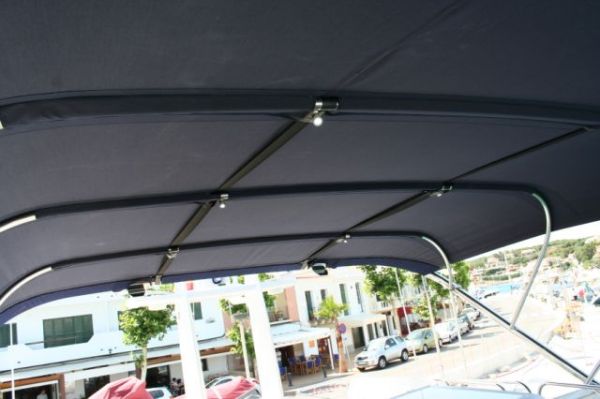
Yes the Fairline bimini is the Flexicovers product. The lights are a standard Fairline option, so I haven't looked into them much or specced them specially. I therefore don't know exactly the spec, As Nick says there are pics on Flexicovers website, and here is a pic of a 2009 Fairline 78 (taken from a secondhand boat for sale ad) showing the lights
2078225_45.jpg

How do they work when you fold the bimini back.
I'd have thought they would get squashed.

Our FB is a bit gloomy at night as well.
Lights are fitted in the underside of the radar arch but they only light the eating/table area
Might be an idea to have some in the bimini as well.
 
I'm intrigued. A 64 footer weighing 48 tonnes with 2x2000hp. Sheesh.
I don't know what boat was used for those tests, but that's rather typical of US sport fish boats like Bertram or Hatteras.
Massively built, very beamy, mainly meant to bash ocean waves at 25+ knots, rather than aiming at flat out performance.
A Pershing 64' can indeed reach 45 kts or so with "only" 2x1500.

Returning to your question, actually I don't have a lot to add to what Nautical already said.
Also my main reasons to spec ST if I were building a new boat are more along the lines of reduced maintenance and vibration/noise (thus overall comfort, particularly for those who like to sleep during night passages).
Whatever comes on top of all that in terms of higher efficiency is of course a bonus, but the previous numbers show why I don't believe - with all due respect - Tony Fleming claims.
An improvement of 1.5kts at 38kts on a planning hull is obviously much smaller than an improvement of 1.5kts on a SD hull at 15kts, where it's already being pushed near its limits. A genuine half knot would already be a fantastic result on such boat, imho.

Re.the other topic of fuel lines cooling, I can report my first hand experience.
Four stainless steel tanks, all in the e/r, one cubic meter each, working as one virtual tank (connection valves open).
Engines feeded from lines drawing from the bottom and return lines re-entering from the top of the tanks, as you said.
When I bought the boat, no coolers were fitted, and I noticed that the e/r temperature was slowly but constantly increasing while cruising, regardless of whether the vent were turned on or not. Mind, it took hours, not minutes, and the temperature increase was not so worrying (roughly 1°C per hour, IIRC).
After the first longish cruise (8 hours or so), the doubt that the fuel return lines had something to see with that popped to my mind, and I went down to check the tanks. I could not keep a hand on the top of them for more than a second, and they were equally hot also along the side walls, for their whole height.
I suppose that there are two reasons why the hot and cold fuel didn't stay separate as you suggested: the first is the boat motion, which obviously depends on sea conditions (which were rather rough during the cruise I'm talking about), and the second is that the hot fuel on top heats the steel of the tanks, thus heating the whole tank structure and eventually also the fuel on the bottom.
Anyway, upon my return I fitted coolers on the return lines of each engine. Since then, I don't even run the vents while cruising. And after the longer non stop passage I've made (34 hours), the tanks were as cool as the rest of the e/r: 6 or 7 degrees above the external temperature.
 
I don't know what boat was used for those tests, but that's rather typical of US sport fish boats like Bertram or Hatteras.
Massively built, very beamy, mainly meant to bash ocean waves at 25+ knots, rather than aiming at flat out performance.
A Pershing 64' can indeed reach 45 kts or so with "only" 2x1500.

Returning to your question, actually I don't have a lot to add to what Nautical already said.
Also my main reasons to spec ST if I were building a new boat are more along the lines of reduced maintenance and vibration/noise (thus overall comfort, particularly for those who like to sleep during night passages).
Whatever comes on top of all that in terms of higher efficiency is of course a bonus, but the previous numbers show why I don't believe - with all due respect - Tony Fleming claims.
An improvement of 1.5kts at 38kts on a planning hull is obviously much smaller than an improvement of 1.5kts on a SD hull at 15kts, where it's already being pushed near its limits. A genuine half knot would already be a fantastic result on such boat, imho.

Re.the other topic of fuel lines cooling, I can report my first hand experience.
Four stainless steel tanks, all in the e/r, one cubic meter each, working as one virtual tank (connection valves open).
Engines feeded from lines drawing from the bottom and return lines re-entering from the top of the tanks, as you said.
When I bought the boat, no coolers were fitted, and I noticed that the e/r temperature was slowly but constantly increasing while cruising, regardless of whether the vent were turned on or not. Mind, it took hours, not minutes, and the temperature increase was not so worrying (roughly 1°C per hour, IIRC).
After the first longish cruise (8 hours or so), the doubt that the fuel return lines had something to see with that popped to my mind, and I went down to check the tanks. I could not keep a hand on the top of them for more than a second, and they were equally hot also along the side walls, for their whole height.
I suppose that there are two reasons why the hot and cold fuel didn't stay separate as you suggested: the first is the boat motion, which obviously depends on sea conditions (which were rather rough during the cruise I'm talking about), and the second is that the hot fuel on top heats the steel of the tanks, thus heating the whole tank structure and eventually also the fuel on the bottom.
Anyway, upon my return I fitted coolers on the return lines of each engine. Since then, I don't even run the vents while cruising. And after the longer non stop passage I've made (34 hours), the tanks were as cool as the rest of the e/r: 6 or 7 degrees above the external temperature.

MapisM, jfm or one of the other engineers, could you tell me what benefits there are from cooling the fuel? Do diesel engines run more efficiently with cooler fuel? If so, surely it would be better to cool the fuel feed lines rather than the return lines. Are there other benefits beyond generally reducing the ambient temperature resulting from the tanks acting as a radiator. Sorry if this is an elementary question - am genuinely curious.
 
MapisM, jfm or one of the other engineers, could you tell me what benefits there are from cooling the fuel? Do diesel engines run more efficiently with cooler fuel? If so, surely it would be better to cool the fuel feed lines rather than the return lines. Are there other benefits beyond generally reducing the ambient temperature resulting from the tanks acting as a radiator. Sorry if this is an elementary question - am genuinely curious.
That's actually a good question, which I'm afraid I won't be able to answer accurately.
Trouble is, I did get a proper explanation on this subject quite some years ago, from someone who was definitely an engineer (whilst I'm not) - the chief engineer of SeaTek - but I can't remember the details. It had something to see with the higher density of cool fuel, which up to a point makes the engine run more efficiently and generating a higher output.
Maybe some other more techy forumites can add or correct as appropriate.
Anyway, that guy is one of the very few who can claim to have built marine diesels reaching the mark of 100hp/litre and 100hp/kg, and he confirmed me that for the above reason (albeit much better explained) fuel coolers are standard on all their high output engines.
So, when I decided to fit coolers also on my boat, I knew it makes sense, though efficiency improvement wasn't my main target.
Btw, the Cat mechanic who did the installation happened to agree, and it wasn't such a costly upgrade to make him agree with my request just for the sake of getting the job.

That said, you're probably right saying that cooling the feed lines seems more logical if you look at engine efficiency alone. But that wouldn't stop the progressive build up of tank heat, which ultimately (in my boat at least) was the main problem. Also because in the engines designed to be cooled by both the closed circuit AND the fuel, the hotter the fuel, the lower its cooling effect, which in turn means even hotter fuel on return lines. A vicious circle I didn't like, even just on a common sense basis.
 
I guess somebody more learned will be along in a minute but my understanding is that modern diesel engines are running increasingly hotter to meet ever more stringent emissions regs and that return line fuel cooling is now common on larger diesel engines to stop heat build up in the fuel tank. Excessively high fuel temperatures may exceed the temperature limit of the fuel tank material, fuel lines and seals as well as being a greater fire risk
 
I guess somebody more learned will be along in a minute but my understanding is that modern diesel engines are running increasingly hotter to meet ever more stringent emissions regs and that return line fuel cooling is now common on larger diesel engines to stop heat build up in the fuel tank. Excessively high fuel temperatures may exceed the temperature limit of the fuel tank material, fuel lines and seals as well as being a greater fire risk

modern common rail car engines have fuel coolers installed. vw polo tdi has an alloy finned block under the floor about below drivers seat. due to the higher injection pressures. cooled to save wear on the pump and to maintain fuel density to achieve required power out put
 
Thats a very kind offer John.

I can see it now. 2 lines of people queueing. One full of interested buyers about 100 long and another 200 long full of formites waiting for the personal tour with the owner:)

I can see that happening too.

JFM - do you know yet if you will be on the water at the show or indoors under cover?
 
I can see that happening too.

JFM - do you know yet if you will be on the water at the show or indoors under cover?

It will definitely be indoors, at the back of the main Fairline stand. It's not 100% certain my boat will be finished in time for the show though. It's looking likely, and Fairline want to do it becuase boat ahead of mine in the build shed is bog standard uncustomised so doesn't allow Fairline to demonstrate their customisation offering. But we wont know for sure till a month or so from now
 
Bimini Lights

How do they work when you fold the bimini back.
I'd have thought they would get squashed.

Our FB is a bit gloomy at night as well.
Lights are fitted in the underside of the radar arch but they only light the eating/table area
Might be an idea to have some in the bimini as well.

Flexicovers can supply a Bimini lighting kit 6 x leds with all the wiring and sockets needed. 12v or 24v.(£450+Vat) Now using a different LED which fits much flusher to the frame. Details of this will soon be on our website but in the meantime please contact www.flexicovers.co.uk if this is of interest to you.

Best Regards

Bill
 
I guess somebody more learned will be along in a minute but my understanding is that modern diesel engines are running increasingly hotter to meet ever more stringent emissions regs and that return line fuel cooling is now common on larger diesel engines to stop heat build up in the fuel tank. Excessively high fuel temperatures may exceed the temperature limit of the fuel tank material, fuel lines and seals as well as being a greater fire risk

With common rail engines, the process to increase line pressure to 1800+ bar puts a lot of heat into the fuel. As not all the fuel is then injected, it is returned to the fuel tank, which if not cooled, heats the bulk fuel in the tank. With vehicles, most fuel tanks are plastic, so as they heat can give off harmful CFC's, plus play havoc with seals and fuel hoses, and increase the work in the lift pumps.

With a boat, there is less opportunity for heat to air cooling, as it all goes on in the engine room, so heat exchangers are necessary.

Hope this helps.
 
With common rail engines, the process to increase line pressure to 1800+ bar puts a lot of heat into the fuel. As not all the fuel is then injected, it is returned to the fuel tank, which if not cooled, heats the bulk fuel in the tank. With vehicles, most fuel tanks are plastic, so as they heat can give off harmful CFC's, plus play havoc with seals and fuel hoses, and increase the work in the lift pumps.

With a boat, there is less opportunity for heat to air cooling, as it all goes on in the engine room, so heat exchangers are necessary.

Hope this helps.

Thanks Rafiki. The Cat C32s on my boat are not common rail. They have camshaft driven unit injectors iirc. I don't know, but that might heat the fuel less than common rail systems?

In addition, my default valve setting is that engines draw fuel from a 1500litre keel tank and return to engine room 6000litre tanks. The bottom of the engine room tanks is roughly level with top of keel tank, but the keel tank is a few metres further forward in the boat and connected to the engine room tanks by a balance pipe. I reckon (but tell me if you disagree) the hot returned fuel will stay in the engine room tanks and the engine will always draw cold fuel from the keel tank. There will be no appreciable mixing of hot and cold fuel by sloshing around/brownian motion, because the balance pipe is such a big restrictor.

Om a more normal boat with just twin fuel tanks and a balance pipe, it would be better I think to have both engines draw from one tank and both return to the other, and leave the balance pipe open. The hot/cold fuel would never mix appreciably via the balance pipe. The engines would always be drawing cold fuel. OK, if you use all your fuel in one long 15hour trip you'd eventually have to draw the hot fuel into the engines, but for most normal day cruising you wouldn't. Whaddya reckon?
 

Thanks. So it's not camshaft driven the way I said; it's hydraulically driven, independent of the camshaft. Clever stuff, and amazing they can make kit like that so reliable. Respect to the engineers.

Interestingly it says the fuel is taken through a "heater bowl". So after all the above thread about cooling the fuel, it turns out they want to heat it up. I'm well confused now! Help, Latestarter1 !

Separately Tom, Fairline told me today the flybridge dash is all installed on the boat with the instruments and panels and looks the biz. I've asked them for a pic and will post on here when I get it.
 
Interestingly it says the fuel is taken through a "heater bowl". So after all the above thread about cooling the fuel, it turns out they want to heat it up. I'm well confused now!
That's probably thermostatically controlled for cold weather operation, to avoid clogging the filters with jellified diesel.
But that's just a thought - glad to stand corrected if anyone knows better.
 
That's probably thermostatically controlled for cold weather operation, to avoid clogging the filters with jellified diesel.
But that's just a thought - glad to stand corrected if anyone knows better.

The performance figures on the spec sheet are with fuel temperatures up to 52 degrees C
Cat offer a fuel cooler as an option on this engine
 
Separately Tom, Fairline told me today the flybridge dash is all installed on the boat with the instruments and panels and looks the biz. I've asked them for a pic and will post on here when I get it.

Sounds like good progress is being made, have still got the other pics you sent me to pass on to Robin when hes back soon, if you could also send me the others I can add them aswell.
 
Thanks Rafiki. The Cat C32s on my boat are not common rail. They have camshaft driven unit injectors iirc. I don't know, but that might heat the fuel less than common rail systems?

In addition, my default valve setting is that engines draw fuel from a 1500litre keel tank and return to engine room 6000litre tanks. The bottom of the engine room tanks is roughly level with top of keel tank, but the keel tank is a few metres further forward in the boat and connected to the engine room tanks by a balance pipe. I reckon (but tell me if you disagree) the hot returned fuel will stay in the engine room tanks and the engine will always draw cold fuel from the keel tank. There will be no appreciable mixing of hot and cold fuel by sloshing around/brownian motion, because the balance pipe is such a big restrictor.

Om a more normal boat with just twin fuel tanks and a balance pipe, it would be better I think to have both engines draw from one tank and both return to the other, and leave the balance pipe open. The hot/cold fuel would never mix appreciably via the balance pipe. The engines would always be drawing cold fuel. OK, if you use all your fuel in one long 15hour trip you'd eventually have to draw the hot fuel into the engines, but for most normal day cruising you wouldn't. Whaddya reckon?

Why are you concerned about the temp of the fuel entering the engine (other than it being too cold of course)? Surely once the fuel is pressurised and injected, it's temperature is way way higher than any temp it might reach stored in the tanks. As rafiki says, the issue is the tank material and pipes/seals degrading with higher temps.

Btw I dont know what filling system you have for your various tanks but I have 3 tanks on my boat all connected by balance pipes which are always left open. At first I thought I could fill all 3 tanks from one filler but I can't because the fuel flows through the balance pipes slower than the tank is filled so now, to get a full fuel load, I have to fill all 3 tanks from their separate fillers which is a pain. If I was speccing a boat from new, I think I'd ask for all tanks to have their fillers located in the same position on one side deck and then duplicated on the other side deck so all tanks can be filled from one location whichever side to you're moored and without stretching filthy hoses across the boat
 
Top