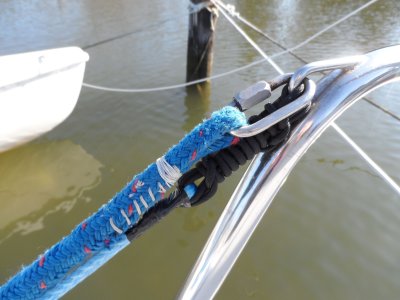
Boat covers bungee or rope

6mm polyester will have a breaking strain of 500kg+, so I reckon it'll be plenty strong enough with an attachment every few feet.

If you get the sort of wind that comes close to breaking it, you'll want it to break anyway, or you'll be picking up your boat from the next field...

AND you can always sleeve the rope ... simple old garden hose is a good way to sleeve rope ...
 
The benefit of the water containers ... they will actually give a bit when wind gets strong .. meaning that tarp is les stressed than it would be with fixed hard lashings .. when wind lets off - they drop back again ..
 
The benefit of the water containers ... they will actually give a bit when wind gets strong .. meaning that tarp is les stressed than it would be with fixed hard lashings .. when wind lets off - they drop back again ..
Exactly that and it worked very well but in strong winds they can hit the hull. Give it enough times and they wear through or puncture so sand or gravel would be better.

I cant recall any cheap bits of string snapping. Lengths Of shock cord should work equally as well.
I used blue mdpe 25mm water pipe (as it can be cheap) to make hoops over the boat for the tarp to sit on reducing rub points. I had my mast as the ridge
 
I think I would prefer water ... if the container does rupture - then any sand or gravel that comes out will possibly create abrasive action ... if its water ... it will just spill and that's it.
I appreciate that the weight will then be less etc .. but at least hull will not be abraded ...

But all you would have to do is have long enough lanyards to the containers so they are not in conflict with the hull ...
 
Boat yard today .... watcfhed guys rigging covers ....

Long normal rope ~6mm round boat .... bungee from cover at frequent intervals fastened to the rope ... the rop itself had about 4 light lines each side pulling it down to stop it riding up and to hold in place ... bungees then able to react to wind etc.

The other covers they do are shrink-wrap !! My pals 12m mobo has that in the yard ...
 
I'm on the west coast of Scotland, we get some wind sometimes ;-)

I gave up on "off the shelf" tarps from the "DIY shops" - they shredded quickly, even if strapped / tied down, the eyes were not strong enough to tie down well anyway and were not actually waterproof - the matrix of the fabric leaked with standing water of a few inches.

I now use a "heavy weight" tarp, ~600g/m2 IIRC (~£20? for a 8ft x 10ft olive green one) which is very similar to the curtain sides on trucks. - fully waterproof 3 seasons and counting.

As for tie down - I use bungee, but bought a roll of it and tie it off rather than use hooks. I also screw a pair of roof battens down the port / stb sides of the tarp to give some structure and to distribute loads. the bungee is routed along the edges, zig zag to the toe rail *AND* also over the top of the coach roof etc, not unlike a net. Whole setup was? £75 and is reused each year.

600g/m2 tarps
Good tip. Just picked up a couple in the vain hope the spring cleanup might be less onerous.
 
I have used these and they can be great, but there are limits to their grip.

If they are suspect - can always drill through and put a nut + bolt ?

I have my 25ft'r now at house and considering 'tenting her' ..... plastic water pipe bent and secured creating a domed tent structure for tarp to be placed over .. such clips would be the answer for this ..
 
My boats in the garden, and it's blowing 40mph at the moment with heavy hail and rain.
I use damp proof membrane sheeting for the winter cover. Held on by bungees, down to the trailer with plastic tarpaulin clips and a couple of ropes over the top.

Doesn't shred like the cheap blue tarpaulins , it does hole on creases but not enough to worry about.
Damp proof membrane is cheap and does a couple of seasons .
 
My boats in the garden, and it's blowing 40mph at the moment with heavy hail and rain.
I use damp proof membrane sheeting for the winter cover. Held on by bungees, down to the trailer with plastic tarpaulin clips and a couple of ropes over the top.

Doesn't shred like the cheap blue tarpaulins , it does hole on creases but not enough to worry about.
Damp proof membrane is cheap and does a couple of seasons .

Its funny that ... I had a half roll of the Tylex Roofing sheet left over after guys did my roof ... wife loves it for covering the BBQ table out there ... its orange / labels on one side - but plain white on other ... most hardy table cloth ever !!
 
Using bungee to hold my cockpit cover on, I tie a slack rope over the top of the cover to stop it lifting too much in wind gusts.
A thought just struck me.
As I now have the bungee in a protective sheath, instead of the slack rope, I could run a slack Dyneema fishing line through the sheath alongside the bungee.
Any thoughts?
 
Long ago I had a relatively voluminous heavy canvas over-boom cockpit tent (with window and door flap) on a little 16' 3" centre-boarder. Now, it was only used when I was aboard, so didn't see the wildest weather, but in use it was very secure, kept its intended shape (including large unsupported areas) well and didn't flap about even in very breezy weather. It was obviously of some antiquity so had lasted very well. It seemed to me that contributors to its success (and bearing in mind the relatively small size) were -

- very heavy, very stiff material (not so good for storage and rigging/de-rigging!), well designed and made to fit the shapes/curves of the boat well;
- numerous closely-spaced eyelets (about 9" apart?) around most of the perimeter of the tent;
- secured for most of the tent's perimeter by bungee cord (c6mm?) run parallel to the tent edge, between eyelets, rather than perpendicular to it, and secured mainly to small pressed s/s hook plates (curved over 'hook' one side between two securing screws/rivets) positioned immediately under the rubber rubbing strake between each pair of eyelets on the canvas. This allowed only just sufficient movement for fitting and if something/someone fell against it, but kept it very well tensioned and did not allow it the edges to lift and flap about.
- at the front of the tent there were several lengths of non-bungee cord going from eyelets and tied off tightly to handrails or other fittings on the cabin roof and sides (after the cockpit perimeter had beed bungee secured). Bungee cords in these locations would have allowed excessive movement and lifting of the canvas, due to the length of the cords, the length of canvas (compared to that across the boat) and the shapes and necessarily wider eyelet spacing of the front of the cover, but this did require these few lines to be tied off tightly to suit each time.
 
Top