Bilge water sensors (again)

We have three seperate independant bilge pumps with float switches. Together they will move 19,000 litres an hour. Enough to manage a 2" hole at 1m below the surface. Workes for me

 
We have three seperate independant bilge pumps with float switches. Together they will move 19,000 litres an hour. Enough to manage a 2" hole at 1m below the surface. Workes for me

Sounds like a plan to me. The total reliability that OP seeks can only be achieved by duplication and careful selection of switches and duplication of pumps and batteries. But to achieve the reliability of turning off will be a bit more tricky. Perhaps switches in series so 2 must operate to get pump to work so increasing chances of the pump switching off.
The float switch seems to be the popular choice but as said there are other technologies of ultrasonics (as in your depth sounder) or vibrating reed or not mentioned electrical conduction of salt water across contacts. In the end nothing electrical is completely reliable in a hostile environment. olewill
 
We have three seperate independant bilge pumps with float switches. Together they will move 19,000 litres an hour. Enough to manage a 2" hole at 1m below the surface. Workes for me

For how long before your batteries die ...... ? Six hours, twelve hours - very unlikely to be more than a day.

And have you calculated that at manufacturer-spec ie zero head or the actual pump outlet head(s)?

I'm not saying that effective and powerful bilge pumps are wrong, just that the chance of any auto bilge pump setup "saving" an unattended boat are slim, and rely on you ariving on board in time to stop the inflow before your batteries are flat.
 
I may have answer for battery drain and bilge pumps, for me if my bilge pump is activated i also get a text message, secondly I have another sensor in the bilge to detect water and again will text me if water is detected. In this scenario i can at least call the marina staff to take action. My system is a modified alertpal system.
 
For what it's worth I use a Whale electronic switch with a built in time delay. This way I am able to locate the switch halfway up the bilge sump and the pump still empties the bilge. This avoids constant cycling of the pump with a small quantity of un-pumpable water in the bilge and keeps the switch out of the water for most of the time. The down side is that the first Whale switch I had which was located further down and was constantly wet, failed inside a year. The time delay works well if you have a small deep sump.

Yoda
 
My boat has three semi-watertight compartments; the engine room, the main cabin, and the forward cabin. Each will be equipped with its own Gulper 320 pump with independent sensors. House battery bank is nearly 1kAh, and she's got shore power connected most of the time. I plan to fit two 300W solar panels as well, which should keep the battery bank topped up when shore power isn't available. I also have a security system on board which will SMS and email me when water is detected, and the pump status and history can be monitored remotely. Should I see indications that a significant leak is occurring I can probably make my way to where she's moored in less time than the battery bank can keep the pumps running - or at least get a friend or marina staff to take a look. I fail to see why some people here are so against this concept - this is my home we're talking about, and all my belongings are on board, why shouldn't I take every reasonable precaution against flooding?
 
My boat has three semi-watertight compartments; the engine room, the main cabin, and the forward cabin. Each will be equipped with its own Gulper 320 pump with independent sensors. House battery bank is nearly 1kAh, and she's got shore power connected most of the time. I plan to fit two 300W solar panels as well, which should keep the battery bank topped up when shore power isn't available. I also have a security system on board which will SMS and email me when water is detected, and the pump status and history can be monitored remotely. Should I see indications that a significant leak is occurring I can probably make my way to where she's moored in less time than the battery bank can keep the pumps running - or at least get a friend or marina staff to take a look. I fail to see why some people here are so against this concept - this is my home we're talking about, and all my belongings are on board, why shouldn't I take every reasonable precaution against flooding?

Given your circumstances I agree you need to take far more precautions than most but am surprised you chose such a low capacity pump. If your main worry is water ingress when you are not on board, what is the worst case fault? Obviously not hull damage due to impact. Skin fitting or propshaft seal?

Www.solocoastalsailing.co.uk
 
For how long before your batteries die ...... ? Six hours, twelve hours - very unlikely to be more than a day.

And have you calculated that at manufacturer-spec ie zero head or the actual pump outlet head(s)?

I'm not saying that effective and powerful bilge pumps are wrong, just that the chance of any auto bilge pump setup "saving" an unattended boat are slim, and rely on you ariving on board in time to stop the inflow before your batteries are flat.
The bilge pump outputs are corrected for zero head. The zero head rated output of pumps is 29,000 litres per hour. We have 900 amp hours of domestic battery capacity and lots of solar and wind. Since we live onboard the boat isnt left unattended during the night. During the day we put in lots of amps from wind and solar being in the Caribbean. We dont have a great fear of sinking from a failed skin fitting. If we were leaving our boat on a mooring all seacocks would be switched off so reducing the risk of a failire to some extent
 
Given your circumstances I agree you need to take far more precautions than most but am surprised you chose such a low capacity pump.

They're one of the highest capacity diaphragm type pumps, which has a couple of important benefits: they can run dry for extended periods of time, they self prime up to several metres which allows me to mount the pump in a convenient location, and they don't clog. Another benefit is that this is the same type of pump I'm fitting for the shower, so I only need to keep one set of spare parts.

If your main worry is water ingress when you are not on board, what is the worst case fault? Obviously not hull damage due to impact. Skin fitting or propshaft seal?

Why not impact damage? Plenty of idiots around on the inland waterways, and it's a riveted steel hull from the 1920s, only partially overplated. I can imagine many other scenarios which may cause flooding, even some more unusual ones like a freshwater tank leak (I have 650L on board), or burglars leaving a hatch open, or hidden rust damage that may cause a sudden catastrophic failure somewhere below the waterline. Interestingly, the previous owner did not have any bilge pump of any kind fitted, but then the bilges were also severely rusted - something which has costed thousands of pounds to rectify. With all the work that's been carried out to get her back into (ship) shape, I'm not taking any chances.
 
They're one of the highest capacity diaphragm type pumps, which has a couple of important benefits: they can run dry for extended periods of time, they self prime up to several metres which allows me to mount the pump in a convenient location, and they don't clog. Another benefit is that this is the same type of pump I'm fitting for the shower, so I only need to keep one set of spare parts.


Why not impact damage? Plenty of idiots around on the inland waterways, and it's a riveted steel hull from the 1920s, only partially overplated. I can imagine many other scenarios which may cause flooding, even some more unusual ones like a freshwater tank leak (I have 650L on board), or burglars leaving a hatch open, or hidden rust damage that may cause a sudden catastrophic failure somewhere below the waterline. Interestingly, the previous owner did not have any bilge pump of any kind fitted, but then the bilges were also severely rusted - something which has costed thousands of pounds to rectify. With all the work that's been carried out to get her back into (ship) shape, I'm not taking any chances.

Thanks for explanation. Yout strategy sounds pretty watertight to me :)

Www.solocoastalsailing.co.uk
 
Last edited:
If both switches are 99% reliable do you get 99.99% reliability. Not sure, but certainly much much better.
1:100 failure, becomes 1:10,000. You could in theory add a third switch to get 1:1,000,000.

But to achieve the reliability of turning off will be a bit more tricky. Perhaps switches in series so 2 must operate to get pump to work so increasing chances of the pump switching off.
But as the 'off' switch is the 'on' switch that breaks the on reliability, although not as badly as you expect -- it becomes 2:100 (i.e.1:50) but that's a big jump from 1:1,000.

Probably worth thinking about how the failure modes work. So a float switch fails because debris blocks it. How can you stop debris blocking it? Metal Mesh Guard?

For the failure to switch off, I'd be tempted to work out if I had a float switch activated when there are 5cm of water in an area 4m x 0.75m = 150,000cm3 so 150 litres. If my pump should be pumping 900litres/hr I'd want to have an alarm sound if the pump has been running more than 10 minutes. That would be the time needed to pump out the pumpable area from the level the pump switched on to empty... so either the pump isn't pumping right, or the switch is jammed or there is more water coming in. Any of those three you probably want to know about it! If getting someone to investigate that isn't an option, you'd either then want to have the ability to remotely switch the pump off and have sensor states remotely... or even more complex you need to process the data in something like an arduino and have it decide if it should over ride the sensor. Personally I doubt an Aruino can do that reliably. Your knowledge will be useful. Its 5pm after a day of gales and heavy rain. The pump is running lots. You could be there in an hour. You probably leave it running and head up to see whats going on. On another day, Its a flat calm day. Nothing would make you think the boat is likely to have sprung a leak. You've had a couple of occasions recently with a sticky switch. You can't be there for 24 hours - and you know your battery will die. You may as well switch off for a bit and maybe have a higher sensor that would alarm if things deteriorated. ... How do you get a computer chip to take into account the weather, the when can someone be there etc.
 
For the failure to switch off, I'd be tempted to work out if I had a float switch activated when there are 5cm of water in an area 4m x 0.75m = 150,000cm3 so 150 litres. If my pump should be pumping 900litres/hr I'd want to have an alarm sound if the pump has been running more than 10 minutes. That would be the time needed to pump out the pumpable area from the level the pump switched on to empty... so either the pump isn't pumping right, or the switch is jammed or there is more water coming in. Any of those three you probably want to know about it! If getting someone to investigate that isn't an option, you'd either then want to have the ability to remotely switch the pump off and have sensor states remotely... or even more complex you need to process the data in something like an arduino and have it decide if it should over ride the sensor. Personally I doubt an Aruino can do that reliably. Your knowledge will be useful. Its 5pm after a day of gales and heavy rain. The pump is running lots. You could be there in an hour. You probably leave it running and head up to see whats going on. On another day, Its a flat calm day. Nothing would make you think the boat is likely to have sprung a leak. You've had a couple of occasions recently with a sticky switch. You can't be there for 24 hours - and you know your battery will die. You may as well switch off for a bit and maybe have a higher sensor that would alarm if things deteriorated. ... How do you get a computer chip to take into account the weather, the when can someone be there etc.

I don't believe in automation; the on-board computers are there mainly to monitor and report rather than make decisions, measure and log rather than control. I will also have a camera in the cabin, which can be viewed remotely, and which will start recording when certain sensors are triggered.

WRT to the "false on" triggering of bilge pumps, adding a second switch will double the likelihood of this happening.
 
If you are able to find a 100% reliable switch, you then need to find a 100% reliable pump to go with it. In practise, there is no completely reliable electrical equipment in the proximity of salt water.

For some years I have been using fill switches from automatic washing machines. If you don't have a redundant washing machine about, there are plenty at recycling centres. These are operated by rising water pressurising a chamber at the bottom of the bilge. You can use a chamber from the washing machine or make your own. I have a short offcut of larger pipe with a bung in the top. A small diameter flexible tube connects to the switch which is mounted well above water level in a convenient dry place. These are usually double change over switches and you can adjust both the cut in level and the differential. The second switch can turn on an alarm if the water rises to a higher level, either because the pump has not triggered or the water is coming in faster than being pumped out. Fitting a diode will allow the second switch to also activate the pump in the unlikely event that the first switch fails.

Many bilge pumps fail due to clogging with debris. Regular thorough cleaning of the bilges is the best way to avoid this. A useful tip is to mount an electric pump a little above the bottom of the bilge. The suction of the manual pump should lead to the bottom. The manual pump can then be used to pump the bilge dry, so the electric pump will normally be all above water, and less likely to fail if and when it is needed.
 
Last edited:
If you are able to find a 100% reliable switch, you then need to find a 100% reliable pump to go with it. In practise, there is no completely reliable electrical equipment in the proximity of salt water.

The switch I have selected is certified for "use as redundant alarm in classified applications" in media such as fuel, acetone and hydrochloric acid. It is IP68 rated and has a 25 mA maximum current consumption. At a list price of £230 it also costs a lot more than any bilge sensor I've seen - but I'm pretty good at not paying list prices ;) None of this means it will never fail of course, but it should be at least as reliable as any dedicated bilge switch is likely to be.

For some years I have been using fill switches from automatic washing machines. If you don't have a redundant washing machine about, there are plenty at recycling centres. These are operated by rising water pressurising a chamber at the bottom of the bilge.

Clever idea! I've found one or two bilge switches which operate on this principle, so it isn't entirely new, but I like the recycling :)

Many bilge pumps fail due to clogging with debris.

The Whale Gulper 320 is a diaphragm pump, selected specifically because it does not clog.
 
The switch I have selected is certified for "use as redundant alarm in classified applications" in media such as fuel, acetone and hydrochloric acid. It is IP68 rated and has a 25 mA maximum current consumption. At a list price of £230 it also costs a lot more than any bilge sensor I've seen - but I'm pretty good at not paying list prices ;) None of this means it will never fail of course, but it should be at least as reliable as any dedicated bilge switch is likely to be.


Clever idea! I've found one or two bilge switches which operate on this principle, so it isn't entirely new, but I like the recycling :)


The Whale Gulper 320 is a diaphragm pump, selected specifically because it does not clog.

Make that "does not easily clog" :)
 
Make that "does not easily clog" :)

Make that "is less likely to clog than any other bilge pump type available to mere mortals".

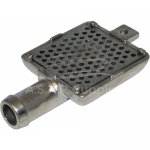
Edit: This is the strum box I will be using, from ASAP supplies:

strumbox.jpg

Looks like it will be good at sucking up even very small amounts of water, while being relatively clog-proof.
 
Last edited:
Make that "is less likely to clog than any other bilge pump type available to mere mortals".

Probably. They do clog though. They can also suffer fouled valves which stop them working, as will clogged pipes. You will still be well advised to fit strainers.
 
Probably. They do clog though. They can also suffer fouled valves which stop them working, as will clogged pipes.

Of course. And the diaphragms eventually wear out. The point is though, that I do not think there is any other pump available at reasonable cost/size that is more reliable. If you think I have made the wrong choice I would welcome alternative suggestions.

You will still be well advised to fit strainers.

Yep - see updated post above.

Edit: I might add that the 19mm (3/4") hose I've selected was chosen because that's the free diameter passing through the pump - the Gulper 320 will also accept a 25mm (1") hose, but objects that can fit through this cannot necessarily pass through the pump, which may cause a blockage at the pump inlet barb.
 
Last edited:
The switch I have selected is certified for "use as redundant alarm in classified applications" in media such as fuel, acetone and hydrochloric acid. It is IP68 rated and has a 25 mA maximum current consumption. At a list price of £230 it also costs a lot more than any bilge sensor I've seen - but I'm pretty good at not paying list prices ;) None of this means it will never fail of course, but it should be at least as reliable as any dedicated bilge switch is likely to be.

What sort of waterproof relay are you going to use with it?
 

Other threads that may be of interest

Top