Bilge / Twin keel

CAPTAIN FANTASTIC

Well-Known Member
Joined
15 Jul 2009
Messages
3,311
Location
Bristol Channel
Visit site
How many people here have bilge/twin keelers? How many would have liked to have a bilge keeler? And how many would have wished to change their bilge keeler for a fin or long keel instead?

 
How many people here have bilge/twin keelers? How many would have liked to have a bilge keeler? And how many would have wished to change their bilge keeler for a fin or long keel instead?

47 years ago i had a bilge keeler for one season since then Fin & spade
 
What type of keel do you have now? if the boat has no bilges, is the sailing performance better or worse?

I too wonder what sort of performance remains in a bilge keeler with no keels! I have sailed BK most of my life because the kind of sailing I do generally involves shallow drying harbours in which a fin keeler would be hazardous. Yes there were occasions when I wondered whether a fin keeler would perform slightly better, and undoubtedly few bilge keelers can point as close as a good fin keeler.

Buut so miuch depends on the kind of sailing you do. Many fo the longer p[assages I have done have undoibtedly been improved by having a decent fin keel below me. But that same fin keeler would have prevented me from accessing many smaller harboirs and creeks which I so enkoy exploring, while the passages bteween them have rarely been seriously imp[aired by all but one or two of the least weatherly examples. Some of the best passages I have made have been in bilge keelers. Would they have been greatly impirved ina fin keeler? I doubt it.
 
I have just sold my bilge keeler, beached once and kept on a wet mooring.

I mistakenly thought I would time in retirement for two boats. Twin keeler (the shorter of the two) will probably go, but a cheap half tide mooring in a sheltered harbour doesn't really make me feel any urgency to sell. I have gone into a harbour with a drying entrance an hour or more after a friend passed it by for lack of water. Draft is 1.2m and one reason for purchase was that it would - if I wanted - do the French canals. Easy to clean the hull mid season by drying out (useful the time the chandler sold me fertilizer rather than antifoul). It's got a very big main and is pretty sporty. If there had been a larger version of it available, I would certainly have considered that rather than the fin keeler I did buy. RMs look fabulous to my eye.
 
Last edited:
What type of keel do you have now? if the boat has no bilges, is the sailing performance better or worse?

She has a central keel. She is wooden by the way. Without bilge keels she:

points higher - arguably more than 5 degrees, perhaps 10 degrees.
has less drag - the second bow wave hard on the wind has gone, I have found I overrun my mooring! until I have retrained myself! (the disadvantage is that once stationary in a cross wind she will blow off her bow much quicker than she had the bilge keels
still tacks nicely
still has good trim
has a reduction in some ballast weight but I suspect at the moment that the reduction has been insignificant.

I had a bad season last year so I did not sail in v. bad weather. But in reasonable conditions did not suggest any threat of poor handling.
 
I mistakenly thought I would time in retirement for two boats. Twin keeler (the shorter of the two) will probably go, but a cheap half tide mooring in a sheltered harbour doesn't really make me feel any urgency to sell. I have gone into a harbour with a drying entrance an hour or more after a friend passed it by for lack of water. Draft is 1.2m and one reason for purchase was that it would - if I wanted - do the French canals. Easy to clean the hull mid season by drying out (useul the time the chandler sold me fertilizer rather than antifoul). It's got a very big main and is pretty sporty. If there had been a larger version of it available, I would certainly have considered that rather than the fin keeler I did buy. RMs look fabulous to my eye.
My old Mirage 28 was a cracking boat, easy to handle single handed. I just never used the ability to beach it.

My plans are for adventures further afield and I've made the move to a fin keeled Gib'Sea 96, just need to sort out using the spinnaker single handed now and I'll be set.
 
34 years ago, I procrastinated whether to go for twin, or single keel. I went for twin keels , and have had zero regrets about that decision. Back then, 80% of the boats I built had single keels .Now the reverse is true, and those who went for twin keels are glad they did, while most of those who went for a single keel wish they had twin keels. Twin keels have let me cruise mostly full time for 34 years, without ever having paid to tie her to a dock. I have done only two haul outs in 34 years ,and only did those because I was in Tonga, with not enough tidal range to do things on the beach, and a 4,000 mile windward bash ahead of me. Twin keels means having a cleaner bottom more of the time, as cleaning is so easy at low tide.
Two of my 36 footers, one with twin keels and one with a single keel , had a race.They were matched on all points of sail, except to windward, where the single keeler had about a 5% advantage. Other advantages greatly out weigh that difference.
 
Last edited:
I removed the bilge plates on my Eventide over 20 years ago and deepened the central long keel by about 9" also adding additional ballast. Reason for doing it was that despite being in shallow Poole harbour I rarely dried out (most of it is soggy mud!) and have a deep water all tide mooring (then a marina berth). Transformed the boat.

All types of keel have their place - that is why they exist - and your choice depends on your priorities. The usefulness of twin keels, shallower draft and ability to dry out tends to decline as boats get larger. There are some really good boats of that type in the 28-33' range where the performance loss is marginal compared with their fin keel sisters and make very capable offshore cruisers.
 
Twin keels can be very efficient. Triple keels, of any kind, are almost invariably a disaster, performance wise.Too much interaction between them.
 
It is quite clear that you only have a twin keel/bilge keel sail boat if you need it for drying out or shallow water operation.
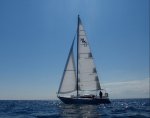
Now where I live about 50 years ago I met a guy who built a bilge keel boat since then of thousands of boats I have looked at I have not seen another one. But then that is because we do not have large tides so no shallow/drying water moorings used. My little boat has a lift deep fin keel. It sails extremely well and if as often happens I run aground it is easy to heel the boat to enable me to sail away. You can't do that with a twin keel. No I never raise the keel until it is time to put it on the trailer. olewill
 
It is quite clear that you only have a twin keel/bilge keel sail boat if you need it for drying out or shallow water operation.

Yes, but there are many harbours in Atlantic Europe where you wouldn't go if you didn't have a means of taking the ground. I found it limiting when going down coasts of France and N. Spain with a deep keel. Here's a pic to show (size of mast ...) that twin keels doesn't necessarily mean bathtub.

IMG_0002.JPG
 
Last edited:
We started our sailing lives with a little 20ft bilge keeler on a drying mooring, it was a cheap and forgiving format while we learned the ropes and made our initial mistakes.
Went on to trimaran then catamaran whilst we had kids. Ideal for parking up on a beach and getting into sheltered, non-crowded, creeks. Also fast enough to keep passage times down a bit and the kids interested because we could 'race' and (usually) pass other boats quite frequently.
When we discarded the kids we got a 'cosier' shallow fin/centreboard mono which still sails well but I do miss the ability to dry out and use some of those creeks and harbours.
 
I removed the bilge plates on my Eventide over 20 years ago and deepened the central long keel by about 9" also adding additional ballast. Reason for doing it was that despite being in shallow Poole harbour I rarely dried out (most of it is soggy mud!) and have a deep water all tide mooring (then a marina berth). Transformed the boat.

All types of keel have their place - that is why they exist - and your choice depends on your priorities. The usefulness of twin keels, shallower draft and ability to dry out tends to decline as boats get larger. There are some really good boats of that type in the 28-33' range where the performance loss is marginal compared with their fin keel sisters and make very capable offshore cruisers.

Agree, all keel configurations have their place; in the Med, twin keelers have no use. However, having a twin keeler in the UK East and South coast allows you to explore many places upriver; most harbours in the Bristol channel and north Devon, dry up, having a twin keeler is very useful. It can be frustrating when going upwind, but a few degrees off the wind, it helps a lot.
 
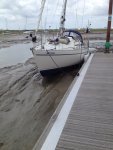
Ashlett Creek, depth of water about 3ft so a little ploughing required to reach the pontoon.

Pete

View attachment 70015

Used to visit the Esso sailing club every year with the multihulls but haven't taken our current boat in there. Theoretically I should be able to get up to the quay and lie alongside. We draw 3ft with the plate and rudder up.
More likely to visit Owers lake next door these days, That said, the wind turbine people are supposed to have moved into the power station so I'm not sure if they will tolerate anyone anchoring in their fairway.
 
Top