Bilge pump arrangements

"geem' is close to what I consider the factors ......

But I am not looking for a situation to 'match or near equal' water in ... my idea is to stop the water as fast as possible .... a bin liner under a planing hull can slow water to a trickle - its how we used to salvage boats in fact ... water pressure pushes the liner into the hole ... as long as lines are holding the corners - you now have a lot more time to work.
Dinner plate and a load of cabin gear pressing it onto the hole reduces water in ...

The trick is to INCREASE the time you have for pumping out by reducing the water in. That also makes your low volume pumps do the job ....

When it really goes against you and you have time - run the b***** boat aground or up against a wall ....
That all OK if you are sailing near land. We sail the ocean. We need another plan. Impact may happen at night. Everything gets harder. It may be rough. It gets harder still. More pumping capacity buys more time. Some modern boats have liners that make access to parts of thr hull difficult. Fortunately we don't have this problem. Individuals will assess the risk differently for their circumstances. I believe we have an adequate system for our risk
 
Last edited:
I didn't have to do much to upgrade my pumping system. We just added the Rule 3700gph pump. All others were fitted. This pu,p has a 1.5" outlet and moves some serious water.
We sail as a couple. My thoughts were that if we started to take on water I would want to know straight away and not wait for a high level alarm to activate. Having the main bilge pump activate a sounder every time it operates works for me. We only get worried if it doesn't stop. I would want to be looking for a leak ASAP and not have the floorboards floating. We don't have a fixed manual pump. With just two of us onboard I don't want half the crew pumping whilst we try and deal with an influx of water. We would need both of us on the case. We do have a stirrup pump that we can use for pumping out jobs but it's not designed to empty the boat of water.
If we get a skin fitting failure of say 1.5" diameter a foot below the water then we should easily be able to cope with electric pumps whilst we plug the hole. Interestingly that failure is quite possible in a smaller boat than ours. The difference is that we take longer to sink due to our higher hull volume than the same size hole in a smaller volume hull.
I’ve just dismantled our manual bilge pump to find it completely u/s, valves perished and fallen apart, diaphragm installed incorrectly so it could never pump. I agree manual pumps are not much use but I will replace it otherwise I’ve to deal with the hole in the bulkhead where it is fitted. So, that leaves me with the hopeless little 500gph 2,5A jobbie :( upgrade inbound….
 
My Whale manual that empties the shaft tunnel pumps - but definitely looks like its well overdue a service. It takes ages to move a small amount ... so this winter - looks like remove, dismantle and rejuvenate !!
 
I agree manual pumps are not much use
I am not so sure about that.
When I had my first Stella I had a Henderson pump which had the front that could be removed in a trice to remove blockages from the flap valves. It had a decent length handle & one could shift a lot of water. It was positioned so I could pump with one hand whilst helming with the other. Very important on a boat that did not have a self draining cockpit & was VERY wet upwind in a blow. In F7 it would take volumesi nto the cockpit which went straight down into the bilge then up the side of the hull depending on what tack one was on. Pumping every 15-20 mins was mandatory. if one wanted a dry bunk that night.
On my current boat, neither my electric nor, my manual bilge pumps have seen enough water to actually pump anything in 18 years.
 
That all OK if you are sailing near land. We sail the ocean. We need another plan. Impact may happen at night. Everything gets harder. It may be rough. It gets harder still. More pumping capacity buys more time. Some modern boats have liners that make access to parts of thr hull difficult. Fortunately we don't have this problem. Individuals will assess the risk differently for their circumstances. I believe we have an adequate system for our risk


Fully understand ... and would suggest that majority who are here are not deep water boaters - much as they like to try and give the impression of. They would have 'luxury' of escaping to shallower water in real need.
 
I am not so sure about that.
When I had my first Stella I had a Henderson pump which had the front that could be removed in a trice to remove blockages from the flap valves. It had a decent length handle & one could shift a lot of water. It was positioned so I could pump with one hand whilst helming with the other. Very important on a boat that did not have a self draining cockpit & was VERY wet upwind in a blow. In F7 it would take volumesi nto the cockpit which went straight down into the bilge then up the side of the hull depending on what tack one was on. Pumping every 15-20 mins was mandatory. if one wanted a dry bunk that night.
On my current boat, neither my electric nor, my manual bilge pumps have seen enough water to actually pump anything in 18 years.
Our standby Henderson pump pretty much saved us a couple of days out of Gibraltar heading for Madeira.

We had a continuous leak that we couldn’t identify and would rise above floorboards within 30 minutes or so. The electric pump filter kept clogging up - first slowing down the flow until stopping so all very inefficient, followed by 5 minutes with pump stopped as we took off, cleaned, and replaced the filter, then same again. The bilge which had been mostly dry had also had odd bits of gunk from wood shaving, to pencil rubbers to hair in dry hidden places. Of course they all made their way to the sump once the flooding started. And kept doing so for 10-20 filter cleans with no sign of the debris stopping.

The Henderson hand pump which we had ignored excrept to replace its handle and test once a season when hosing bilges now pumped the boat dry of an hours worth of leak in about 5-10 minutes. And crucially could be done by the person on watch in the cockpit.
 
A neat trick I read many years ago was to put an analogue 12v clock in parallel with the pump. If it says anything other then 12:00, the pumps have run, and you know how much. Obviously that requires a separate float switch. Can you still find that kind of clock
I bought one of these and fitted it. It was easy peasy, and works well.
 
Our standby Henderson pump pretty much saved us a couple of days out of Gibraltar heading for Madeira.

We had a continuous leak that we couldn’t identify and would rise above floorboards within 30 minutes or so. The electric pump filter kept clogging up - first slowing down the flow until stopping so all very inefficient, followed by 5 minutes with pump stopped as we took off, cleaned, and replaced the filter, then same again. The bilge which had been mostly dry had also had odd bits of gunk from wood shaving, to pencil rubbers to hair in dry hidden places. Of course they all made their way to the sump once the flooding started. And kept doing so for 10-20 filter cleans with no sign of the debris stopping.

The Henderson hand pump which we had ignored excrept to replace its handle and test once a season when hosing bilges now pumped the boat dry of an hours worth of leak in about 5-10 minutes. And crucially could be done by the person on watch in the cockpit.
We have two of those on our Blakes Lavac toilets. What kind of bilge pumps were blocking up? Our Rule pumps take an amazing amount.of junk without stopping. We recently cleaned out the main sump. It was full of junk but the pump worked ok.
Having recent painted the bilges there is little in the way of junk in there now
 
Our standby Henderson pump pretty much saved us a couple of days out of Gibraltar heading for Madeira.

We had a continuous leak that we couldn’t identify and would rise above floorboards within 30 minutes or so. The electric pump filter kept clogging up - first slowing down the flow until stopping so all very inefficient, followed by 5 minutes with pump stopped as we took off, cleaned, and replaced the filter, then same again. The bilge which had been mostly dry had also had odd bits of gunk from wood shaving, to pencil rubbers to hair in dry hidden places. Of course they all made their way to the sump once the flooding started. And kept doing so for 10-20 filter cleans with no sign of the debris stopping.

The Henderson hand pump which we had ignored excrept to replace its handle and test once a season when hosing bilges now pumped the boat dry of an hours worth of leak in about 5-10 minutes. And crucially could be done by the person on watch in the cockpit.

My old Mk3 Henderson shifts water like crazy! Puts the automatic rule 500 to shame. But the rule keeps the bilge dry for 6 months of the year while I’m not there to pump.
 
I am not so sure about that.
When I had my first Stella I had a Henderson pump which had the front that could be removed in a trice to remove blockages from the flap valves. It had a decent length handle & one could shift a lot of water. It was positioned so I could pump with one hand whilst helming with the other. Very important on a boat that did not have a self draining cockpit & was VERY wet upwind in a blow. In F7 it would take volumesi nto the cockpit which went straight down into the bilge then up the side of the hull depending on what tack one was on. Pumping every 15-20 mins was mandatory. if one wanted a dry bunk that night.
On my current boat, neither my electric nor, my manual bilge pumps have seen enough water to actually pump anything in 18 years.
I have similar now .... but cockpit is self draining while stationary .... as soon as stern squats - the drains are near W/L ... so I have to shut them off. Forget all that X'over of pipes as they are too close to W/L anyway.

Having a ply cockpit sole screwed down - even with foam edging eventually water seeps down there.
 
If we get a skin fitting failure of say 1.5" diameter a foot below the water then we should easily be able to cope with electric pumps whilst we plug the hole. Interestingly that failure is quite possible in a smaller boat than ours. The difference is that we take longer to sink due to our higher hull volume than the same size hole in a smaller volume hull.

I and agree.... An extra 1000 litres of water sloshing around the bilge is going to affect a 40 ft boat in a less serious way than it would affect a 24ft boat.

This implies the smaller boat should have at least the same size pumps and not just think that because they're smaller they can get away with smaller pumps... although the one advantage of a smaller boat is that you're likely to find the hole quicker.
 
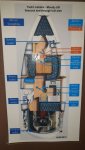
One thing not mentioned in this thread is the usefulness of your laminated chart showing all through hull locations...

Our chart even splits the below water line (down one side) vs the above water line (listed on the other side)...

20220923_180924.jpg

Locations are also marked (with stickers) on floorboards or backs of seats etc so crew know how to quickly find them as well...
 
A member of our Owners Forum has suggested these Whale low profile pumps - they look like a practial solution, maybe more than one deployed could be a good strategy as you say. Have a look: Whale Marine - Products
I would NOT recommend those Whale pumps. I have had two now. One lasted for a couple of years, and the second, about a year. I got a small amount of diesel in my bilge water, and this was the cause of the problem. The plastics they use are broken down very quickly if they come into contact with diesel
 
One thing not mentioned in this thread is the usefulness of your laminated chart showing all through hull locations...

Our chart even splits the below water line (down one side) vs the above water line (listed on the other side)...

View attachment 143998

Locations are also marked (with stickers) on floorboards or backs of seats etc so crew know how to quickly find them as well...
Makes sense for charter boats but I know every inch of my boat. We do
I would NOT recommend those Whale pumps. I have had two now. One lasted for a couple of years, and the second, about a year. I got a small amount of diesel in my bilge water, and this was the cause of the problem. The plastics they use are broken down very quickly if they come into contact with diesel
My Rule 2000gph bilge pump and the same installed as a shower pump came with the boat. We are liveaboards 9 months of the year normally and have had the boat 10 years so the Rule pumps has proven to be very reliable.
 
This has all been very enlightening. After I found my manual bilge pump to be u/s I then went on to find my Rule 500gph pump to be similarly u/s. Whilst the pump does work on manual mode it doesn’t work on auto mode. It’s a sealed unit so no repair, binned. Two new pumps ordered.

From this discussion I have seen the need for a high capacity pump to add to the armoury, more research to be done.
 
Ok so 12m steel motor vessel. I have three separate compartments each with a 24v electric bilge pump that supposedly can shift 6000LPH at 2m head. Each pump has its own alarm panel and back up float switch.

Surveyor comments - very nice, so what are you going to do if you don’t have any electrical power??

So we now have a manual Whale Titan mounted on a board and ready rigged with a length of lay flat hose for discharge, which we can take into any area of the boat and chuck the lay flat through an open window or porthole etc. All we have to do is connect the rigid suction hose and pump!

We can also shut the seacocks on the engines and drop the intake hoses into the bilge so that the engines will draw their cooling water from the engine space bilge. Obviously this would require a close eye to be kept on water levels, but when things are desperate……..!
 
We have two of those on our Blakes Lavac toilets. What kind of bilge pumps were blocking up? Our Rule pumps take an amazing amount.of junk without stopping. We recently cleaned out the main sump. It was full of junk but the pump worked ok.
Having recent painted the bilges there is little in the way of junk in there now
It’s a Jabsco but it was the filter - classic screw-on - that caused the problems.
 
I didn't have to do much to upgrade my pumping system. We just added the Rule 3700gph pump. All others were fitted. This pu,p has a 1.5" outlet and moves some serious water.
We sail as a couple. My thoughts were that if we started to take on water I would want to know straight away and not wait for a high level alarm to activate. Having the main bilge pump activate a sounder every time it operates works for me. We only get worried if it doesn't stop. I would want to be looking for a leak ASAP and not have the floorboards floating. We don't have a fixed manual pump. With just two of us onboard I don't want half the crew pumping whilst we try and deal with an influx of water. We would need both of us on the case. We do have a stirrup pump that we can use for pumping out jobs but it's not designed to empty the boat of water.
If we get a skin fitting failure of say 1.5" diameter a foot below the water then we should easily be able to cope with electric pumps whilst we plug the hole. Interestingly that failure is quite possible in a smaller boat than ours. The difference is that we take longer to sink due to our higher hull volume than the same size hole in a smaller volume hull.
Very wise.

Having been on a holed yacht once all I can say is whatever capacity people think they need double it and double it again (they don't all have to be fitted) . Combo of 500gph electric, manual BP and 10,000 bucket scoops saved us.

On my Hunter H 272 I have a 750gph fitted in the bilge but also have a 2000 gph and 750gph unit on aluminium boards with enough hose to get it over the side with the lower washboard in place. No float switch. They both have croc clips so I can go straight to the battery.

I've just bought a Hunter Channel 323. I shall fit an electric 1100gph. Carry the above and also probably buy one of those Seaflo 3700gph units when I start going further afield.
 
Would it be smart to retrofit a small sealable compartment inside the hull, around through-hull fittings?

If a fitting were to fail, the hole in the hull could be made perfectly watertight in a few moments. Assuming it's accessible.
 
Top